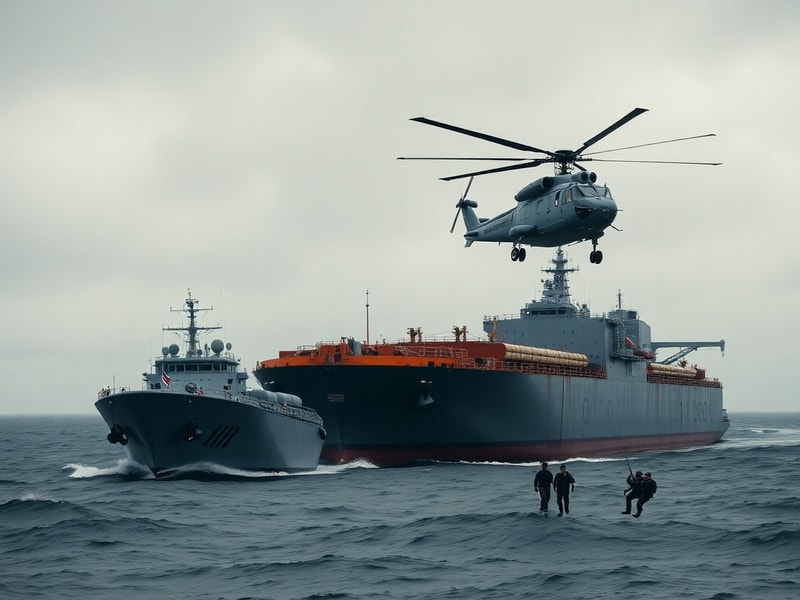
The United Kingdom has taken a decisive step in enforcing international sanctions by intercepting a Russian-flagged oil tanker in British waters. The vessel, identified as the NS Leader, was detained by Royal Navy personnel off the coast of Scotland on suspicion of violating economic restrictions imposed following Russia’s military actions in Ukraine. This operation marks one of the most high-profile enforcement actions taken by the UK since sanctions were expanded in 2022.
Maritime authorities confirmed the interception occurred in the North Sea, a region frequently monitored for illicit shipping activities. The NS Leader, a 180-meter-long tanker owned by a subsidiary of Russia’s state-owned shipping giant Sovcomflot, was reportedly en route to a European port when it was intercepted. Investigations are ongoing to determine whether the vessel was carrying oil that originated from Russia or was involved in sanctions circumvention schemes.
How the Interception Unfolded
According to a statement from the UK’s Maritime and Coastguard Agency (MCA), the interception followed intelligence sharing with allied nations concerned about Russian oil smuggling. The Royal Navy’s offshore patrol vessel HMS Tamar was dispatched to locate and board the tanker. Upon inspection, naval personnel found documentation discrepancies and irregularities in the cargo manifest.
A spokesperson for the MCA stated, “The vessel was boarded in accordance with international maritime law. Our officers worked alongside HM Revenue & Customs to assess the situation. The tanker has since been escorted to a secure port where further investigations are being conducted.” The operation involved coordination between military, customs, and legal teams to ensure compliance with both UK and international law.
This is not the first time UK authorities have targeted vessels linked to Russian oil. In 2023, the UK sanctioned several tankers for transporting Russian crude disguised as non-Russian oil. The current case, however, is the first public interception of a large-capacity tanker under the 2024 sanctions package, which specifically targets vessels involved in circumventing price caps on Russian oil.
The Legal and Geopolitical Context
The interception of the NS Leader underscores the growing complexity of enforcing sanctions in the maritime sector. The UK, alongside the European Union and G7 nations, has imposed a $60 per barrel price cap on Russian oil to limit Moscow’s revenues while maintaining global energy supplies. However, enforcement remains a challenge, with reports of widespread evasion through ship-to-ship transfers and falsified documentation.
International law experts note that the UK’s actions are legally defensible under maritime conventions. “The interception is consistent with UNCLOS provisions allowing for the inspection of vessels suspected of carrying contraband or violating sanctions,” said Dr. Emma Laurent, a professor of international maritime law at the University of Southampton. “The key issue will be proving the cargo’s origin and whether it was re-exported from a third country.”
Russia has condemned the interception as a politically motivated act. In a statement released by the Russian Embassy in London, officials called the action “a deliberate provocation aimed at destabilizing global energy markets.” The embassy also accused Western nations of hypocrisy, citing continued purchases of Russian liquefied natural gas (LNG) by some EU countries.
Sanctions Evasion Tactics in Focus
Investigators believe the NS Leader may have been involved in one of several common evasion tactics:
- Ship-to-ship transfers: Oil is transferred between vessels at sea to obscure its origin.
- Falsified documentation: Cargo manifests list the oil as originating from countries like India or China, even when it comes from Russia.
- Dark fleet operations: Older, poorly tracked vessels are used to transport sanctioned oil.
- Price cap circumvention: Oil is sold above the $60 cap by routing through non-G7 ports.
According to a report by the Centre for Research on Energy and Clean Air (CREA), over 150 vessels linked to Russian oil have been identified using these tactics since 2022. The UK government has allocated additional funding to its sanctions enforcement unit, doubling its investigative capacity to target such operations.
Global Reactions and Implications
The interception has drawn attention from energy markets and policymakers worldwide. Oil prices remained relatively stable following the announcement, though analysts warn of potential supply disruptions if enforcement actions escalate. The Brent crude futures contract saw a modest uptick of 0.4% on the day of the interception but settled back within its recent trading range.
In the United States, a State Department spokesperson reiterated support for “allied efforts to enforce sanctions against Russia’s war machine.” Meanwhile, critics in the EU have raised concerns about the economic impact on smaller shipping firms caught in the crossfire of sanctions enforcement.
Within the UK, the interception has sparked debate about the balance between national security and economic stability. Some industry leaders have warned that overly aggressive enforcement could disrupt energy supplies and drive up costs for consumers. “While sanctions are necessary, we must ensure they don’t create unintended consequences in global markets,” said Tony Foster, CEO of UK-based energy trader Foster Global Commodities.
What Happens Next?
The NS Leader remains under detention in a Scottish port as investigations continue. UK authorities have 30 days to either release the vessel or initiate legal proceedings under the Sanctions and Anti-Money Laundering Act 2018. If violations are confirmed, the tanker could face forfeiture, and its owners may be added to the UK’s sanctions list.
Legal experts suggest this case could set a precedent for future enforcement actions. “If the UK successfully prosecutes this case, it will send a strong signal to other shipping companies considering sanctions evasion,” noted maritime lawyer Sarah Whitmore. “However, the burden of proof remains high, especially when dealing with complex supply chains.”
As the investigation unfolds, the UK is expected to increase aerial and satellite surveillance of vessels in its waters. The Royal Navy has also announced plans to deploy additional patrol vessels to monitor high-risk shipping lanes.
For now, the interception of the NS Leader serves as a reminder of the ongoing struggle to balance sanctions enforcement with global energy demands. While the UK asserts its commitment to holding Russia accountable, the broader challenge of sanctions circumvention remains a formidable obstacle.
As one analyst put it, “This is not just about one tanker. It’s about the integrity of the international sanctions regime itself.”
Read more on global sanctions enforcement and explore in-depth analysis of geopolitical conflicts.