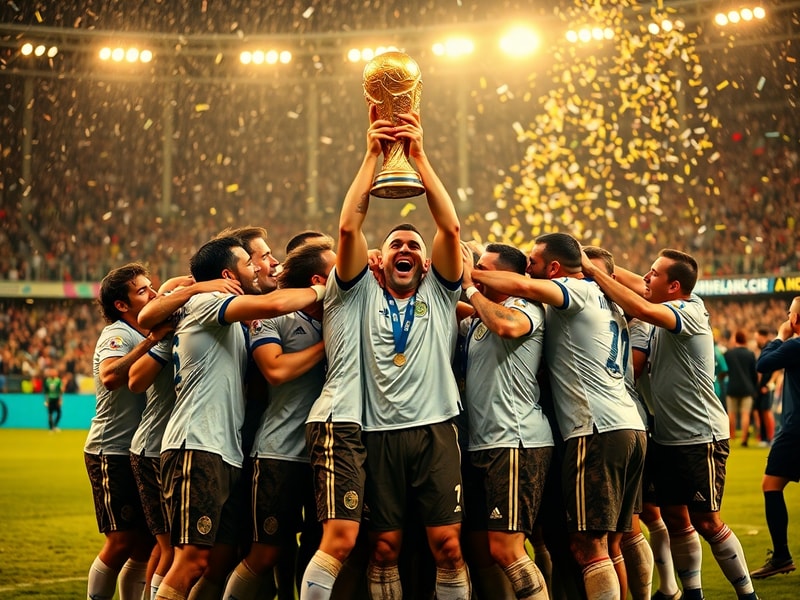
The FIFA World Cup has always been more than just a tournament—it’s a global stage where legends are made, careers are defined, and moments become etched in history. For the players who step onto the pitch, the World Cup represents the pinnacle of their profession, a chance to etch their names into football’s pantheon alongside the likes of Pelé, Maradona, and Ronaldo. These athletes don’t just play the game; they carry the hopes of nations, the expectations of millions, and the pressure of performing on the world’s biggest sporting platform.
The World Cup is unique in its ability to unite the planet for a month every four years, transcending borders, languages, and cultures. For players, it’s an opportunity to showcase their talent on a stage where every pass, tackle, and goal is scrutinized by billions. The best players rise to the occasion, delivering performances that define generations. Meanwhile, others fall prey to the weight of expectation or the unpredictability of knockout football. What makes the World Cup so compelling isn’t just the competition—it’s the stories of the players who make it unforgettable.
The Icons Who Shaped the World Cup
Few players have left as indelible a mark on the World Cup as Brazil’s Pelé. Still the only player to win three World Cups (1958, 1962, 1970), Pelé’s combination of skill, vision, and sheer audacity redefined what it meant to be a footballer. His performance in the 1958 final at just 17 years old remains one of the most iconic moments in sports history. Pelé didn’t just play in the World Cup—he owned it, turning it into a personal showcase of greatness.
Diego Maradona’s 1986 campaign for Argentina is another defining chapter in World Cup lore. His infamous “Hand of God” goal against England and the subsequent solo effort that is often ranked as the greatest goal in World Cup history showcased a genius capable of bending the game to his will. Maradona’s World Cup wasn’t just about football; it was a statement, a rebellion against the establishment, and a reminder of how one player could dominate a tournament.
More recently, players like Lionel Messi and Cristiano Ronaldo have carried the torch of World Cup excellence. While Messi’s 2022 triumph with Argentina cemented his legacy as one of the greatest ever, Ronaldo’s five World Cup appearances across two decades highlight his enduring brilliance and adaptability. These players don’t just play in the World Cup—they define eras.
Key Traits of World Cup Players
- Mental Resilience: The ability to perform under immense pressure, especially in high-stakes knockout matches, separates the good from the great. Players like Paolo Maldini and Philipp Lahm thrived in World Cups not because of flashy skills, but because of their composure and tactical intelligence.
- Technical Mastery: World Cup players often possess an elite level of technical ability. Whether it’s Zinedine Zidane’s elegance, Johan Cruyff’s movement, or Neymar’s flair, the best players make the difficult look effortless.
- Adaptability: The World Cup is unpredictable. Players who can adjust to different styles of play, weather conditions, and tactical setups often rise to the top. Germany’s 2014 victory, for example, was built on a squad that could adapt seamlessly between systems.
- Leadership: Captains like Iker Casillas and Fabio Cannavaro didn’t just lead by example—they inspired their teams to dig deeper, believe in themselves, and deliver when it mattered most.
From Underdogs to Legends: The World Cup’s Unpredictable Narratives
The World Cup has a way of turning the script upside down. It’s where the unheralded players become heroes and the favorites crumble under the weight of expectation. Cameroon’s 1990 campaign, led by the indomitable Roger Milla, showed the world that Africa could compete with the best. Milla’s celebrations at the corner flag became a symbol of joy and rebellion, challenging the traditional power structures of world football.
Similarly, Greece’s 2004 triumph remains one of the most improbable in World Cup history. A team built on defensive solidity and organization, led by Otto Rehhagel, defied all odds to lift the trophy. Their victory wasn’t about individual brilliance but collective belief—a lesson in how football is often decided by heart over talent.
These stories remind us that the World Cup isn’t just a competition; it’s a narrative machine. It writes tales of triumph, heartbreak, and everything in between. For players, the World Cup is the ultimate proving ground. Those who succeed write their names in gold, while those who fall often do so in dramatic fashion, ensuring their stories are told for decades.
The Broader Impact of World Cup Players
Beyond the pitch, World Cup players often become cultural icons whose influence extends far beyond football. Pelé transcended sport to become a global ambassador for Brazil and an advocate for social change. David Beckham’s influence extended into fashion, business, and philanthropy, turning him into a brand synonymous with style and success.
The economic impact of World Cup players is also significant. Their performances can boost a nation’s morale, drive tourism, and even influence stock markets. When a player like Messi scores a last-minute winner, it’s not just a goal—it’s a boost to the country’s economy and global standing. Studies have shown that a strong World Cup performance can lead to increased foreign investment and tourism for years afterward.
Moreover, World Cup players often become role models, inspiring the next generation of footballers. Whether it’s Messi’s humility, Ronaldo’s work ethic, or Zidane’s grace under pressure, these players shape the values and aspirations of young athletes worldwide. Their influence is a reminder that the World Cup is more than a tournament—it’s a cultural event that shapes societies.
What’s Next for World Cup Players?
The future of World Cup football looks as exciting as ever. With the expansion of the tournament to 48 teams in 2026, more nations will have the chance to compete on the global stage. This shift could lead to a new wave of underdog stories and unexpected heroes. Players from smaller federations will now have a real opportunity to shine, potentially changing the landscape of world football.
Technological advancements, such as VAR (Video Assistant Referee), have also changed the way players approach the game. While it has sparked debates about officiating, it has also pushed players to be more disciplined and precise in their actions. The next generation of World Cup players will need to adapt to these changes, ensuring that the tournament remains as competitive and unpredictable as ever.
For aspiring footballers, the World Cup remains the ultimate dream. The players who succeed in this arena will continue to shape the game’s history, leaving a legacy that transcends their careers. As the tournament evolves, so too will the stories of the players who define it—proving that the World Cup is not just a competition, but a celebration of the beautiful game.
Conclusion
The World Cup is a stage where legends are born, and the players who grace it become immortalized in the hearts of football fans worldwide. From Pelé’s three trophies to Messi’s 2022 triumph, these athletes don’t just play the game—they define eras, inspire generations, and shape the cultural landscape of global sport. Their stories are a testament to the power of football to unite, inspire, and transcend.
As the tournament continues to evolve, the players who step onto the pitch will carry the hopes of nations, the expectations of millions, and the weight of history. The World Cup is more than a competition; it’s a narrative of triumph, heartbreak, and everything in between. And for the players who rise to the occasion, it’s the greatest stage in football.
For those who want to dive deeper into the stories behind the World Cup’s greatest moments, explore our Trending and Sports sections for more analysis, features, and insights into the beautiful game.