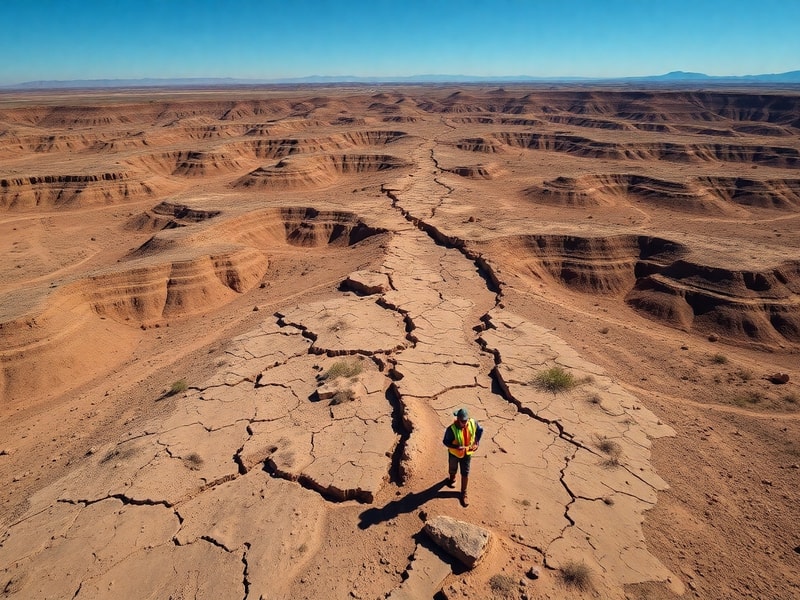
The San Andreas Fault has long been a focal point for seismologists and geologists due to its potential to generate devastating earthquakes. Recent studies have shed new light on the stress levels accumulating along different segments of the fault, prompting concerns about future seismic activity. Understanding these stress dynamics is crucial for both scientific research and public safety.
How Stress Builds Along the San Andreas Fault
The San Andreas Fault is a transform boundary where the Pacific Plate and the North American Plate slide past each other. While friction typically locks these plates in place, stress continues to build over time. When the accumulated stress exceeds the fault’s strength, it ruptures, releasing energy in the form of an earthquake.
Recent research published in the Journal of Geophysical Research highlights variations in stress accumulation across different segments of the fault. The southern segment, particularly near the Salton Sea, shows elevated stress levels, while the central segment near Parkfield exhibits more gradual strain buildup. These differences are influenced by the fault’s geometry, historical seismic activity, and tectonic interactions with nearby faults.
Key Factors Influencing Stress Levels
- Fault Geometry: The angle and orientation of the fault plane affect how stress is distributed and released.
- Historical Seismicity: Past earthquakes influence current stress conditions by redistributing stress along the fault.
- Tectonic Interactions: Adjacent faults, such as the San Jacinto Fault, can transfer stress to the San Andreas, altering its behavior.
- Creep Rate: Some segments of the fault exhibit aseismic creep, where slow, continuous movement reduces stress accumulation.
Monitoring Stress with Advanced Technology
Seismologists rely on a combination of tools to monitor stress along the San Andreas Fault. GPS stations track ground deformation, while InSAR (Interferometric Synthetic Aperture Radar) satellites detect subtle changes in the Earth’s surface. These technologies provide real-time data that helps researchers model stress accumulation and identify high-risk areas.
A study conducted by the Dave’s Locker Science section emphasizes the importance of integrating these datasets with machine learning algorithms. By analyzing patterns in seismic and geodetic data, scientists can improve earthquake forecasting and refine hazard models.
Notable Findings from Recent Studies
- Southern Segment Stress: The region near the Salton Sea shows stress levels approaching critical thresholds, raising concerns about a potential major earthquake.
- Parkfield Segment Behavior: The central segment, known for its recurring moderate quakes, is currently in a phase of low stress accumulation, suggesting a temporary lull in activity.
- Northern Segment Uncertainty: The northernmost section of the fault, which last ruptured during the 1906 San Francisco earthquake, remains a significant unknown due to limited data.
Broader Implications for California and Beyond
The implications of elevated stress levels along the San Andreas Fault extend beyond California’s borders. A major earthquake in this region could have cascading effects on infrastructure, the economy, and emergency response systems. The U.S. Geological Survey estimates that a magnitude 7.8 quake on the southern San Andreas could result in over 1,800 fatalities and $200 billion in damages.
Preparedness is key to mitigating these risks. Cities like Los Angeles and San Francisco have invested in seismic retrofitting programs, while state agencies conduct regular earthquake drills. However, the unpredictability of fault behavior means that continuous monitoring and research remain essential.
What Residents Should Know
For residents living near the San Andreas Fault, understanding local seismic risks is critical. The California Geological Survey provides detailed hazard maps that outline high-risk zones. Additionally, the Dave’s Locker Education section offers resources on earthquake preparedness, including checklists for emergency kits and evacuation plans.
“The San Andreas Fault is not a single line but a complex system of fractures. Each segment behaves differently, and predicting the next major rupture requires a multi-faceted approach.” — Dr. Emily Chen, Seismologist at the California Institute of Technology
Looking Ahead: The Future of Fault Monitoring
Advancements in technology are revolutionizing our ability to monitor and understand fault stress. Next-generation seismometers, fiber-optic sensing networks, and AI-driven analytics are enhancing our capacity to detect subtle changes in fault behavior. These innovations could lead to more accurate early warning systems and improved risk assessments.
However, challenges remain. The San Andreas Fault’s complexity means that even the most advanced models have limitations. Public awareness and community engagement are equally important in building resilience against future seismic events.
As research continues, one thing is clear: the San Andreas Fault will remain a critical focus for scientists and policymakers alike. By staying informed and prepared, communities can better navigate the uncertainties of living in earthquake country.
For more insights into seismic activity and fault dynamics, explore the latest updates in the Dave’s Locker Science section.
© 2023 Dave’s Locker. All rights reserved.