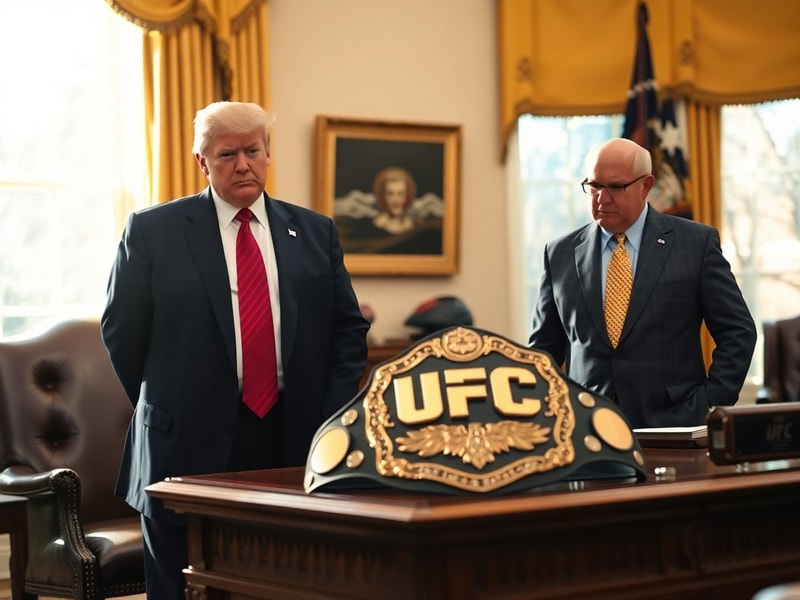
Trump, UFC, and the White House: A Fusion of Power and Pop Culture
The intersection of politics and sports entertainment has rarely been as visible—or as contentious—as during the brief but intense speculation surrounding Donald Trump’s potential involvement with the Ultimate Fighting Championship (UFC) in the context of the White House. While no formal partnership materialized, the mere suggestion of such a union illuminated deeper cultural currents: the blurring of entertainment, politics, and public perception in the 21st century.
This wasn’t just about a former president dabbling in combat sports. It was about how power reshapes identity, how spectacle becomes political currency, and how institutions once considered separate now merge in the public imagination. From the Octagon to the Oval Office, the conversation revealed much about where authority resides—and who gets to wield it.
The Background: Trump, the UFC, and a Preexisting Alliance
Donald Trump’s relationship with the UFC predates his presidency by over a decade. Long before he entered politics, Trump hosted UFC events at his casinos in Atlantic City during the late 1990s and early 2000s, when the sport was still fighting for legitimacy. He even appeared in the Octagon to present belts, his towering presence a stark contrast to the raw intensity of the fighters.
That era marked a turning point. The UFC, under Dana White’s leadership, was transforming from a fringe spectacle into a global entertainment empire. Trump’s endorsement—both financial and symbolic—helped legitimize the sport in mainstream American culture. By the time he became president in 2017, the UFC was a multi-billion dollar brand, and Trump had already positioned himself as an ally.
- 1997: Trump hosts UFC 12 at Trump Plaza in Atlantic City.
- 2000: UFC 28 held at Trump Taj Mahal.
- 2016: UFC sold to WME-IMG for $4 billion, solidifying its place in global sports entertainment.
- 2017–2021: Trump hosts UFC champions at the White House, including Francis Ngannou and Daniel Cormier.
During his presidency, Trump continued to embrace the UFC, inviting champions to the White House and praising the sport’s discipline and meritocracy. These gestures weren’t merely symbolic—they reinforced a narrative: that the UFC embodied American individualism, resilience, and competitive spirit, values Trump often championed in his political rhetoric.
The Speculation: Could Trump Have Bought the UFC?
In 2020, amid the COVID-19 pandemic and financial uncertainty, rumors began to circulate that Trump might explore purchasing the UFC. The source of the speculation varied—some pointed to his long-standing admiration for Dana White, others to advisers suggesting a sports league as a media platform. While no concrete bid was ever confirmed, the idea itself sparked widespread discussion.
Such a move would not have been unprecedented. In 2001, Trump attempted to buy the NFL’s Buffalo Bills. In 2018, he reportedly considered purchasing the New York Mets. Sports franchises have long been seen as status symbols, platforms for influence, and even tools for political messaging. If Trump could turn a football team into a media asset, why not a global fight league?
The UFC’s business model—centered on pay-per-view events, digital content, and international expansion—aligns with Trump’s media-savvy approach. A Trump-owned UFC could have amplified his messaging, blended entertainment with politics, and created a 24-hour propaganda channel disguised as sports entertainment. It would have been a merger of persona and platform, where Trump’s brand of brash confidence could be repackaged as athletic achievement.
Critics warned of conflicts of interest, given Trump’s history of leveraging public office for private gain. Supporters saw it as a natural evolution: a businessman turning a passion into power. Either way, the conversation exposed how deeply intertwined celebrity, sports, and politics have become in the modern media landscape.
The Global Perspective: Why This Story Matters Beyond U.S. Borders
While the story originates in American politics, its implications ripple across the world. The UFC is now a global brand with major markets in Brazil, Europe, the Middle East, and Asia. Its events draw hundreds of millions of viewers annually, many outside the United States. When Trump’s name is linked to the UFC, it’s not just a domestic story—it becomes a global spectacle.
In countries like Brazil, where mixed martial arts is a source of national pride, the idea of an American president owning the UFC could be seen as cultural appropriation or, conversely, as validation of the sport’s global reach. In Europe, where combat sports face regulatory hurdles and public skepticism, the association might either legitimize or politicize the UFC further.
Moreover, in an era where authoritarian leaders increasingly use soft power—sports, entertainment, and media—to consolidate influence, the Trump-UFC narrative becomes a case study. It raises questions about transparency, ownership, and the role of public figures in shaping cultural institutions. When a former president can casually be linked to a global sports empire, what does that say about the erosion of boundaries between public service and private enterprise?
This isn’t just about Trump. It’s about a world where power is increasingly wielded through entertainment, where charisma trumps policy, and where influence is measured in followers, not votes. The UFC, once a controversial sideshow, now sits at the center of this transformation.
The Cultural Legacy: Where Politics Meets the Octagon
Regardless of whether Trump ever owned the UFC, the cultural footprint of their relationship endures. The image of a president standing in the White House with a UFC champion is now part of the sport’s mythology. It symbolizes a moment when combat sports transitioned from underground spectacle to mainstream power broker.
This fusion also reflects a broader cultural shift. In the age of social media, politics is no longer confined to policy papers and press briefings. It’s performed on platforms like Twitter, Instagram, and YouTube. Athletes and entertainers are not just celebrities—they’re influencers with real-world impact. When Trump invites a UFC star to the White House, he’s not just meeting an athlete; he’s engaging with a cultural icon whose values—strength, discipline, resilience—align with his own political narrative.
Yet this alignment comes with risks. The UFC’s brand is built on authenticity—on the idea that fighters earn their place through skill and sacrifice. When politics enters the Octagon, even symbolically, it risks diluting that authenticity. Fans may begin to question whether the sport is being used as a tool for political messaging rather than a celebration of athletic achievement.
Ultimately, the story of Trump, the UFC, and the White House is less about ownership and more about perception. It’s about how power reshapes identity, how spectacle becomes currency, and how institutions once considered separate now merge in the public imagination. Whether through invitation or acquisition, the boundaries between politics and sports entertainment have blurred—and they may never fully separate again.
As the UFC continues to expand globally and political figures increasingly seek platforms in entertainment, the lessons of this moment remain relevant. In a world where influence is often measured in likes and shares, the Octagon and the Oval Office may not be so different after all.
For more on the intersection of sports and culture, visit our Sports and Entertainment sections.