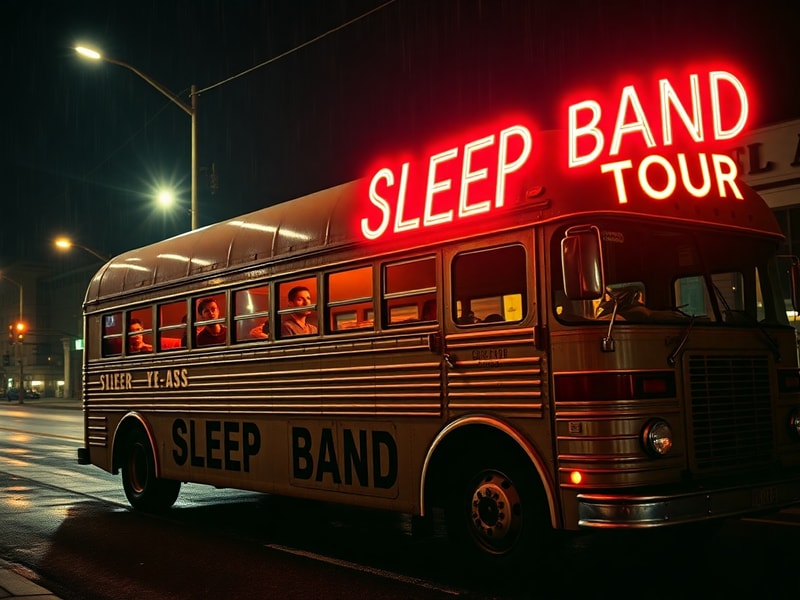
Few touring concepts have blurred the line between performance art and live music quite like the Sleep Band Tour. Originating as an experimental project by avant-garde composer Max Richter in 2019, the concept involves a full orchestra performing Richter’s eight-hour ambient masterpiece Sleep in venues that double as temporary sleep labs. Patrons aren’t just listening—they’re encouraged to lie down on mattresses provided on the floor, drifting between wakefulness and rest while the music evolves in real time. The experience challenges conventions of concert etiquette, redefines audience participation, and raises intriguing questions about the role of music in our sleep-deprived culture.
The tour has crisscrossed Europe and North America, stopping in venues as diverse as Berlin’s Kraftwerk and New York’s Park Avenue Armory. Each stop adapts the experience to local acoustics and cultural expectations. In some cities, attendees arrive at 10 p.m. and remain until 6 a.m., with optional guided meditation and tea breaks. In others, shorter “micro-sleep” sessions of 90 minutes are offered during daytime hours, targeting shift workers and new parents. The tour’s flexibility speaks to its growing appeal not just among classical music fans, but among wellness communities, insomniacs, and even corporate teams seeking stress relief.
The Origins: From Concert Hall to Sleep Lab
Richter’s Sleep was first performed in full in 2015 at the Wellcome Collection in London, where it was presented as a 24-hour live broadcast. Inspired by neuroscience and the rhythms of human sleep cycles, the piece uses looping strings, gentle pulses, and slow harmonic shifts to mirror the architecture of slumber. Richter collaborated with sleep researchers to ensure the music’s tempo and volume aligned with natural sleep stages. The Sleep Band Tour emerged from this collaboration—a scaled-down, immersive version designed for live audiences.
“We wanted to break out of the concert hall,” Richter said in a 2021 interview. “Music shouldn’t just be heard. It should be felt, experienced, even lived through.” The tour’s production team developed a modular system of speakers and microphones that could transform any space into a sonic cocoon. Mattresses were sourced from local sleep clinics, and lighting was programmed to dim gradually over the course of each performance, mimicking circadian rhythms. The result is less a concert and more a collective meditation—one that dissolves the boundary between performer and audience.
What to Expect: A Night in the Sleep Band Experience
Attendees at a Sleep Band Tour stop are greeted with soft lighting, ambient field recordings, and a room arranged with hundreds of mattresses and pillows. No chairs. No phones. Just fabric, foam, and the quiet hum of anticipation. Once the performance begins, the orchestra—typically 16 to 20 musicians—plays Richter’s score in shifts, with overlapping sections creating a seamless, eight-hour soundscape. Snacks are limited to herbal teas and light broths to avoid disrupting digestion. Bathrooms are accessible, but the environment is designed to encourage lingering.
Many participants arrive with sleeping bags, eye masks, and even CPAP machines. Some sleep deeply. Others lie quietly, listening. A few meditate. One attendee in Berlin reported waking up to the orchestra’s crescendo at 3 a.m., feeling as though she had just surfaced from a dream. “It wasn’t a concert,” she wrote in a review. “It was a passage.”
The tour’s program includes several tiers of participation:
- Full Night Pass (8 hours): Includes access to all amenities, guided sleep coaching, and optional wake-up rituals.
- Daytime Micro-Sleep Session (90 minutes): A condensed version designed for those unable to attend overnight.
- VIP Sleep Lab (4 hours): For groups or individuals seeking a private, monitored experience with biometric feedback.
The tour has also introduced a “silent disco” variation in some cities, where attendees wear wireless headphones and can choose between Richter’s score and ambient soundscapes from nature. This adaptation has broadened the tour’s appeal to younger audiences who might otherwise avoid classical music settings.
Cultural Impact: Beyond the Music
The Sleep Band Tour has sparked conversations about the intersection of art, health, and public space. Critics have praised it as a bold reimagining of the concert experience, while skeptics question whether such an event can truly be considered a “performance.” Some venues have reported increased foot traffic from local sleep clinics and wellness centers, suggesting the tour is serving as a gateway to broader conversations about rest in modern life.
In Reykjavik, the tour partnered with a local sleep research institute to collect anonymous data on attendees’ heart rates and movement during the performance. Preliminary findings suggest that participants experienced measurable reductions in cortisol levels—an indicator of stress—after just two hours. While the study remains unpublished, it has fueled interest from corporate wellness programs, with several companies inquiring about private bookings for employee retreats.
The tour has also faced challenges. In Vienna, local authorities initially denied a permit, citing concerns over public health and noise ordinances. After negotiations, the event was allowed to proceed with strict sound limits and a maximum capacity of 200 people. Organizers have since worked closely with city officials in each location to address concerns about sanitation, accessibility, and emergency protocols.
The Future: Sleep as a New Frontier for Live Music
As the Sleep Band Tour enters its fifth year, its creators are exploring expansions into new formats. A proposed “Sleep Festival” would combine the tour with workshops on lucid dreaming, sound baths, and circadian lighting design. Richter has also hinted at a follow-up project, provisionally titled Awake, which would explore the opposite end of the consciousness spectrum—music designed to enhance focus and productivity.
Industry analysts see the tour as part of a larger trend: the rise of “experience-based” live events that prioritize emotional and physical transformation over traditional entertainment. Venues like the Sleep Salon in Portland and the Dreamatorium in Tokyo have begun hosting similar programs, blending art, wellness, and technology. Some predict that within a decade, sleep concerts could become as common as yoga studios or meditation apps.
“We’re not just selling tickets,” said tour producer Elena Vasquez. “We’re selling a permission slip—to rest, to slow down, to exist outside the relentless pace of modern life. That’s revolutionary.”
The Sleep Band Tour isn’t just a musical event. It’s a cultural statement. In an age of constant stimulation, it offers a radical alternative: the chance to do nothing—and to do it together. Whether this is the future of live performance remains to be seen. But one thing is clear: the conversation it has started is far from over.