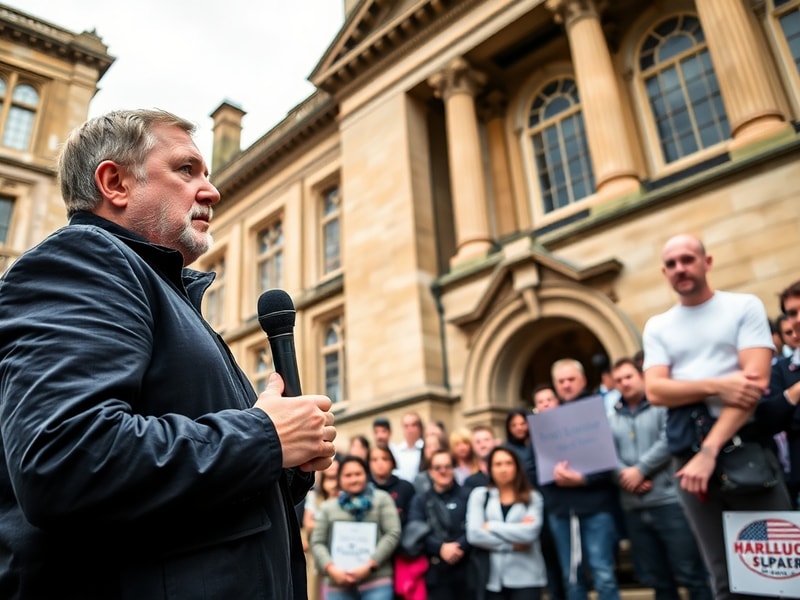
On a rainy evening in Oxford, Stephen Yaxley-Lennon—better known by his pseudonym Tommy Robinson—delivered a speech that once again thrust him into the center of Britain’s ongoing culture wars. The event, held at the Oxford Union, drew a crowd of supporters, protesters, and journalists, underscoring the combustible nature of his public appearances. While some framed the speech as a defense of free speech, others saw it as a platform for divisive rhetoric. The evening revealed as much about the audience as it did about the speaker, exposing deep divisions in how free expression is defined and defended.
The Oxford Union: A Stage for Controversy
The Oxford Union, renowned for its tradition of hosting provocative speakers, has become a microcosm of broader societal tensions. Robinson’s invitation and subsequent speech were not merely academic exercises; they were performative acts with real-world consequences. The Union’s decision to extend the invitation sparked immediate backlash, with critics arguing that Robinson’s history of inflammatory statements made him an unsuitable figure for such a prestigious forum. Supporters, however, praised the Union for upholding its commitment to open debate, regardless of the speaker’s reputation.
The event itself was tightly controlled, with robust security measures in place to prevent clashes between opposing factions. Attendees described a charged atmosphere, where cheers for Robinson’s rhetoric alternated with chants from protesters outside the venue. This juxtaposition highlighted the polarized nature of contemporary political discourse, where even the act of listening to an opposing viewpoint is often seen as an endorsement.
Key Moments and Rhetorical Strategies
Robinson’s speech followed a familiar template, blending personal anecdotes with broader critiques of immigration, multiculturalism, and what he describes as the suppression of free speech in Britain. Among the most notable moments were his claims of systemic bias in media coverage and his portrayal of himself as a victim of coordinated efforts to silence him. These arguments resonated strongly with his core supporters, who see him as a truth-teller in a landscape dominated by political correctness.
However, the speech also exposed the limitations of Robinson’s rhetorical approach. His reliance on emotional appeals and sweeping generalizations often overshadowed substantive policy discussions. Critics pointed out that his arguments frequently conflated correlation with causation, particularly when discussing crime statistics and immigration. For instance, he cited specific incidents to argue for broader policy changes, a tactic that simplifies complex social issues into binary oppositions of “us versus them.”
One of the most telling exchanges came during the Q&A session, when Robinson was pressed on his past legal troubles. His response—deflecting blame onto authorities and media outlets—highlighted a pattern of victimhood that has become central to his public persona. This strategy not only deflects scrutiny but also reinforces the narrative that he is under siege from powerful elites, a claim that galvanizes his base while alienating critics.
What Defines Free Speech in 2024?
The debate surrounding Robinson’s speech is not unique to him; it reflects a broader crisis in how free speech is understood and defended in modern democracies. On one side, free speech advocates argue that no topic should be off-limits, including controversial or offensive ideas. On the other, critics contend that unchecked speech can normalize bigotry and incite violence, particularly when directed at marginalized communities. Robinson’s case forces a confrontation with this tension, asking where the line should be drawn between free expression and harmful rhetoric.
This dilemma is further complicated by the role of social media, which amplifies controversial figures like Robinson by giving them direct access to millions of followers. Platforms like Twitter and Telegram have become echo chambers where divisive rhetoric thrives, often without the guardrails of traditional media or institutional oversight. In this context, the Oxford Union’s invitation to Robinson can be seen as both a principled stand for free speech and a tacit endorsement of his methods.
Broader Implications for British Politics
Robinson’s influence extends beyond his immediate audience. His rhetoric has seeped into mainstream political discourse, particularly within segments of the Conservative Party and the far-right fringe. While mainstream politicians often distance themselves from Robinson, his ideas have found indirect support in policies aimed at curbing immigration and tightening asylum laws. This indirect validation raises questions about the mainstreaming of extremist ideas, where once-radical positions become normalized over time.
The speech in Oxford also underscores the fragmentation of the political left. While progressive groups are united in their opposition to Robinson, they are divided on how to counter his influence. Some advocate for direct confrontation, while others prefer to ignore him, fearing that engagement might legitimize his platform. This division weakens the left’s ability to mount a cohesive response, allowing figures like Robinson to dominate the narrative.
Lessons from the Oxford Union Debate
The Robinson controversy at the Oxford Union offers several key takeaways for understanding the state of public discourse in Britain today. First, it demonstrates how institutions that once served as neutral forums for debate are now battlegrounds for ideological conflict. The Union’s decision to host Robinson was not merely an academic exercise but a political statement, reflecting the broader erosion of consensus around what constitutes acceptable discourse.
Second, the event highlights the role of social media in amplifying controversial figures. Robinson’s ability to bypass traditional gatekeepers and connect directly with supporters has redefined political communication, making it more immediate but also more volatile. This shift has democratized speech in some ways but has also eroded the quality of public debate, where nuance is often sacrificed for emotional impact.
Finally, the speech underscores the challenge of balancing free speech with the protection of marginalized communities. Robinson’s supporters see his invitation as a victory for free expression, while his critics view it as a dangerous normalization of hate speech. This tension is unlikely to fade, as long as societal divisions continue to deepen.
Conclusion: The Road Ahead
The Oxford Union speech by Tommy Robinson is more than a single event; it is a symptom of a larger crisis in how societies engage with controversial ideas. As institutions struggle to maintain their neutrality and social media continues to reshape public discourse, the boundaries of acceptable speech will remain contested. For those who value open debate, the challenge is to find ways to engage with difficult ideas without empowering those who seek to undermine democratic values. For Robinson’s supporters, the speech was a validation of their worldview. For his critics, it was a reminder of the work still to be done in fostering a more inclusive public sphere.
One thing is clear: the debate over free speech, once confined to academic circles, has now entered the mainstream. How society navigates this terrain will define the future of democratic discourse for generations to come.
For further reading on related topics, explore our News and Politics sections, where we delve deeper into the intersection of media, free speech, and societal change.