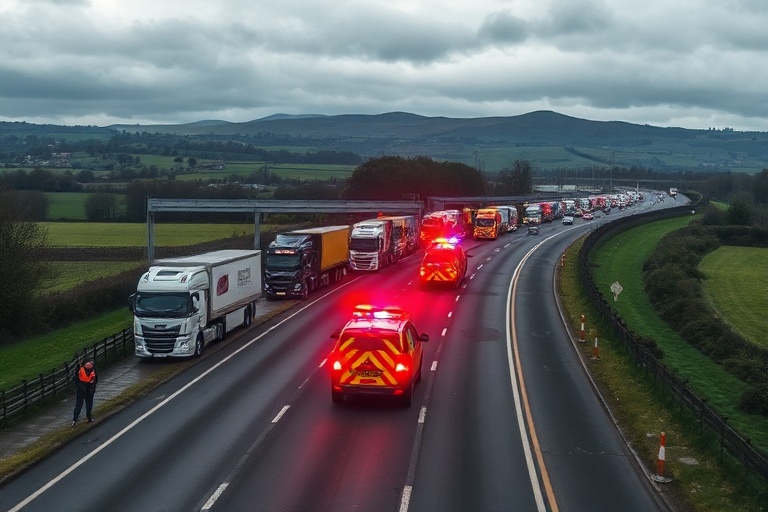
The M54 motorway, a vital artery connecting the West Midlands to North Wales, has been closed indefinitely following a series of structural failures. The closure, which took effect last week, has left commuters and freight operators scrambling for alternative routes. Local authorities and transport officials are working against the clock to assess the damage and determine the feasibility of repairs.
At the heart of the issue is a severe deterioration of the motorway’s elevated sections. Engineers have identified significant corrosion in the steel supports and concrete fatigue in multiple bridges. The situation escalated after routine inspections revealed cracks large enough to compromise structural integrity. Traffic officials have warned that even temporary fixes may not be possible until a comprehensive long-term solution is implemented.
Why the M54 Closure Matters
The M54 serves as a critical link for thousands of daily commuters traveling between Wolverhampton and the Welsh border. Its closure has already created ripple effects across the region, particularly for businesses that rely on the motorway for deliveries and employee transportation. The disruption extends beyond local commuters; freight companies are rerouting goods through longer, more congested paths, adding hours to delivery times.
Local councils have activated emergency protocols to mitigate the impact. Wolverhampton City Council has partnered with transport authorities to open temporary detour routes, but these come with their own set of challenges. Increased traffic on alternative roads like the A449 and A41 has led to congestion, longer travel times, and a surge in road accidents. Residents near these detour routes have reported higher noise levels and air pollution, raising concerns about long-term health impacts.
Economic Consequences for Local Businesses
The economic fallout from the closure is becoming increasingly apparent. Businesses in the West Midlands and Shropshire that depend on the M54 for supply chain logistics are feeling the strain. Retailers, manufacturers, and agricultural producers are reporting delays in receiving raw materials and shipping finished goods. Some small businesses have resorted to air freight or overnight courier services, which significantly increase operational costs.
A recent survey by the Shropshire Chamber of Commerce highlighted the severity of the situation. Over 70% of respondents stated that the closure has negatively impacted their revenue, with 40% expecting losses of more than 20% in the next quarter. The hospitality sector, particularly hotels and restaurants along the motorway, has also suffered as business travelers and tourists opt for alternative routes.
To compound the issue, insurance claims related to rerouted freight and delayed shipments are climbing. Many small business owners are calling for government intervention to provide financial relief or subsidies to offset the unexpected costs. The Federation of Small Businesses has urged local authorities to expedite the repair process and explore interim solutions, such as funding for alternative transport modes.
Government and Transport Authority Response
The UK Department for Transport has acknowledged the urgency of the situation and pledged to allocate £50 million in emergency funding for immediate repairs. However, engineers caution that this may only cover temporary measures. A full structural overhaul could take years and cost hundreds of millions, depending on the extent of the damage.
Transport Secretary Mark Harper stated, “Safety is our top priority. While we work to reopen the M54 as quickly as possible, we are also exploring every option to minimize disruption for residents and businesses. This includes accelerating repair work and evaluating the need for additional funding.”
Timeline for Repairs and Reopening
Officials have released a preliminary timeline, though they emphasize that dates are subject to change based on ongoing assessments. Here’s what drivers and businesses can expect:
- Week 1-4: Temporary stabilization of the most critical sections to prevent further collapse. This includes installing support beams and sealing visible cracks.
- Week 5-12: Detailed structural assessments of each bridge and elevated section. Engineers will determine whether repairs are feasible or if full reconstruction is necessary.
- Week 13-24: If repairs are possible, work will begin on reinforcing steel and concrete structures. Alternative routes will remain in place, and traffic management systems will be implemented to reduce congestion.
- Month 6-12: Final safety checks and phased reopening of lanes to test structural integrity. Full reopening will only occur after all certifications are complete.
If reconstruction is required, the timeline could extend to 18-24 months. Authorities are also considering a permanent reduction in the motorway’s capacity, which could lead to long-term traffic management challenges.
Alternatives and Long-Term Solutions
For now, drivers are encouraged to plan their routes carefully using real-time traffic apps. The most viable detours include the A449 northbound to A5, the A41 to Welshpool, and the M6 Toll as a last resort. However, these routes add significant travel time—some journeys are now 40-50% longer than before the closure.
Long-term solutions under discussion include:
- Upgrading parallel routes: Expanding the A449 and A41 to handle increased traffic volumes, with dedicated freight lanes to reduce congestion.
- Exploring rail freight options: Partnering with Network Rail to develop rail freight hubs near Wolverhampton and Shrewsbury, reducing reliance on road transport.
- Investing in public transport: Enhancing bus and rail services between Wolverhampton and North Wales to provide commuters with reliable alternatives.
- Permanent lane restrictions: Implementing variable speed limits and peak-hour restrictions to manage traffic flow on alternative routes.
Some transport analysts argue that the M54 closure presents an opportunity to rethink the region’s infrastructure. With the rise of remote work and e-commerce, the demand for road freight may never return to pre-pandemic levels. This could justify a shift toward more sustainable and efficient transport networks.
Community and Environmental Impact
Beyond the economic and logistical challenges, the closure has also raised environmental and community concerns. Increased traffic on detour routes has led to a measurable rise in carbon emissions and air pollution. Environmental groups are calling for urgent measures to offset these impacts, such as incentivizing carpooling or promoting electric vehicle use.
Residents along the detour routes have organized protests, citing noise pollution and safety hazards. Wolverhampton South MP Eleanor Smith has called for additional funding to soundproof homes and install traffic calming measures on residential streets. “This isn’t just about getting from A to B,” Smith stated in a recent interview. “It’s about ensuring that communities aren’t left paying the price for a failure they didn’t cause.”
Environmentalists are also highlighting the irony of the situation. The M54 was originally built to improve connectivity and reduce congestion on local roads. Its closure has achieved the opposite, proving that infrastructure failures can have cascading effects on both the economy and the environment.
Looking Ahead: What Drivers and Businesses Can Do
The coming months will be critical as authorities work to stabilize the M54 and develop a long-term repair plan. In the meantime, drivers and businesses must adapt to the disruption. Here are some steps they can take:
- Plan ahead: Use traffic apps like Google Maps or Waze to identify the fastest detour routes. Allow extra travel time for all journeys.
- Explore carpooling: If possible, share rides with colleagues or neighbors to reduce traffic congestion on detour routes.
- Stay informed: Follow updates from Highways England and local councils for real-time information on road closures and repair progress.
- Support local businesses: If you’re a consumer, consider shopping locally to reduce the strain on supply chains. Businesses can also explore partnerships with nearby suppliers to minimize delivery delays.
- Advocate for solutions: Contact your local representatives to urge them to prioritize the M54 repairs and explore long-term infrastructure improvements.
For more insights into how infrastructure disruptions like the M54 closure impact local economies, visit our News section. To learn about alternative transport options during the closure, check out our Travel category.
The M54 closure is more than just a traffic inconvenience; it’s a test of the UK’s ability to adapt to infrastructure failures and prioritize both safety and sustainability. As repairs begin and communities rally together, the lessons learned from this crisis could shape the future of transport in the region.