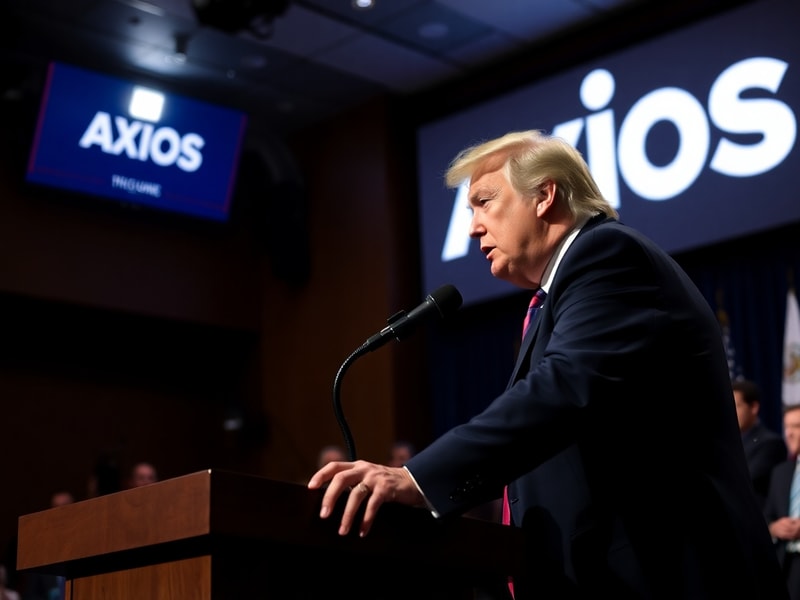
The Axios interview with former President Donald Trump in April 2024 was more than a media moment—it was a case study in how power limits reveal themselves in real time. In a conversation that ranged from policy to personal grievances, Trump’s responses exposed the boundaries of influence, even for a figure who has dominated American politics for nearly a decade. The interview, conducted in Trump’s signature unfiltered style, inadvertently highlighted the constraints that shape even the most powerful voices: legal boundaries, media gatekeeping, and public perception.
Trump’s Interview as a Power Audit
During the Axios interview, Trump faced questions that probed the limits of his political and rhetorical power. When pressed on legal accountability, he deflected with familiar deflection tactics—dismissing investigations as “witch hunts” and framing legal challenges as attacks on his supporters. Yet, his insistence on portraying himself as a victim of institutional overreach underscored a critical tension: the erosion of unchecked authority.
Journalists played a key role in this dynamic. Axios’ Mike Allen and Jonathan Swan didn’t just ask questions—they held up a mirror to Trump’s own rhetoric. Their approach reflected a broader shift in political journalism: audiences no longer accept unchallenged assertions from public figures. The interview became a microcosm of how power now operates under scrutiny, where every claim is met with counterclaims, and every statement is dissected for consistency.
This scrutiny isn’t new, but its intensity has grown. Social media amplifies contradictions in real time, turning interviews into viral moments that define narratives beyond traditional media cycles. Trump’s responses—often tangential, sometimes evasive—highlighted how even the most dominant voices must now navigate a landscape where their words are constantly parsed, challenged, and repurposed.
Legal and Institutional Constraints: The Invisible Ceiling
No figure, regardless of past influence, operates outside legal and institutional limits. During the Axios interview, Trump’s comments on his legal troubles—including ongoing cases in New York, Florida, and Washington—revealed the constraints of his power. His refusal to acknowledge potential consequences didn’t negate their existence; it merely underscored the gap between rhetoric and reality.
- Judicial Boundaries: Courts have repeatedly ruled against Trump’s attempts to delay or dismiss cases, signaling that legal accountability isn’t a political tool but an institutional safeguard.
- Constitutional Limits: Even as a former president, Trump is subject to the same laws as any citizen. His claims of immunity have been rejected by multiple courts, reinforcing that no individual is above the law.
- Media Scrutiny: Outlets like Axios, The New York Times, and CNN don’t just report on power—they measure it. Trump’s interviews are now platforms where power is tested, not just amplified.
The interview also exposed the limits of institutional loyalty. While Trump retains a loyal base, even his most ardent supporters are not immune to legal realities. The willingness of courts, law enforcement, and regulatory bodies to pursue cases against him—despite his political influence—demonstrates that power in America is not absolute.
Public Perception: The Ultimate Power Check
Trump’s interview didn’t just play to his base; it also revealed the fragility of his broader appeal. His tendency to pivot to grievances—whether about the 2020 election, media bias, or personal slights—highlighted a disconnect between his self-perception and public sentiment. Polling data consistently shows that while his core supporters remain steadfast, undecided and independent voters are increasingly skeptical of his divisive rhetoric.
This shift isn’t just about policy differences. It’s about tone. Trump’s interview style—confrontational, often dismissive—reinforces the perception that he prioritizes conflict over solutions. In an era where voters increasingly demand competence and pragmatism, his approach risks alienating the very audiences he needs to expand his coalition.
Moreover, the interview’s reception on social media revealed another layer of power limits: viral moments don’t always translate to influence. While clips of Trump’s responses spread quickly, they also sparked backlash, with critics highlighting inconsistencies or inflammatory remarks. Social platforms, once seen as amplifiers of Trump’s message, now serve as accountability tools, dissecting his statements in real time.
The Broader Implications: Power in the Age of Scrutiny
The Axios interview was a reminder that power in modern America is not a static force but a dynamic negotiation. It thrives on perception, but it wilts under scrutiny. For Trump, the interview underscored three critical realities:
- Rhetoric ≠ Reality: Trump’s ability to dominate headlines doesn’t equate to control over outcomes. Legal, institutional, and public opinion forces are reshaping the boundaries of his influence.
- Media as a Counterbalance: Outlets like Axios are no longer passive conduits for political messaging. They actively challenge, contextualize, and sometimes dismantle narratives, forcing figures like Trump to engage in good faith or risk exposure.
- Public Sentiment as a Safeguard: The erosion of unchecked loyalty means that even the most powerful figures must now contend with shifting voter priorities. A base that once tolerated bombast may now demand substance.
This dynamic extends beyond Trump. It reflects a broader trend in American politics, where power is increasingly decentralized. Social media, independent journalism, and institutional checks are redistributing influence away from traditional gatekeepers. Figures who once relied on unfiltered access now face a landscape where every statement is met with immediate pushback.
For observers, the Axios interview was a masterclass in how power reveals itself under pressure. It wasn’t just a conversation—it was a stress test. And like all stress tests, it exposed the cracks in the facade of unassailable authority.
As Trump’s political future remains uncertain, one thing is clear: the limits of his power are no longer theoretical. They are operational, visible, and increasingly difficult to ignore. In an era where influence is measured in real time, the old playbook of deflection and dominance no longer suffices. The question isn’t whether Trump’s power is waning—it’s how he, and others like him, will adapt to a world where power is conditional, not absolute.