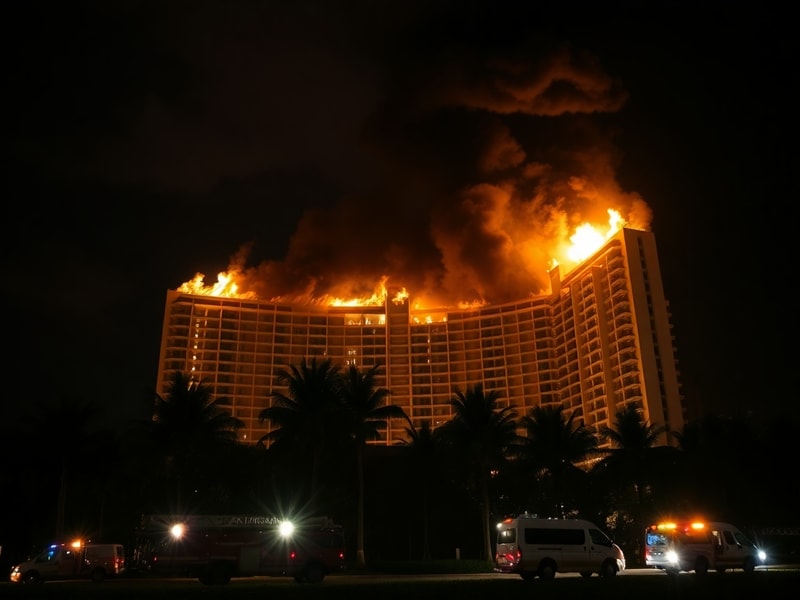
Dominican Resort Fires: Hidden Risks Behind Caribbean Paradise
Fire safety in tropical resorts often takes a backseat to white-sand beaches and all-inclusive cocktails. Yet in the Dominican Republic, where luxury resorts line the Caribbean coast, the stakes of fire preparedness are higher than most travelers realize. Between 2018 and 2023, the country saw at least six major resort fires that required evacuations, disrupted thousands of vacations, and exposed vulnerabilities in regional emergency response. These incidents reveal more than just construction flaws; they highlight how global tourism demands intersect with local infrastructure, cultural attitudes toward risk, and international safety standards.
What recent fires have revealed about Dominican resort safety
The most widely reported incident occurred in June 2022 at the Hard Rock Hotel & Casino Punta Cana. A fire broke out in a spa area, sending smoke through multiple floors and forcing the evacuation of over 1,200 guests. While no fatalities were reported, the blaze exposed lapses in alarm systems and sprinkler coverage. Investigators later found that the spa’s ceiling void lacked proper firebreaks, allowing flames to spread rapidly through concealed spaces. Similar patterns emerged during the 2019 fire at the Grand Bahia Principe La Romana, where a short circuit in an electrical room ignited a blaze that gutted 200 rooms.
These events are not isolated anomalies. A 2023 report by the Caribbean Tourism Organization (CTO) identified electrical faults as the leading cause of resort fires in the region, accounting for 38% of cases. Poorly maintained wiring, overloaded circuits, and the use of non-compliant materials—often imported from markets with lower safety standards—compound the risk. In many Dominican resorts, maintenance cycles stretch beyond manufacturer recommendations, and staff training on emergency protocols remains inconsistent.
How cultural attitudes shape fire prevention and response
The Dominican Republic’s approach to fire safety reflects broader Caribbean attitudes toward risk and regulation. Historically, the region has prioritized economic growth over stringent enforcement, particularly in tourism-heavy zones. Building codes exist, but compliance is uneven. Some resorts comply with international standards like NFPA 701 or NFPA 13, but many smaller properties operate under grandfathered permits or rely on self-certification. A 2021 study by the University of Santo Domingo found that only 62% of tourist accommodations had up-to-date fire safety certifications.
Cultural norms also play a role. In many local communities, fire prevention is viewed as an “external” concern—something managed by hotel management rather than a shared responsibility. This mindset can delay action when alarms sound. During the 2022 Hard Rock incident, some guests reported waiting 15 minutes before receiving evacuation instructions, while others relied on social media for real-time updates. These delays underscore a disconnect between guest expectations and on-site emergency protocols.
Meanwhile, local firefighters face their own challenges. The Dominican Republic has only one fire inspector for every 120,000 residents, far below the ratio recommended by the World Fire Protection Association. Rural fire stations often lack modern equipment, and urban units can be overwhelmed during peak tourist seasons. This infrastructure gap forces resorts to rely on private security and in-house teams, which may not be equipped to handle large-scale evacuations.
Global standards vs. local realities: Can the gap be bridged?
International hotel chains operating in the Dominican Republic face a paradox: they must meet the safety expectations of guests from North America and Europe, yet operate within a regulatory environment that often lags behind. Many global brands voluntarily exceed local requirements, installing advanced detection systems, automated sprinklers, and even drone-based thermal monitoring. The Hyatt Ziva Cap Cana, for example, uses a centralized fire alarm network linked to local fire departments, reducing response times by nearly 40%.
Yet voluntary compliance is not enough. In 2023, the Dominican government introduced a new tourism safety law requiring all Category A resorts—those accommodating over 300 guests—to install automatic sprinkler systems by 2025. The law also mandates annual fire drills and third-party inspections. While a step forward, critics argue the timeline is too lenient, and enforcement remains weak. Hotels found in violation currently face only minor fines, which many operators view as a cost of doing business.
Meanwhile, travelers are increasingly factoring safety into their booking decisions. A 2023 survey by Travel found that 42% of U.S. and Canadian tourists now research fire safety records before choosing a Caribbean destination. This shift has prompted some global insurers to raise premiums for properties with outdated systems, creating financial incentives for upgrades.
What travelers can do to stay safe
While resorts bear primary responsibility for safety, guests can take steps to protect themselves. Upon arrival, locate the nearest emergency exits and test the fire alarm in your room. If the hotel lacks visible sprinklers or smoke detectors, ask reception about their fire suppression systems. During stays in older properties, consider packing a portable carbon monoxide detector—a small device that can provide early warning of electrical or gas leaks.
It’s also wise to monitor travel advisories. The U.S. State Department’s Smart Traveler Enrollment Program (STEP) issues alerts when resorts report safety incidents. In 2022, after the Hard Rock fire, the embassy updated its guidance for Punta Cana, urging travelers to confirm that hotels had passed recent fire safety inspections.
For those planning extended stays, choosing newer resorts with transparent safety records can mitigate risk. Properties built after 2015 are more likely to comply with modern codes, including fire-resistant building materials and integrated alarm networks. Even so, no destination is entirely risk-free, and travelers should balance safety concerns with the realities of tropical tourism.
Ultimately, the fires in Dominican resorts reveal a tension between paradise and precaution. They remind us that luxury travel does not exempt destinations from the laws of physics—or the need for vigilance. As climate change intensifies hurricane seasons and strains electrical grids, the region’s fire risks may grow. The question is not whether the Dominican Republic can afford to prioritize safety, but whether it can afford not to.