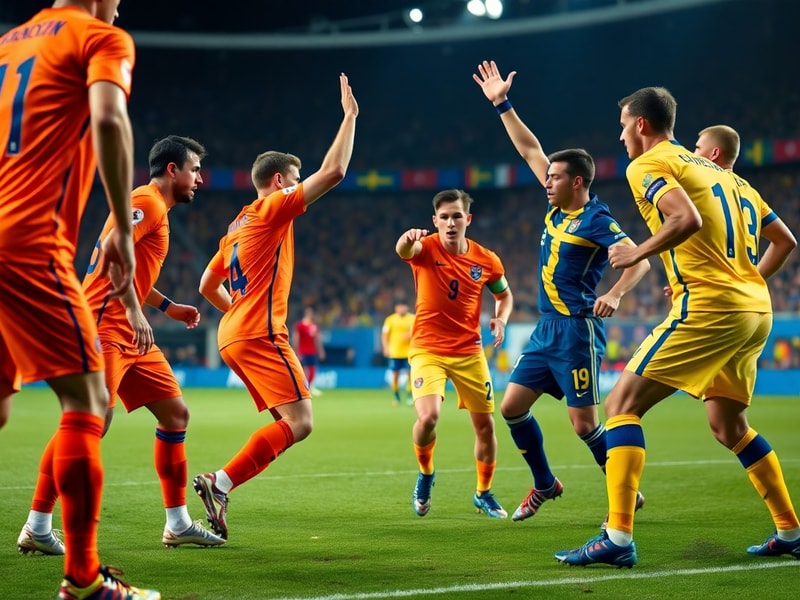
The Netherlands and Sweden have long been footballing neighbors with contrasting styles—Dutch flair against Swedish pragmatism. When these two nations met in a recent European qualifier, the clash wasn’t just about three points; it was a collision of philosophies, pressure, and the weight of history. The outcome would ripple beyond the scoreboard, shaping narratives for both teams heading into the next campaign.
The Tactical Clash: Possession vs. Pragmatism
Sweden arrived with a compact 4-4-2, built on defensive solidity and direct transitions. Their game plan relied on quick vertical passes, stretching play with long balls to Alexander Isak and Emil Forsberg, then flooding the box with runners. The Swedes defended in a mid-block, absorbing pressure before exploiting any gaps on the counter. It was a system designed to frustrate opponents who favored technical superiority.
The Netherlands, meanwhile, lined up in a fluid 4-3-3, emphasizing positional play and positional interchange. Their midfield trio—Frenkie de Jong, Xavi Simons, and Ryan Gravenberch—operated as a single unit, circulating possession with surgical precision. The full-backs pushed high, creating overloads on the wings, while Memphis Depay and Cody Gakpo moved centrally to drag defenders out of position. It was football as art, but art requires patience—and patience is a luxury when facing a disciplined low block.
The first half was a tactical chess match. Sweden’s midfield sat deep, forcing de Jong into deeper positions. Every time the Dutch tried to play through them, Sweden collapsed into a compact shape, making angles impossible to exploit. The breakthrough came in the 37th minute: a loose ball in midfield fell to Simons, who sprayed a diagonal pass to Gakpo on the left. A quick one-two, a cross to Depay, and the Netherlands led 1-0. The goal wasn’t pretty, but it exposed Sweden’s vulnerability: they could absorb pressure, but one mistake could be fatal.
Key Moments That Defined the Match
Sweden nearly equalized within five minutes of halftime. A swift break down the left saw Isak ghost past Virgil van Dijk, only for Jasper Cillessen to make a brilliant save with his feet. It was a moment that embodied Sweden’s threat: sudden, explosive, and clinical. From that point on, the game became a battle of attrition—the Dutch probing, the Swedes countering, both sides aware that one slip could decide the match.
Here are the key turning points:
- 37th minute: Gakpo’s run and Depay’s finish give the Netherlands the lead. A moment of individual quality breaking down a collective structure.
- 42nd minute: Cillessen’s save from Isak keeps the Dutch ahead. A display of reflexes under pressure.
- 68th minute: Sweden sub Douglas Bergqvist nearly scores after a rebound, but the flag goes up for offside. A close call that could have changed everything.
- 82nd minute: Sweden throws everything forward in search of an equalizer, leaving space behind their defense. The Dutch nearly punish them, but the final pass is just off target.
In the end, the Netherlands held on for a 1-0 victory, but the match revealed deeper truths about both teams. For Sweden, it was another lesson in how to compete against elite opposition without dominating possession. For the Dutch, it was a reminder that even the most aesthetically pleasing football can falter if execution isn’t perfect.
Broader Implications: What This Means for Both Teams
The result had immediate consequences. For the Netherlands, it kept their qualification hopes alive, but it also exposed their frailties. Their inability to break down low blocks has become a recurring issue. Against stronger teams, their possession-heavy approach can feel sterile, lacking the verticality needed to unlock stubborn defenses. The match against Sweden wasn’t a disaster, but it wasn’t a statement either. It was a performance that begged the question: can they adapt when the opposition refuses to engage?
For Sweden, the loss was a setback, but not a fatal one. Their campaign remains competitive, and their style—functional, organized, and resilient—has proven effective against top-tier opponents. They may not dazzle, but they grind out results. The match against the Netherlands highlighted their strengths: defensive organization, counterattacking threat, and mental toughness. These are the traits that could see them through to the next stage, even if they don’t always control the game.
Beyond the immediate standings, the match carried symbolic weight. It was a clash of footballing identities—Dutch creativity versus Swedish pragmatism. The Dutch, historically associated with Total Football, are in a transitional phase. Their golden generation is fading, and a new one, led by players like Xavi Simons and Brian Brobbey, is still finding its footing. Sweden, meanwhile, continues to punch above their weight, relying on a generation of players who grew up watching the likes of Zlatan Ibrahimovic but have forged their own path.
Looking Ahead: What’s Next for Netherlands and Sweden?
The Netherlands must decide whether to double down on their possession-based identity or incorporate more direct, vertical football. The current squad has talent, but they need to find a way to break down stubborn defenses without resorting to long balls or hopeful crosses. The next set of fixtures will be crucial in determining their trajectory.
Sweden, on the other hand, can take confidence from their performance. They may not have the star power of some of their rivals, but they have a clear identity. Their challenge will be maintaining consistency across multiple matches. Can they sustain this level of performance against stronger opponents? The answer will define their campaign.
For fans of European football, these matches are more than just games—they’re a reminder of the diversity of styles that make the sport so compelling. The Netherlands and Sweden may not always be title contenders, but they represent two distinct ways of playing the game. And in a sport often dominated by extremes—either tiki-taka or long-ball football—it’s the middle ground that offers the most intrigue.