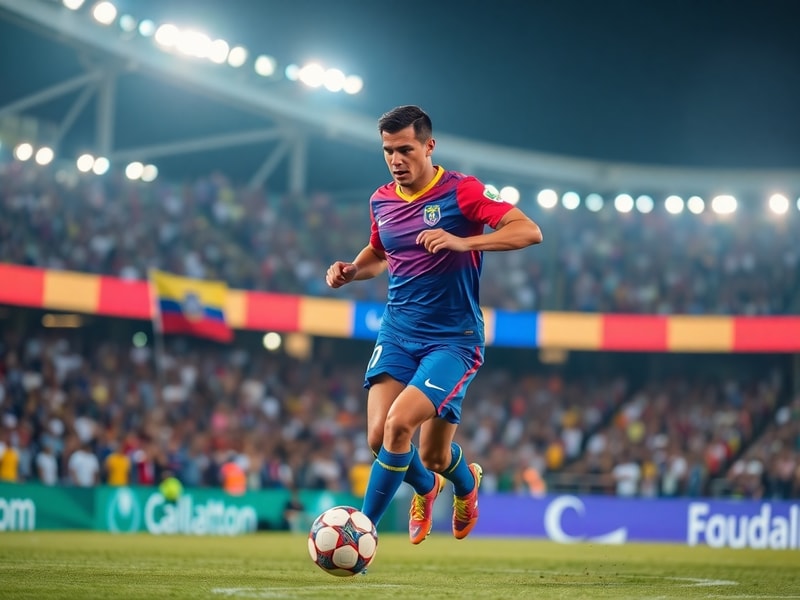
Gonzalo Plata’s rise from Ecuador’s youth leagues to European football’s brightest prospects reads like a script written for a coming-of-age sports drama. Born on November 1, 2000, in Guayaquil, Plata’s journey began in the rough-and-tumble pitches of Barrio del Centenario, where he honed his dribbling on cracked concrete and dreamed of wearing the famous Ecuadorian national team colors. His technical grace and explosive pace caught the eye of scouts early, but it was his decision to join Independiente del Valle’s academy at 15 that truly set the stage for his professional breakthrough.
At 18, Plata made his senior debut for Independiente, immediately showcasing the flair and creativity that would define his career. His performances in the Copa Sudamericana and Ecuadorian Serie A earned him comparisons to Ronaldinho for his close control and audacious flicks. By 2020, Plata had secured a high-profile move to Sporting CP in Portugal’s Primeira Liga, a transfer that signaled his arrival on the global stage. His first season in Lisbon was uneven, but flashes of brilliance—including a virtuoso assist against Porto—hinted at the player he was becoming.
What makes Plata’s story particularly compelling is how it reflects broader trends in South American football. Clubs across the continent are increasingly prioritizing youth development, with academies like Independiente del Valle proving that small budgets need not limit ambition. Plata’s success underscores a shift where technical skill and tactical intelligence can outshine traditional scouting metrics focused solely on physicality. For Ecuador, a nation with a rich footballing culture but limited resources, Plata represents hope—a reminder that talent, when nurtured properly, can transcend borders.
Breaking through in Europe: Challenges and triumphs
Plata’s transition to European football was not without its hurdles. The Portuguese league’s physicality and tactical demands initially exposed gaps in his decision-making, particularly under high-pressure situations. Critics pointed to his inconsistent end product, noting that while he dazzled in training and isolated moments, his assist and goal tallies did not yet reflect his creative potential. Yet, Plata’s response was characteristically bold. He doubled down on his fitness regimen, refined his finishing, and developed a deeper understanding of positional play under Sporting CP’s rotating managerial staff.
His breakthrough came during the 2022–23 season. Plata’s partnership with Pedro Gonçalves (Pote) in attack revitalized Sporting’s attack, and his direct style—marked by rapid changes of direction and sudden bursts of speed—became a tactical weapon. A standout moment arrived in the UEFA Europa League, where his solo run and composed finish against Midtjylland went viral, amassing millions of views and igniting debates about his ceiling. Coaches and pundits began to frame him not just as a winger, but as a box-to-box playmaker, capable of dictating tempo and creating from deep positions.
The 2023 FIFA U-20 World Cup further cemented his reputation. As Ecuador’s captain, Plata led a young team deep into the tournament, scoring crucial goals and orchestrating attacks with maturity beyond his years. His ability to perform in high-stakes environments drew interest from top clubs across Europe, with rumors linking him to moves to the Premier League and La Liga. While some questioned whether his style would translate to the Premier League’s intensity, Plata’s performances suggested adaptability—he was not just a dribbler, but a thinker.
Style of play: The modern winger redefined
Plata’s game is a fusion of elegance and efficiency, a blend of South American flair and European tactical discipline. He operates primarily as a left-winger but drifts centrally, exploiting half-spaces with diagonal runs that unbalance defensive lines. His left foot is his primary tool, but his two-footedness and ability to cut inside allow him to play effectively on either flank. What sets him apart is his use of misdirection—feints, body swerves, and sudden changes of pace that leave defenders grasping at air.
Defensively, Plata is more engaged than the stereotype of the “luxury winger.” He tracks back with purpose, pressing opponents high up the pitch and initiating counterattacks with quick transitions. His work rate and stamina enable him to maintain intensity over 90 minutes, a trait increasingly valued in modern football. Yet, his defensive contributions are not without criticism; at times, he can be caught out of position or too eager to press, leaving gaps for counterattacks. Improving his defensive awareness remains a key focus for his development.
Here are some key attributes that define Plata’s playing style:
- Technical mastery: Close control, quick feet, and a low center of gravity allow him to navigate tight spaces.
- Vision and creativity: He sees passes others miss, often threading through balls from wide areas into the box.
- Physical profile: While not the tallest, his acceleration and agility make him difficult to contain in one-on-one situations.
- Mental resilience: He thrives under pressure and uses setbacks as motivation, a trait evident in his recovery from early struggles at Sporting CP.
- Versatility: Can play as an attacking midfielder, a false winger, or even as a second striker in a 4-2-3-1 system.
Plata’s style aligns with the modern football zeitgeist, where wingers are expected to be more than just providers—they must be goal threats, playmakers, and pressing machines. His evolution reflects a broader tactical shift, where fluidity and positional interchangeability are prized over rigid formations. For aspiring young players, Plata’s career offers a blueprint: technical excellence must be paired with tactical intelligence and mental fortitude.
Broader implications: What Plata’s rise means for football’s future
Gonzalo Plata’s career is more than a personal success story—it’s a microcosm of football’s evolving ecosystem. His journey highlights the growing importance of data-driven scouting and holistic player development. Clubs are now leveraging advanced analytics to identify technical attributes like dribbling success rates, progressive carries, and expected threat (xT) metrics, which were once overlooked in favor of raw physical traits. Plata’s data profile—high in xT and progressive passes but lower in aerial duels—would have been undervalued a decade ago. Today, it positions him as a prime target for data-informed recruitment.
Moreover, Plata’s career underscores the strategic value of South American academies. Independiente del Valle, once a mid-table side, has become a talent factory, producing players like Plata and José Cifuente who thrive in Europe. This model challenges the traditional dominance of European clubs in youth development and offers a blueprint for clubs in developing football nations. The success of these academies could reshape the global transfer market, creating a more balanced distribution of talent and financial rewards.
On a cultural level, Plata’s rise resonates deeply in Ecuador, where football is more than a sport—it’s a unifying force. His performances have inspired a generation of young players, particularly in Guayaquil, where the sport is woven into the fabric of daily life. Social media has amplified his impact, with viral clips of his skills circulating across platforms like Dave’s Locker Sports, where fans dissect his every move. This digital engagement reflects a broader trend: footballers are no longer just athletes; they are content creators, influencers, and cultural ambassadors.
Yet, Plata’s story also raises questions about the sustainability of the current transfer model. The pressure to perform at a young age, coupled with the scrutiny of social media, can take a toll on mental health. Clubs must balance ambition with responsibility, ensuring that players like Plata are given time to grow without being prematurely labeled as failures. The case of Plata—who took time to adapt—serves as a reminder that development is not linear, and patience is a virtue in football.
Looking ahead, Plata’s next career chapter will be pivotal. Whether he secures a move to a top-five European league or becomes a linchpin at Sporting CP, his trajectory will influence how South American talent is perceived globally. If he continues to refine his game, he could redefine the winger archetype for a new era. For now, he remains a symbol of possibility—a player who turned raw potential into tangible progress through hard work and adaptability.
Gonzalo Plata’s story is still being written, but one thing is clear: he is not just a product of his circumstances. He is a shaper of them. As football continues to evolve, players like Plata will dictate the narrative, proving that talent, when nurtured and understood, can transcend borders and redefine the beautiful game.