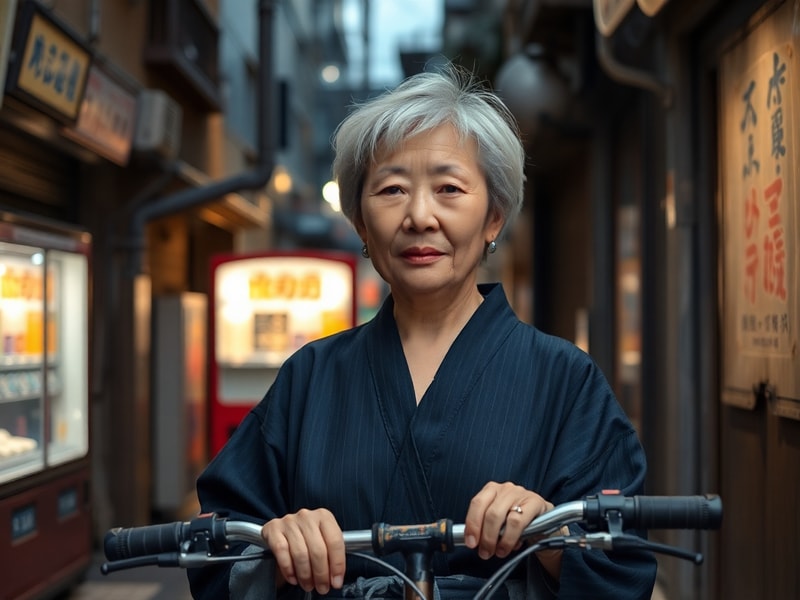
Mamiko Tanaka’s name first surfaced in Tokyo’s indie art scene a decade ago, not with a gallery opening or a viral video, but with a handmade zine tucked into the back row of a tiny bookstore in Shimokitazawa. The zine, Empty Rooms in Full Bloom, contained thirty photocopied pages of handwritten observations, rough sketches, and collaged postcards from places she had never visited—Lublin, Reykjavik, Recife. It was raw, unfiltered, and quietly radical in an era when polished digital portfolios dominated. Tanaka, then in her early twenties, was not a trained artist. She was a part-time translator, a barista, and a voracious reader of mid-century Japanese and Scandinavian literature. But the zine’s DIY aesthetic and its blend of nostalgia and wanderlust struck a chord. Within months, it had been traded hand-to-hand across three continents, sparking a small but devoted following among readers who craved something unpolished, something real.
The Art of Displacement: Tanaka’s Visual Language
At the heart of Tanaka’s work is displacement—not as a condition to overcome, but as a lens through which to see the world. Her paintings, installations, and performances often begin with a simple premise: what happens when you place an object or a gesture outside its expected context? In 2019, during a residency in Helsinki, she created Tea in the Snow, a series of porcelain cups filled with powdered snow collected from various city parks. Each cup was placed on a windowsill in a gallery, melting slowly over the course of the exhibition. The work was minimal, almost invisible to the hurried gallery-goer, yet deeply meditative. It asked viewers to pause and consider the temporality of beauty and the quiet persistence of nature amid urban life.
Tanaka’s visual vocabulary draws from Japanese mono no aware—the pathos of things—and Scandinavian hygge, yet she filters these influences through a distinctly contemporary lens. Her color palette is muted: dusty blues, faded ochres, soft grays. Her forms are often fragmented, as if caught between motion and stillness. In a 2022 interview, she described her process as “editing reality,” stripping away the superfluous to reveal the emotional core of a scene. This approach resonates globally, particularly in an era where digital saturation has made authenticity a rare commodity.
A Global Following, Built One Zine at a Time
Tanaka’s rise has been organic, almost accidental. She has never sought mainstream recognition; instead, her audience has grown through grassroots networks—zine fairs in Buenos Aires, underground galleries in Berlin, pop-up exhibitions in Mexico City. Social media played a minor role; she rarely posts, and when she does, it’s a single image with no caption, no hashtags. Yet her work circulates widely, often reproduced without credit in online forums and private collections. This lack of control over her image has paradoxically amplified her influence. She has become a kind of cult figure among those who value process over product, impermanence over permanence.
Her international reach is evident in the variety of venues that have hosted her work. In 2021, The Quiet Rebellion of Objects, a solo exhibition at a repurposed textile factory in Łódź, Poland, drew visitors from twenty-three countries. The show featured a series of large-scale photographs of abandoned public clocks, their faces frozen at different hours, accompanied by handwritten notes from people who had once waited beneath them. The installation was silent, yet the absence of sound made the presence of time palpable. Critics described it as “a meditation on waiting in a world that never stops.”
Tanaka’s work has also found a home in unexpected places. In 2020, during the early months of the pandemic, she collaborated with a collective of musicians in Reykjavik to create Silent Concerts, performances held in empty rooms where the audience sat in absolute silence while musicians played in adjacent spaces. The audience could hear the music, but not see the performers. The experience was disorienting, almost unsettling. Yet many participants reported it as one of the most moving cultural experiences of the year. It was a testament to Tanaka’s ability to transform absence into presence.
The Politics of the Unseen
Beneath the quiet surfaces of Tanaka’s work lies a subtle political current. She often focuses on overlooked spaces—abandoned subway stations, derelict libraries, empty classrooms—and imbues them with a sense of dignity. In 2018, she spent three months documenting the last days of a neighborhood cinema in Osaka before its demolition. Instead of mourning its loss, she created The Last Frame, an installation where the final movie posters were reprinted on translucent fabric and hung in a dark room. Visitors could walk through the fabric, their bodies momentarily becoming part of the image. The work was a commentary on the fragility of cultural memory and the ways in which we preserve—or fail to preserve—what matters.
Her engagement with the politics of memory extends to her collaborations. In 2023, she worked with a group of Syrian refugees in Berlin to create Letters from Temporary Homes, a series of handwritten letters and small sculptures made from materials found in temporary housing. The project was not about pity or rescue, but about shared humanity. Tanaka once said in an interview, “I’m not interested in trauma as spectacle. I’m interested in the quiet acts of resistance that happen every day—keeping a plant alive in a sterile room, making tea in a disposable cup, writing a letter that may never be answered.”
This focus on the unseen and unheard has made her work particularly resonant in regions experiencing rapid change or displacement. In Athens, where she led a workshop in 2022, participants created small sculptures from debris collected near the port—fishing nets, plastic crates, broken ceramics—and placed them in public squares. The act of collecting and repurposing was both an aesthetic choice and a political statement about resourcefulness and resilience. Tanaka’s role was not to instruct, but to listen and facilitate. Her approach aligns with the principles of socially engaged art, where the process is as important as the outcome.
What’s Next: The Unfinished Project
Tanaka is notoriously private about her future plans. She rarely grants interviews, and when she does, she speaks in riddles. “I’m always looking for the next empty room,” she told a journalist in 2021. “Not to fill it, but to listen to what it has to say.” Her recent projects suggest a turn toward sound and movement. In 2024, she began experimenting with field recordings of urban spaces—construction sites, train stations, marketplaces—and using these sounds as the basis for new installations. The recordings are layered, slowed down, and played back in unexpected locations, such as a forest or a desert. The effect is disorienting: the familiar becomes strange, the mundane becomes haunting.
She is also exploring performance, though in a way that resists spectacle. In her most recent work, Walking Without Destination, participants are given a simple instruction: walk for one hour without a predetermined route, and document the journey in whatever way they choose—a sketch, a note, a photograph. The results are compiled into a collective archive, a growing map of human movement and curiosity. Tanaka sees this as a way to reclaim agency in an era of algorithmic control. “We are constantly being directed,” she says. “By algorithms, by schedules, by expectations. Walking without a destination is a small act of rebellion.”
As her work evolves, so does her audience. What began as a quiet revolution in zine culture has grown into a global movement of sorts—one that values slowness, attentiveness, and the unspoken. In an age of constant connection, Tanaka’s art reminds us that disconnection can be a form of resistance. It asks us to look closer, to listen deeper, and to value the spaces in between—the empty rooms, the unsent letters, the moments of stillness that often go unnoticed.
For those seeking to understand her work, the best approach may be to start small. Pick up a zine. Visit an empty room. Walk without a destination. In doing so, you might find yourself part of the quiet rebellion she’s been nurturing for over a decade.