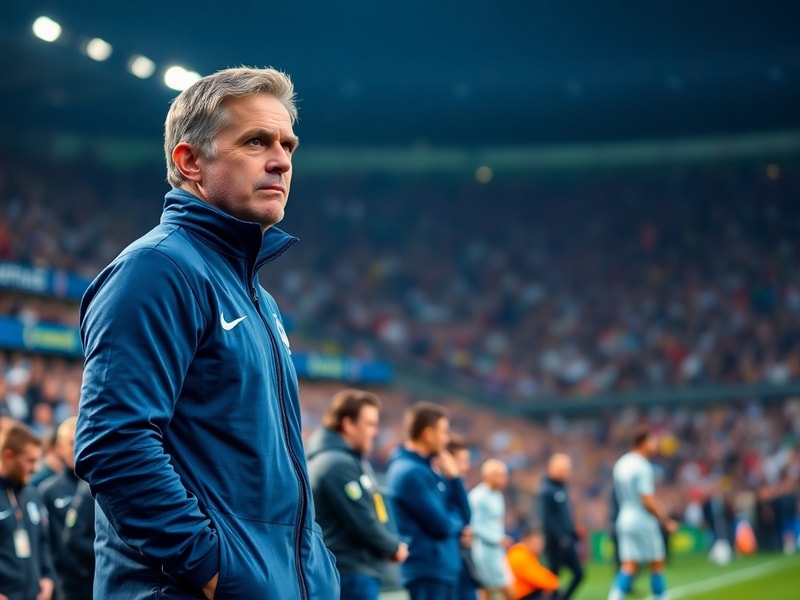
Didier Deschamps: The Architect of Modern French Football Dominance
Didier Deschamps isn’t just another football manager. He is a man who has rewritten the rules of success in the modern game, not through flashy tactics or headline-grabbing signings, but through relentless pragmatism, unshakable self-belief, and an almost pathological aversion to losing. Since taking charge of the French national team in 2012, Deschamps has transformed Les Bleus from a team of immense talent but inconsistent temperament into a global powerhouse capable of winning on every stage. His journey—from World Cup-winning captain to World Cup-winning coach—is a study in leadership, adaptation, and the quiet confidence that turns potential into achievement.
Deschamps’ philosophy is rooted in the belief that football is first and foremost a collective endeavor. He values cohesion over individual brilliance, discipline over flair, and results over aesthetics. This approach has drawn criticism from purists who crave the free-flowing football of France’s golden generation in the late 1990s and early 2000s. Yet, his methods have delivered tangible success: two World Cup finals (winning one in 2018), a Nations League title, and consistent deep runs in major tournaments. More importantly, he has restored France’s reputation as a footballing nation that wins when it matters most.
The Making of a Winner: From Player to Manager
Deschamps’ credentials as a winner are unassailable. As a player, he captained France to victory in the 1998 World Cup and Euro 2000, forming a formidable midfield partnership with Emmanuel Petit and Zinedine Zidane. His playing career spanned top clubs like Juventus, Chelsea, and Barcelona, where he earned a reputation as a tenacious, intelligent, and uncompromising leader. These traits would later define his managerial style.
Transitioning from player to manager in the late 2000s, Deschamps cut his teeth at AS Monaco and Juventus, where he learned the intricacies of man-management and tactical discipline. His first major success came at Marseille, where he won Ligue 1 in 2010. Yet, it was his appointment as France manager in 2012 that truly showcased his potential. At the time, the French national team was in disarray, still reeling from the 2010 World Cup mutiny and the Euro 2012 underachievement. Deschamps inherited a squad brimming with talent but lacking direction. His response? Impose structure. Build a system. And above all, instill a winning mentality.
Building a Team, Not Just a Squad: Deschamps’ Methodology
Deschamps’ approach to team-building is methodical and unyielding. He prioritizes three core principles: tactical flexibility, psychological resilience, and a clear identity. Unlike managers who chase trends or rely on a single star player, Deschamps adapts his system to his personnel while maintaining a clear framework. His 4-2-3-1 formation, often criticized for its perceived lack of creativity, has proven to be a masterclass in balance. It allows France to absorb pressure, transition quickly, and exploit counterattacking opportunities—hallmarks of Deschamps’ teams.
The psychological aspect of his leadership cannot be overstated. Deschamps has cultivated an environment where players understand their roles implicitly. There is no room for prima donnas or egos in his setup. Players like Paul Pogba, Antoine Griezmann, and Kylian Mbappé have thrived under his guidance because they recognize the collective over the individual. This was evident in the 2018 World Cup, where France’s victory was as much about mental fortitude as it was about talent. Deschamps’ ability to keep his squad focused under immense pressure, particularly during the tournament’s pivotal moments, set him apart from his peers.
His man-management extends beyond the pitch. Deschamps has developed a reputation for nurturing young talent while integrating experienced heads. The 2018 World Cup-winning side was a blend of youth (Mbappé, Samuel Umtiti) and experience (Hugo Lloris, Raphaël Varane), a balance Deschamps has maintained throughout his tenure. This approach ensures continuity and prevents the kind of generational drop-offs that have plagued other national teams.
The Critics and the Contempt: Why Deschamps Divides Opinion
For all his achievements, Deschamps remains a polarizing figure in football. Critics argue that his teams lack flair and creativity, preferring pragmatism over the attacking verve that once defined French football. His refusal to select certain players—most notably Karim Benzema, who was excluded from the 2018 World Cup squad due to his legal troubles—has sparked debates about inclusivity and meritocracy. Others point to France’s struggles in the 2022 World Cup final against Argentina, where his conservative tactics were blamed for the team’s inability to break down a stubborn opponent.
Yet, these criticisms often overlook the broader context. Deschamps’ job is not to entertain neutrals; it is to win tournaments. And in that regard, he has delivered. His detractors also ignore the fact that France’s attacking talent—Mbappé, Griezmann, Ousmane Dembélé—has flourished within his system. The issue isn’t creativity; it’s execution. Deschamps’ teams are often at their best when they play with a clear plan, and at their worst when they deviate from it.
Another layer of controversy stems from Deschamps’ perceived reluctance to embrace youth development. While he has blooded young players, his reliance on established stars has led to accusations that he stifles the next generation. This is a fair critique, particularly given France’s wealth of talent in domestic and European leagues. However, Deschamps’ priority has always been winning, not experimentation. If that means relying on players like Olivier Giroud or Adrien Rabiot in key moments, so be it.
The Broader Implications: What Deschamps Teaches Us About Modern Football
Deschamps’ success offers several lessons for modern football. First, it underscores the importance of stability. In an era where managerial turnover is rampant, Deschamps’ eight-year tenure at the helm of France is a rarity. His consistency has allowed him to build something sustainable, something that transcends individual tournaments. Second, his story highlights the value of adaptability. Deschamps has evolved his tactics, his squad selection, and even his communication style to meet the demands of the modern game. He is not a relic of the past; he is a manager who has learned to thrive in the present.
Deschamps’ approach also raises questions about the future of football management. In a sport increasingly dominated by analytics and possession-based systems, his success is a reminder that football is still, at its core, a human endeavor. Tactics matter, but so do psychology, leadership, and resilience. His ability to manage egos, instill discipline, and extract maximum performance from his players is a blueprint that other managers would do well to study.
Moreover, Deschamps’ tenure has had a ripple effect across French football. His success has validated the country’s investment in youth academies like Clairefontaine, which produced many of the players in his 2018 squad. It has also redefined expectations for the national team, setting a new standard of excellence that future managers will be judged against. For a nation that has often struggled with self-belief in football, Deschamps has delivered not just trophies, but a renewed sense of identity.
Looking Ahead: What’s Next for Deschamps and France?
The question now is how long Deschamps will continue at the helm. At 55, he is not yet in retirement territory, but the physical and mental toll of elite management is undeniable. France’s disappointing Euro 2024 campaign, where they were eliminated by Germany in the round of 16, has reignited debates about his future. Will he step aside after the 2026 World Cup, or will he defy expectations once more?
Regardless of the timeline, Deschamps’ legacy is secure. He has proven that success in football isn’t about revolution; it’s about evolution. He has taken a team with immense potential and forged it into a machine capable of winning the biggest prizes. His methods may not be pretty, but they work. And in a sport where results are the ultimate currency, that’s all that matters.
For aspiring managers, Deschamps’ career is a masterclass in turning limitations into strengths. For French football, he is a symbol of resilience and pragmatism. And for fans of the game, he is a reminder that sometimes, the quietest leaders are the ones who leave the loudest legacy.
As France looks to the future, one thing is certain: Didier Deschamps has set the bar higher than ever before. The challenge now is for the next generation to meet it.