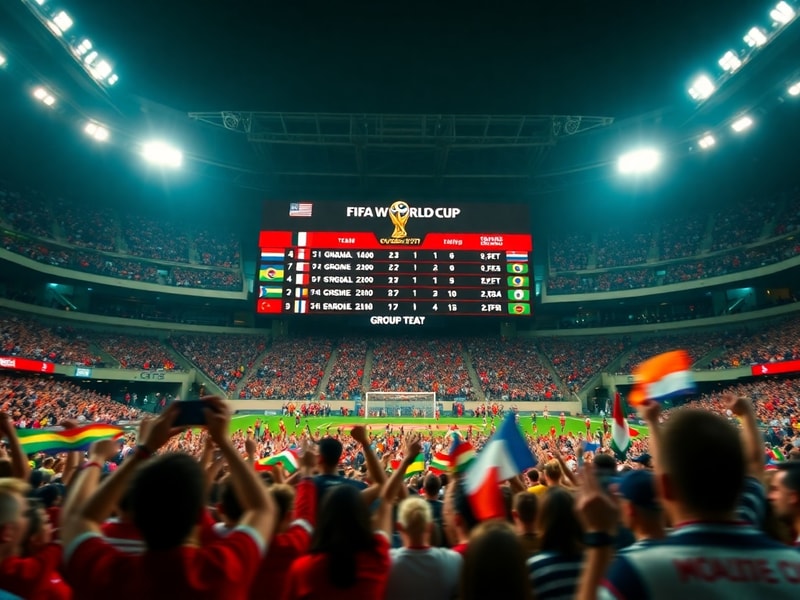
FIFA World Cup Standings: How Rankings Shape Football’s Global Story
How FIFA World Cup Standings Shape Global Football Narratives
The FIFA World Cup is more than a tournament—it’s a four-year cycle of drama, heartbreak, and triumph that reshapes football’s global hierarchy. Standings aren’t just numbers; they reflect national identity, tactical evolution, and the shifting sands of international competition. From the dominance of traditional powerhouses to the rise of underdog stories, the standings tell a story that transcends sport, influencing everything from sponsorship deals to youth development programs across continents.
The 2022 World Cup in Qatar marked another pivotal moment in the history of FIFA World Cup standings. While Argentina claimed the trophy, the real winners were the teams that defied expectations. Morocco’s historic run to the semifinals, Saudi Arabia’s shock victory over Argentina, and Japan’s tactical masterclass against Germany and Spain redefined what’s possible in football’s biggest stage. These performances didn’t just change a few rows in the standings—they altered the trajectory of football development in entire regions.
Understanding the Structure of FIFA World Cup Standings
FIFA World Cup standings are determined through a points system that prioritizes results over goal difference in the group stage. Teams earn three points for a win, one for a draw, and none for a loss. The top two teams from each group advance to the knockout rounds, where standings become binary—win and progress, lose and go home. This binary outcome intensifies the stakes, making every match a potential turning point in a nation’s footballing legacy.
The knockout stage introduces a different kind of pressure. Standings no longer matter beyond who advances; goal difference, head-to-head records, and even fair-play points can come into play in rare circumstances. This is where reputations are built or shattered. A single penalty miss or defensive error can erase years of progress in the standings, proving that in football, fortune favors neither the brave nor the favored—just the prepared.
Historically, the standings have been dominated by a handful of nations. Brazil, Germany, Italy, and Argentina have monopolized the top positions across World Cup editions. Their consistency isn’t accidental—it’s the result of deep-rooted football cultures, investment in grassroots development, and a willingness to adapt tactically. Yet, the 2010s and 2020s have seen this dominance challenged by emerging football nations, particularly in Africa and Asia, where investment in infrastructure and coaching is beginning to pay dividends.
The Cultural Impact of Standings on National Identity
Football standings at the World Cup do more than rank teams—they shape national pride. In Nigeria, a quarterfinal appearance in 1994 or Cameroon’s triumph in the 1990 Round of 16 didn’t just boost FIFA points; they became symbols of post-colonial resilience. These performances inspired generations of players and fans, proving that football could be a vehicle for national identity in a globalized world.
In South Korea, the co-hosted 2002 World Cup transformed the nation’s standing in world football. The Red Devils, as the national team is affectionately known, reached the semifinals, sparking a football revolution. Domestic leagues grew, youth academies flourished, and the national team became a source of unity. The 2022 World Cup saw South Korea nearly repeating the feat, with a thrilling round-of-16 appearance against Brazil, proving that football standings can catalyze long-term cultural and infrastructural change.
Conversely, nations like the Netherlands and Portugal have often punched above their weight in FIFA World Cup standings, only to fall short in the eyes of their own public. The Dutch, with their total football philosophy, have reached three finals without winning, creating a narrative of near-misses that defines their footballing identity. Meanwhile, Portugal’s 2016 European Championship and 2019 Nations League triumphs have shifted attention from World Cup standings to broader international success, showing how a nation can diversify its footballing ambitions.
Standings as a Barometer of Tactical Evolution
The FIFA World Cup standings are a reflection of tactical trends. The 2010 World Cup, won by Spain’s tiki-taka, saw a shift toward possession-based football. By 2014, Germany’s high-pressing system had redefined modern tactics, culminating in a dominant 7-1 win over Brazil. The 2018 and 2022 editions, however, showcased a counter-revolution, with low-block defenses and direct counterattacks proving effective against possession-heavy teams.
This tactical evolution is visible in the standings. Teams like Belgium and France, who invested heavily in youth development and tactical flexibility, have climbed the rankings over the past two decades. Meanwhile, traditional powerhouses like the Netherlands and Italy have struggled to replicate past glories, reflecting a failure to adapt to modern football’s demands.
The rise of data analytics has also influenced standings. Teams like Belgium and Croatia have leveraged data to identify undervalued players, refine set-piece strategies, and optimize training loads. This data-driven approach has allowed smaller nations to compete with traditional powerhouses, as seen in Morocco’s 2022 World Cup run, where tactical discipline and physicality overcame more technically gifted opponents.
Standings, therefore, are not just about results—they are a snapshot of football’s evolution. They reveal which nations are embracing innovation, which are clinging to tradition, and which are caught in transition.
What the Future Holds for FIFA World Cup Standings
The next decade of FIFA World Cup standings promises to be shaped by three key factors: expanded tournaments, technological advancements, and the continued rise of non-traditional football nations. The 2026 World Cup, co-hosted by the United States, Canada, and Mexico, will feature 48 teams, fundamentally altering the competitive landscape. Standings will no longer be the preserve of elite nations; new entrants from North America, Africa, and Asia will have a realistic chance of making an impact.
Technological advancements, particularly in VAR and player tracking, will also influence standings. While VAR has reduced controversial decisions, it has also introduced new layers of complexity, with offside calls and penalty decisions becoming subject to millimeter precision. This technology could shift the balance in tightly contested matches, particularly in the group stage where standings are decided by narrow margins.
Looking ahead, the following nations are poised to challenge the traditional standings hierarchy:
- Japan: With a disciplined approach to youth development and tactical innovation, Japan is well-positioned to build on its 2022 World Cup performance. The nation’s football culture, which emphasizes technical skill and teamwork, makes it a strong contender for consistent high finishes.
- Morocco: The Atlas Lions have become the flagbearers for African football, reaching the 2022 semifinals and proving that African teams can compete at the highest level. With continued investment, Morocco could become a regular fixture in the latter stages of major tournaments.
- United States: The USMNT’s 2022 World Cup performance, despite early elimination, showcased the potential of a new generation of American talent. With Major League Soccer’s growth and increased investment in youth academies, the US could soon challenge for top-8 finishes in FIFA World Cup standings.
- Australia: The Socceroos have steadily improved their FIFA World Cup standings, reaching the Round of 16 in 2022. With a growing Asian football presence and a focus on technical development, Australia is on the cusp of becoming a consistent contender in Asia.
The future of FIFA World Cup standings will also be shaped by off-field factors. Climate change, for instance, could influence hosting decisions, with hotter temperatures favoring teams accustomed to extreme conditions. Political instability, economic disparities, and even social movements will continue to impact team preparations and performances, adding another layer of complexity to the standings.
A Final Look at the Numbers and Narratives
FIFA World Cup standings are more than a leaderboard—they are a chronicle of football’s global journey. From the dominance of South American flair in the mid-20th century to the tactical revolution of European football in the 21st, the standings reflect the sport’s evolution. They are a testament to the power of football as a cultural unifier, a tool for national pride, and a driver of social change.
As the 2026 World Cup approaches, the standings will once again take center stage. New narratives will emerge, old rivalries will be renewed, and the world will watch as nations rise, fall, and redefine their place in football history. Whether it’s Morocco’s next step, Japan’s continued ascent, or a surprise debutant from Oceania or Asia, the standings will once again prove that in football, the only certainty is uncertainty.
For fans of sports and football enthusiasts, the World Cup standings are a source of endless fascination. They are a reminder that football is not just a game—it’s a global story, written one match at a time.