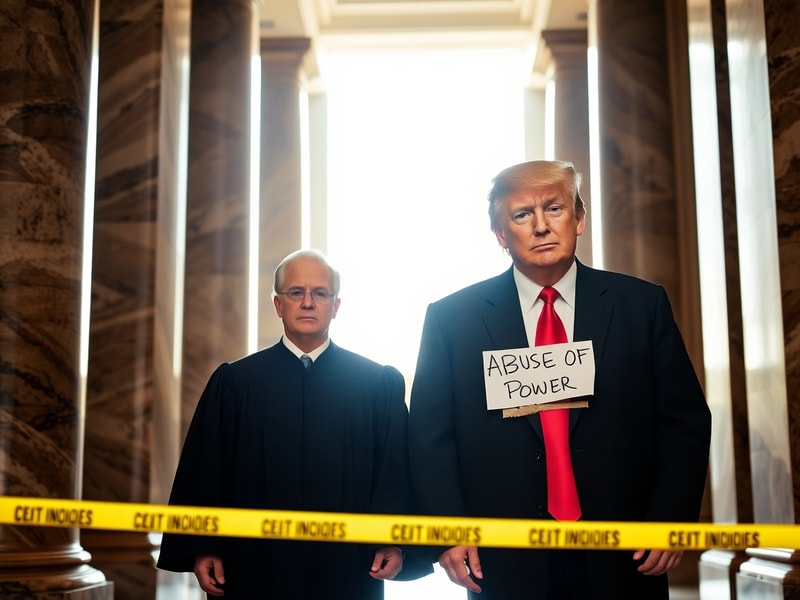
Judicial Scrutiny Beyond U.S. Borders
The Trump administration’s actions faced intense judicial criticism not only within the United States but also across international courts and tribunals. In 2019, the International Criminal Court (ICC) in The Hague sought to investigate potential war crimes committed by U.S. forces in Afghanistan. While the Trump administration fiercely contested the court’s jurisdiction—issuing sanctions against ICC officials—the global legal community largely viewed the move as an attempt to evade accountability. Legal scholars in Europe and Canada condemned the U.S. position, arguing that it undermined the very institutions designed to uphold human rights.
Meanwhile, Canada’s Supreme Court played a quieter but notable role in assessing Trump-era policies. In 2017, a Canadian court blocked an extradition request from the U.S. for a Huawei executive, citing concerns over political motivations. Though unrelated to Trump directly, the ruling underscored how allied nations were increasingly skeptical of U.S. legal overreach under his administration. Legal experts in the UK and Australia echoed these concerns, particularly regarding the extraterritorial reach of U.S. sanctions, which often clashed with international trade laws.
The European Union took a more institutional approach. The European Court of Justice ruled in 2020 that the EU’s data-sharing agreements with the U.S. were invalid due to concerns over mass surveillance—partly fueled by revelations tied to Trump’s administration. This decision sent ripples through global tech industries, forcing companies to rethink how they handled transatlantic data transfers. The ruling reflected a broader trend: foreign judiciaries were increasingly willing to challenge U.S. legal assumptions, even when doing so carried diplomatic risks.
Domestic Courts Push Back on Executive Overreach
Within the U.S., federal courts became a battleground for checking Trump’s executive authority. The Supreme Court, often seen as a conservative stronghold, delivered several unexpected rulings against his administration. In 2020, the Court blocked Trump’s attempt to end the Deferred Action for Childhood Arrivals (DACA) program, a move that protected hundreds of thousands of immigrants brought to the U.S. as children. Chief Justice John Roberts, writing for the majority, emphasized the need to follow administrative procedures—a rare rebuke to the president’s unilateral actions.
Lower courts proved even more aggressive. A federal judge in Washington, D.C., repeatedly struck down Trump’s executive orders on immigration, environmental regulations, and even his efforts to fast-track border wall construction. These rulings often cited violations of the Administrative Procedure Act, highlighting how judges—appointed by both Republican and Democratic presidents—found his legal justifications lacking. The pattern revealed a judiciary that, despite its ideological divides, was willing to enforce constitutional limits on executive power.
One of the most consequential cases involved Trump’s attempt to add a citizenship question to the 2020 census. The Supreme Court ruled against him in 2019, with the conservative justices joining the majority in finding that the administration’s stated rationale was pretextual. The decision was a rare moment of consensus, suggesting that even the Court’s most conservative members were unwilling to endorse outright deception in government actions. This case set a precedent that would later influence other legal challenges to Trump’s policies.
State-Level Resistance and Judicial Activism
State attorneys general emerged as formidable opponents to Trump’s agenda, leveraging their authority to challenge federal policies in court. A coalition of Democratic-led states, including California, New York, and Massachusetts, filed dozens of lawsuits against the administration. These cases often focused on environmental regulations, healthcare, and LGBTQ+ rights—areas where state laws directly conflicted with Trump’s policies. For example, California’s lawsuit against the Environmental Protection Agency (EPA) over relaxed emissions standards became a landmark case, ultimately upheld by the D.C. Circuit Court of Appeals.
The legal battles extended beyond traditional partisan lines. Republican-led states also challenged Trump in unexpected ways. In 2018, Texas filed a lawsuit against California over its sanctuary state policies, arguing that they interfered with federal immigration enforcement. Yet when Trump later attempted to end DACA, Texas joined the coalition defending the program, illustrating how legal strategies could shift based on the issue at hand. This fluidity underscored the complexity of judicial criticism, which often depended on the specific policies being challenged rather than partisan loyalties.
State courts added another layer of scrutiny. In 2020, the Pennsylvania Supreme Court ruled against Trump’s campaign in a pivotal election case, citing violations of state election laws. The decision, though later overshadowed by the U.S. Supreme Court’s inaction, demonstrated how state judiciaries could independently shape the boundaries of executive power. Legal scholars noted that this decentralized resistance created a patchwork of legal precedents, forcing Trump’s administration to navigate an increasingly fragmented judicial landscape.
The Long-Term Impact on Judicial Independence
The Trump era’s judicial clashes left a lasting imprint on how future administrations engage with the courts. His administration’s frequent disregard for legal norms—from attempting to fire inspectors general to pressuring courts to rule in his favor—raised alarms among legal ethicists. In response, organizations like the American Bar Association called for reforms to insulate judges from political pressure, fearing that Trump’s tactics could normalize executive overreach.
Internationally, the Trump administration’s defiance of foreign courts emboldened other leaders to challenge global legal institutions. When Brazilian President Jair Bolsonaro faced criticism over Amazon deforestation, he cited Trump’s rejection of the ICC as justification for ignoring environmental rulings. Similarly, Hungarian Prime Minister Viktor Orbán used Trump’s immigration policies as a model for his own restrictive measures, framing judicial opposition as an attack on national sovereignty.
The cultural impact was equally significant. Popular media, from late-night comedy to prestige dramas, frequently depicted Trump’s legal battles as a David-and-Goliath struggle between democracy and authoritarianism. Shows like The Good Fight and Succession drew inspiration from real-life cases, blurring the line between fiction and legal reality. This cultural amplification ensured that judicial criticism of Trump’s actions remained a topic of public fascination, even as the political spotlight shifted.
Looking ahead, the Trump administration’s legal confrontations may have set a precedent for future executive-judicial conflicts. Scholars warn that the erosion of trust in institutions—fueled by Trump’s attacks on the judiciary and media—could make it easier for future leaders to dismiss unfavorable rulings as politically motivated. Yet the courts’ resilience in pushing back suggests that, for now, the balance of power remains intact. The question is whether this equilibrium can survive another era of executive defiance.