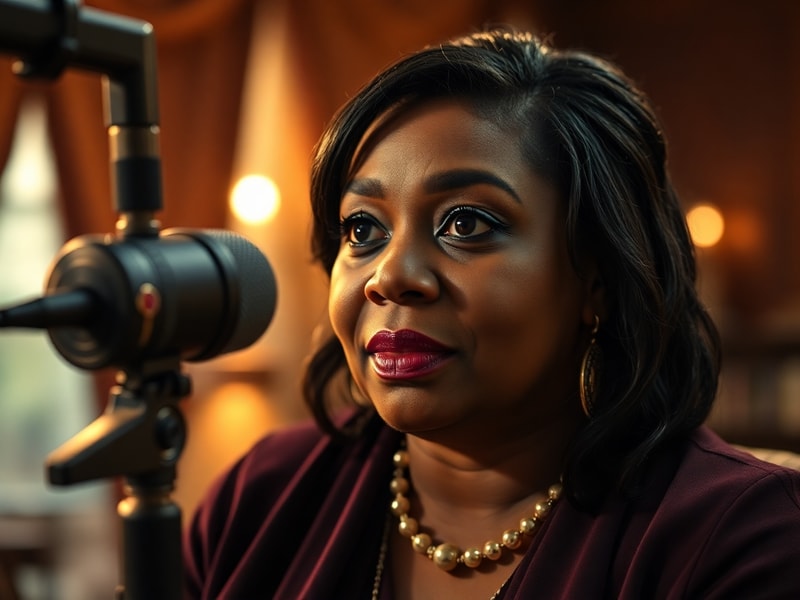
Octavia Spencer’s career is a study in quiet power and relentless authenticity. Few actors balance commercial success with critical acclaim as seamlessly as she does. From her breakout role as Minny Jackson in The Help to her Emmy-winning performance in Self Made, Spencer has carved a niche that values substance over spectacle. Her presence on screen often feels like a grounding force—whether she’s delivering sharp comedic timing or devastating emotional weight.
Early Years and the Struggle for Recognition
Born in Montgomery, Alabama, in 1970, Spencer grew up in a household shaped by hardship and resilience. Raised by a single mother alongside six siblings, she learned early the value of perseverance. Her entry into acting wasn’t immediate; she worked odd jobs—including as a phone operator and a door-to-door salesperson—before landing small TV roles in the late 1990s. Her first notable credit came in 1996 with a minor role in Coach, but her journey to prominence was far from overnight.
Spencer’s career gained traction in the 2000s through collaborations with director Tate Taylor, who cast her in several projects, including Pretty Persuasion and Rough Around the Edges. These roles showcased her ability to convey depth in limited screen time. Yet, it was her portrayal of Minny Jackson in Taylor’s 2011 adaptation of The Help that transformed her from a respected character actor into a household name. The role earned her an Academy Award nomination for Best Supporting Actress, making her the first Black actress to receive two Oscar nominations within the same year (she was also nominated for Hidden Figures).
The Business of Being Octavia Spencer
Spencer’s success extends beyond acting. She’s a producer, an author, and a vocal advocate for diversity in Hollywood. In 2014, she formed her own production company, JuVee Productions, named after her siblings Juanita and Eugene. The company’s mission is clear: to develop projects led by underrepresented voices, particularly women and people of color. Under her leadership, JuVee has produced notable works like Greenleaf and Truth Be Told, both of which explore complex narratives rarely given mainstream attention.
Her business acumen is as sharp as her acting. Spencer has negotiated roles that give her creative control, often securing first-look deals with major studios. This strategy has allowed her to choose projects aligned with her values, such as Criminal and The Shack, where she balanced commercial appeal with personal authenticity. Spencer’s approach reflects a broader trend in Hollywood, where actors are increasingly leveraging their influence to shape the industry from within.
Her financial success is equally noteworthy. According to reports, Spencer earned $1.25 million for her role in The Help, a figure that underscored her rising market value. Today, she commands mid-six-figure salaries for major studio films, a rarity for actresses over 50—and especially for Black actresses in an industry notorious for ageism and racial disparities. Spencer’s career trajectory offers a case study in how talent, strategy, and persistence can redefine industry standards.
Beyond the Screen: Activism and Influence
Spencer’s impact transcends film and television. She’s a prominent voice in discussions about representation, both in front of and behind the camera. In interviews, she frequently highlights the lack of opportunities for Black women in Hollywood, particularly in roles that extend beyond stereotypes. Her advocacy isn’t performative; it’s rooted in decades of navigating a system that often overlooks or marginalizes people like her.
In 2018, she partnered with Netflix to launch Truth Be Told, a series she produces that centers on a Black female journalist investigating a decades-old murder. The show’s success—renewed for multiple seasons—demonstrates how Spencer’s influence can greenlight stories that prioritize Black narratives without sacrificing quality or mass appeal. Her involvement in projects like this signals a shift toward more inclusive storytelling, where audiences see themselves reflected in roles that are nuanced and empowering.
Spencer is also committed to philanthropy. She supports organizations like the Boys & Girls Clubs of America and has donated to historically Black colleges and universities (HBCUs). Her philanthropic efforts reflect a belief in investing in the next generation, particularly those from underprivileged backgrounds who dream of careers in the arts. This commitment to giving back underscores her understanding of the systemic barriers that shape opportunity—and her determination to dismantle them.
Why Octavia Spencer Matters Now
Spencer’s career arrives at a pivotal moment in Hollywood’s reckoning with diversity and inclusion. While progress has been made, systemic inequities persist. Spencer’s ability to thrive in this landscape—while simultaneously advocating for change—positions her as a key figure in the industry’s evolution. Her work challenges the industry to do better, not just in casting, but in the stories it chooses to tell and the people it empowers to tell them.
Consider the broader implications of her success. Spencer’s rise coincides with the growing demand for authentic representation in media. Audiences, particularly younger generations, are increasingly rejecting one-dimensional portrayals of marginalized communities. In this context, Spencer’s career serves as a blueprint for how talent can intersect with activism to create lasting change. Her story is a reminder that representation isn’t just about visibility—it’s about power: who holds the reins, who makes the decisions, and who ultimately shapes cultural narratives.
Moreover, Spencer’s business ventures demonstrate that diversity in Hollywood isn’t just a moral imperative—it’s a smart investment. Projects led by underrepresented creators often outperform their budgets, proving that inclusivity and profitability aren’t mutually exclusive. Spencer’s ability to merge artistry with entrepreneurship offers a model for how marginalized voices can navigate and reshape an industry that has historically sidelined them.
Looking ahead, Spencer’s upcoming projects continue to reflect her commitment to diverse storytelling. She’s set to star in and produce Hustle Honey, a series based on the life of entrepreneur Lisa Price. The project, like many of her others, centers a Black woman’s journey, blending personal ambition with cultural significance. As Hollywood continues to grapple with its past failures, figures like Spencer are leading the charge toward a more equitable future.
Octavia Spencer’s career is more than a series of accolades and box-office hits. It’s a testament to the power of authenticity, strategy, and unyielding determination. In an industry often criticized for its lack of progress, Spencer stands out as a force who has redefined what it means to be a leading woman—not just in Hollywood, but in the broader cultural landscape. Her legacy isn’t just about the roles she’s played; it’s about the doors she’s opened and the ones she continues to push wide open.
- Entertainment – For more on how actors shape cultural narratives
- Trending – To stay updated on rising stars and industry shifts
As Spencer herself has said, “I’m not just an actress. I’m a woman who happens to act.” It’s a statement that encapsulates her approach to both her craft and her activism. In a world where representation is still a fight, Octavia Spencer isn’t just showing up—she’s taking the lead.