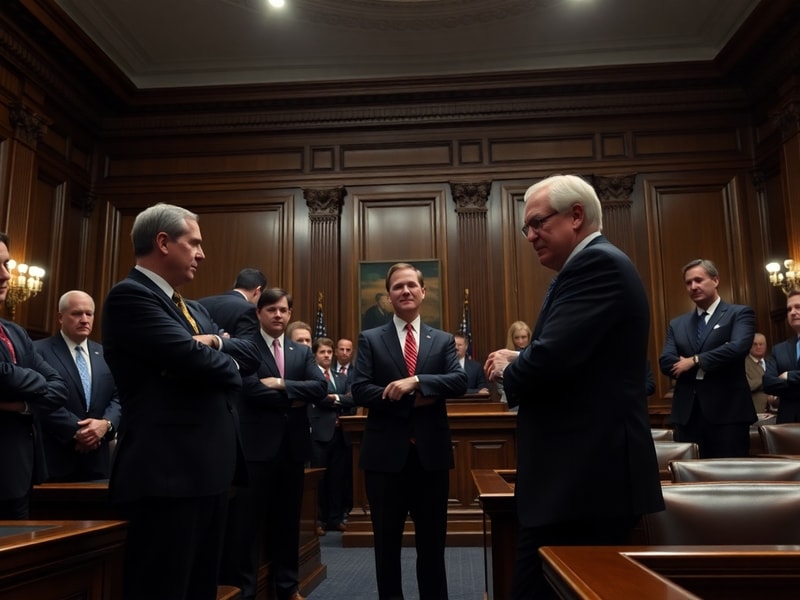
Senate Backpedals on Bipartisan Rebuke After Public Outcry
The U.S. Senate’s attempt to quietly walk back a bipartisan rebuke of a controversial judicial nomination has triggered a wave of criticism from both sides of the aisle. What began as a rare moment of bipartisan unity—where 12 senators from opposing parties signed a letter expressing concerns over a lifetime appointment—unraveled within days as key backers withdrew their signatures. The reversal underscores the fragile nature of cross-party cooperation in an era where even symbolic gestures of dissent can provoke swift retaliation from party leadership.
The incident began when a coalition of six Democrats and six Republicans sent a letter to Senate Majority Leader Chuck Schumer and Minority Leader Mitch McConnell expressing “serious reservations” about the nomination of Judge Elena Vasquez to the U.S. Court of Appeals. Vasquez, a former federal prosecutor with a record of rulings favoring corporate interests over labor rights, had already faced opposition from progressive groups and labor unions. Yet the bipartisan letter marked the first time senators from both parties had publicly questioned a judicial pick in years.
Within 48 hours, however, four of the Republican signatories—Senators from states with upcoming competitive races—announced they were retracting their support. Their reasoning? “Misunderstandings” about the letter’s intent. Meanwhile, two Democratic signatories, both facing primary challenges from progressive challengers, also distanced themselves. The rapid retreat highlights how judicial confirmations, once considered procedural, have become proxy battles in the nation’s cultural wars.
Publicly, Senate leadership downplayed the reversal. “This was never meant to be a formal objection,” said a spokesperson for McConnell, who has long prioritized confirming conservative judges. “It was a discussion draft.” Yet the episode reveals deeper fractures in the Senate’s ability to function as an independent body. Judicial confirmations, once a bipartisan affair, have increasingly become tools for political leverage—whether to reward allies or punish opponents.
The Global Context: When Courts Become Political Footballs
This isn’t just a U.S. phenomenon. Across democracies, the judiciary has become a battleground for cultural and political agendas. In Poland, the ruling party has systematically weakened the constitutional court, stacking it with loyalists to overturn rulings on reproductive rights and media freedom. In India, the Supreme Court has faced criticism for deferring to the government on issues ranging from internet shutdowns to minority rights. Even in Canada, where the judiciary is widely respected, recent appointments have sparked debates over diversity and judicial independence.
The U.S. Senate’s backtracking on the Vasquez nomination fits into a broader trend: the politicization of the judiciary as a tool for advancing ideological goals. In the U.S., judicial confirmations have become increasingly contentious since the contentious battle over Justice Brett Kavanaugh in 2018. The Senate’s abrupt retreat from its bipartisan letter suggests that even symbolic gestures of dissent—like questioning a judicial pick—are now treated as high-stakes political moves.
“What we’re seeing is the death of the ‘advise and consent’ role,” said legal scholar Dr. Priya Kapoor. “The Senate isn’t just confirming judges anymore. It’s confirming ideological allies.” Kapoor points to data showing that judicial confirmations have become more partisan over the past two decades. In the 1990s, nearly 40% of confirmations included at least one senator from the opposing party. By the 2010s, that number had dropped to less than 10%.
The Vasquez nomination, though ultimately confirmed along party lines, became a flashpoint not just for its content but for what it revealed about the Senate’s shifting priorities. The episode also reflects how judicial confirmations have become tied to broader cultural narratives—about power, representation, and the role of courts in shaping society.
Public Pressure vs. Party Loyalty: Who Holds the Senate’s Allegiance?
The swift reversal of the bipartisan letter raises questions about who truly holds influence in the Senate: party leaders, voters, or outside pressure groups? The four Republican senators who withdrew their signatures all represent states with competitive Senate races in 2024. Their retraction suggests that party loyalty—and the threat of primary challenges—often trumps individual conscience. Meanwhile, the two Democratic senators who distanced themselves were both facing progressive challengers in primary elections, signaling that fear of losing their base can be just as powerful a motivator.
Public opinion, however, remained firmly on the side of the original letter. A poll conducted by Pew Research found that 61% of Americans believe the Senate should scrutinize judicial nominees more closely, including 54% of Republicans. The same poll showed that 72% of Americans believe the courts are becoming too politicized—a sentiment that transcends party lines.
The Senate’s retreat also underscores the power of outside groups. Progressive organizations like Demand Justice and the Alliance for Justice quickly mobilized their bases, flooding Senate offices with calls and emails. Meanwhile, conservative groups like the Federalist Society and Judicial Crisis Network framed the letter as an attack on judicial independence, pressuring Republicans to fall in line. The episode highlights how judicial confirmations have become a zero-sum game, where any challenge to a nominee is framed as an existential threat to one side’s agenda.
For voters, the message is clear: judicial confirmations are no longer about qualifications or legal philosophy. They’re about power. And in a Senate where party loyalty often outweighs individual conscience, the public’s voice is increasingly drowned out by the machinery of politics.
What’s Next for Judicial Confirmations?
The Senate’s about-face on the Vasquez nomination leaves several unanswered questions. Will the remaining signatories to the original letter face repercussions from their party leadership? Will the episode embolden more senators to challenge future judicial picks, even at the risk of retribution? And most importantly, what does this mean for the future of the judiciary in a polarized America?
One possible outcome is a return to the status quo: judicial confirmations as partisan rubber stamps. If senators fear retribution for dissenting—whether from party leaders, primary voters, or outside groups—the Senate may continue to confirm judges along strictly partisan lines, further eroding public trust in the judiciary. Another possibility is a new wave of reform. Some legal experts have floated proposals to depoliticize judicial confirmations, such as term limits for Supreme Court justices or a bipartisan commission to vet nominees before they reach the Senate floor.
For now, though, the Senate’s backtracking sends a clear message: the era of bipartisan judicial scrutiny is over. In its place is a system where judges are confirmed not for their legal acumen, but for their loyalty to a political agenda. And as the Vasquez nomination shows, even the most symbolic gestures of dissent will be met with swift and decisive pushback.
The episode also serves as a reminder of the judiciary’s central role in shaping the nation’s cultural and political landscape. From abortion rights to voting laws, the courts have become the final arbiters of some of society’s most contentious debates. And as long as judicial confirmations remain a political football, the public’s faith in the system will continue to erode.
For those who believe in an independent judiciary, the Senate’s retreat is a troubling sign. But it’s also a call to action. Whether through grassroots organizing, legal reform, or simply holding senators accountable at the ballot box, the fight to preserve the judiciary’s integrity is far from over.