The History and Global Impact of Mountain Dew’s 5¢ Bundles
Few soda promotions have embedded themselves into American retail history as deeply as the Mountain Dew 5¢ bundles. Launched in 1964, the campaign didn’t just slash prices—it transformed consumer behavior, reshaped grocery aisles, and even influenced how families planned their shopping weeks. More than half a century later, the strategy echoes across global markets, proving that a simple price cut can become a cultural artifact.
How the 5¢ Promotion Began
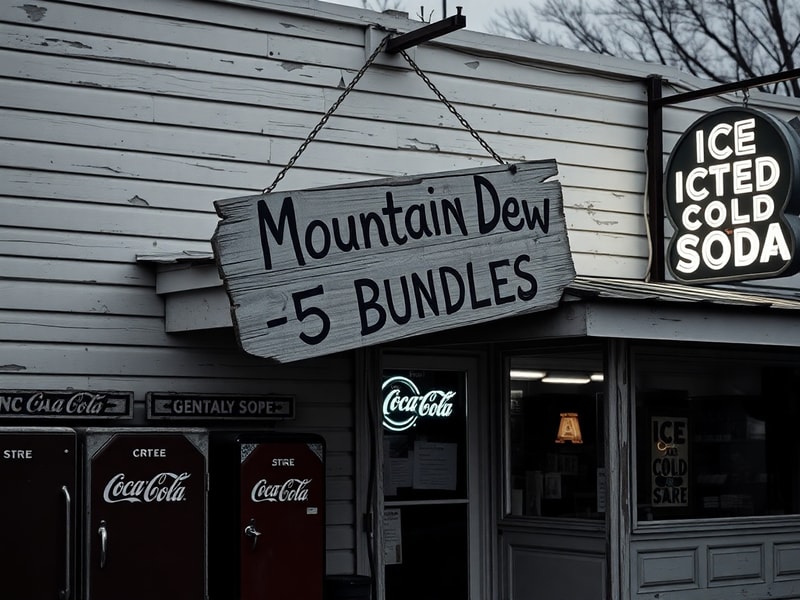
The idea originated in Marion, Virginia, at a local bottling plant owned by the Hartman Beverage Company. Faced with stagnant sales and stiff competition from Pepsi, Hartman’s team proposed a bold move: sell Mountain Dew for just five cents. Local retailers agreed. On May 1, 1964, the first 5¢ bundles hit shelves. Customers responded immediately. Lines stretched out the door. Photographs from the era show families carrying stacks of cases, their children perched on top. Within weeks, the promotion spread across the South, then the Midwest, before going national by the end of the year.
The genius wasn’t just the price—it was the psychology. Five cents was small enough to feel like pocket change, yet large enough to trigger bulk purchases. A single bottle cost more than 5¢, so buying a six-pack or case meant real savings. The campaign also aligned with Mountain Dew’s branding as a rugged, outdoor drink, reinforcing its identity as a “country soda” that thrived in informal, family-friendly settings.
A Global Echo: Where the Idea Spread
While the 5¢ bundles started in the U.S., their influence quickly crossed borders. In Canada, PepsiCo adapted the model in the 1970s, offering 24-pack deals at discounted rates during summer months. Australian retailers ran similar “fiver” promotions in the 1980s, often tied to cricket matches and beach outings. Even in parts of Asia, where soda consumption was growing, localized versions of the bundle strategy helped Mountain Dew gain traction among young consumers.
In India, for example, the brand introduced “Mega Packs” priced at 10 or 15 rupees in the early 2000s—still a fraction of the cost of individual bottles. These bundles became staples at roadside stalls and college canteens, helping Mountain Dew compete against established local brands. The pattern held: lower per-unit pricing led to higher volume, which in turn justified wider distribution.
Why the Strategy Still Works Today
The Mountain Dew 5¢ model endures because it taps into universal consumer habits. People buy in bulk when the savings feel immediate and tangible. A 2022 Nielsen study found that 68% of shoppers are more likely to purchase soda in multi-packs when the per-unit price drops by at least 10%. Mountain Dew’s early campaigns essentially weaponized that instinct, turning a grocery staple into a social event.
Even today, digital retailers like Dave’s Locker continue to feature bulk soda bundles, proving the model scales beyond brick-and-mortar stores. The bundles also serve as loss leaders—retailers absorb a small margin to drive foot traffic, which benefits other high-margin items. In some communities, the sight of a 5¢ or low-cost bundle display signals value, attracting budget-conscious shoppers who might otherwise skip the soda aisle entirely.
The Cultural Footprint: More Than Just a Drink
Beyond sales figures, the 5¢ bundles left a cultural imprint. They became a rite of passage for American teenagers in the 1960s and ’70s. Groups of friends would pool money to buy a case, split the cost, and share the haul at bonfires or sports games. The ritual reinforced community and spontaneity—qualities that aligned perfectly with Mountain Dew’s advertising, which often featured daredevils and outdoor adventures.
In rural towns, the bundles became a form of currency. A case of Mountain Dew could be traded for concert tickets, help with farm chores, or even settle small debts. Local retailers sometimes used them as rewards for loyal customers or prizes at school events. The soda wasn’t just a drink; it was a social lubricant.
Internationally, the bundles helped shape perceptions of American consumerism. In countries where individual servings were the norm, the idea of buying soda by the case felt distinctly “Western”—both aspirational and excessive. Yet, over time, the strategy proved adaptable. In Mexico, for instance, Mountain Dew bundles became popular at sports bars, where soccer fans stocked up for game day. The product’s rugged image translated well across cultures, even when the price point didn’t match the original 5¢.
The Future: Can the 5¢ Bundle Survive in a Premium World?
Today’s soda market is far more fragmented. Health-conscious consumers are cutting back on sugary drinks. Premium sparkling waters and craft sodas are gaining shelf space. Even within the soda aisle, smaller “sleek can” formats command higher prices. Yet, Mountain Dew’s parent company, PepsiCo, continues to experiment with bundle promotions—just with different numbers. Limited-time “3 for $5” deals or “buy one, get one free” offers now dominate, reflecting inflation and changing buying power.
Still, the spirit of the 5¢ bundles lives on. The strategy’s core insight—that small price changes can drive massive behavioral shifts—remains valid. In some emerging markets, where disposable income is growing but still limited, low-cost multi-packs continue to be a gateway for brand loyalty. The lesson is clear: when price becomes the story, everything else becomes secondary.
As soda aisles evolve, the Mountain Dew 5¢ bundles stand as a historical artifact—a moment when marketing, psychology, and culture collided to create something greater than the sum of its parts. Whether that moment ever fully returns is uncertain, but its legacy is undeniable. It proved that even in a world of infinite choices, sometimes all it takes is a nickel to change everything.