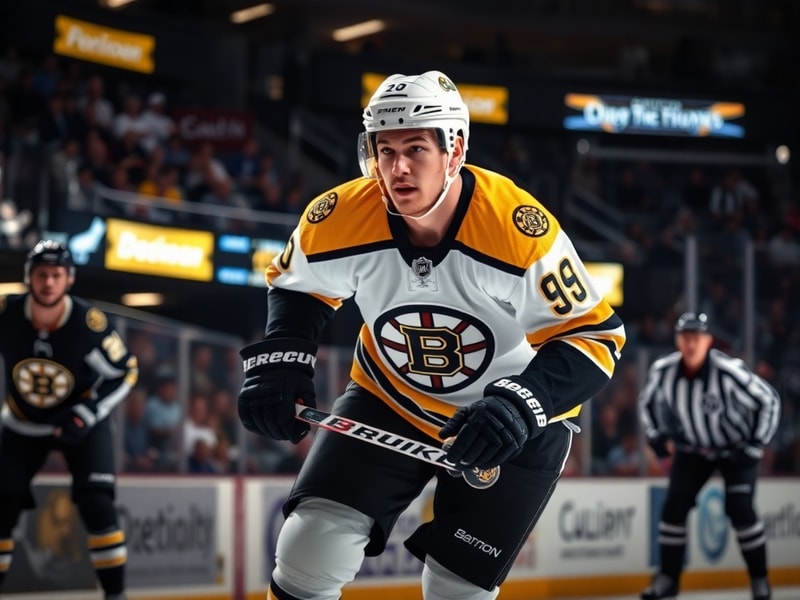
Brandon Carlo has quietly established himself as one of the NHL’s most reliable defensive anchors. Since joining the Boston Bruins in 2016, the 6-foot-6, 220-pound defenseman has evolved from a promising prospect into a cornerstone of Boston’s blue line. His physical presence, hockey IQ, and ability to suppress high-danger chances make him a rare breed in today’s fast-paced league. Carlo’s development reflects broader trends in how NHL teams build sustainable success through long-term defensive partnerships and structured systems.
The rise from draft projection to NHL cornerstone
Carlo was selected 37th overall by the Bruins in the 2015 NHL Entry Draft, a selection that at the time was viewed as a safe bet rather than a franchise-altering move. He came from a major junior program in the WHL with the Tri-City Americans, where he quickly gained attention for his shutdown capabilities and mobility despite his size. Unlike many high-end prospects who rely on offensive flash, Carlo’s game was built on positioning, gap control, and defensive reads—traits that often go underappreciated until they’re missing.
His NHL debut in 2016–17 came during a transitional period for Boston. The Bruins were shifting from a youth movement to a more balanced roster, and Carlo’s steady play allowed veterans like Zdeno Chara to mentor him while gradually expanding his role. By 2018–19, he had become a full-time NHL player, forming a shutdown pairing with Charlie McAvoy that would become one of the league’s most reliable combinations. Their chemistry wasn’t built on highlight-reel plays, but on reliability. They minimized mistakes, controlled territorial play, and limited high-danger scoring chances against top competition.
This kind of incremental growth is often overlooked in an era that celebrates flashy rookies and immediate impact. Yet Carlo’s path underscores a critical truth in modern hockey: elite defense wins championships, and it’s often constructed brick by brick, not overnight.
Defensive core of a contender: Carlo’s role in Boston’s blue-line architecture
Carlo’s contributions extend beyond individual statistics. In an analytics-driven league, his impact is best measured through advanced metrics like expected goals against (xGA) and defensive zone exit rates. Over multiple seasons, he consistently ranks among Boston’s top defensemen in limiting high-danger chances when on the ice. This is particularly notable given the Bruins’ aggressive forecheck and high-pressure system, which often demands defensemen to recover quickly and break puck possession cycles.
His partnership with McAvoy has been central to Boston’s blue-line structure. While McAvoy brings puck-moving skill and offensive creativity, Carlo provides the physical anchor and defensive reliability. Together, they form a complementary duo that allows the Bruins to deploy other offensive defensemen (like Matt Grzelich or Hampus Lindholm) in more advantageous situations. This balance is essential in a league where top teams often rely on specialized roles to optimize performance.
Here are some key elements of Carlo’s game that define his role:
- Gap control: He maintains optimal distance from forwards, preventing odd-man rushes and forcing turnovers in the neutral zone.
- Board battles: His size and strength allow him to win puck battles along the boards, a critical skill in a league that prioritizes possession retention.
- Shot suppression: Carlo rarely allows high-quality scoring chances from the slot, reducing the frequency of dangerous rebounds and second chances.
- Power-play defense: While not a primary penalty-killer, he uses his reach and positioning to disrupt passing lanes and limit shot volume.
This kind of role isn’t glamorous, but it’s indispensable. In a league where parity is increasing and salary cap constraints force teams to maximize every roster spot, Carlo represents the archetype of the modern NHL defenseman: a player whose value is measured not by goals or assists, but by the goals they prevent.
Broader implications: How Carlo reflects the changing NHL landscape
Carlo’s career trajectory intersects with two major trends reshaping the NHL: the rise of analytics and the increasing emphasis on defensive structure. As teams like Boston, Colorado, and Vegas prioritize systems-driven hockey over individual heroics, players like Carlo become more valuable. His ability to execute a structured system—whether it’s the Bruins’ aggressive forecheck or their trap-oriented defensive setup—highlights how modern hockey favors adaptability and situational awareness.
Another layer to Carlo’s significance is his durability. At 27 years old, he has already played over 500 NHL games, a rarity for defensemen who often face high injury risks due to physical play. His conditioning and recovery protocols reflect the league’s growing focus on sports science and load management, areas where Boston has invested heavily in recent years. This durability allows the Bruins to rely on him in high-leverage situations, from playoff series to international tournaments.
His role also raises questions about positional value in the NHL. As the league continues to trend toward smaller, faster players, teams are increasingly searching for traditional stay-at-home defensemen who can anchor a blue line. Carlo’s success suggests that size and defensive acumen still carry premium value, particularly in playoff hockey where low-scoring games amplify the importance of defensive reliability. This could influence how NHL teams draft and develop defensemen in the coming years, with a renewed appreciation for shutdown specialists.
Looking ahead: What’s next for Brandon Carlo?
As Carlo enters the prime of his career, the Bruins face a pivotal moment. With core players like David Pastrnak and Patrice Bergeron aging, the team is likely to undergo roster reconstruction in the next two to three years. Carlo’s contract situation adds another layer of complexity. He’s set to become an unrestricted free agent in 2026, and his next two seasons will be critical in determining whether Boston can retain him long-term or if he becomes a trade chip for a contending team.
For Carlo, the challenge will be maintaining his elite defensive metrics while adapting to a league that continues to evolve. The NHL’s crackdown on obstruction and stick infractions may reduce the physical toll on defensemen, but it could also alter the way shutdown players like Carlo operate. He’ll need to refine his mobility and puck retrieval skills to remain effective in an increasingly transitional game.
Regardless of what comes next, Carlo’s career offers a compelling case study in the value of steady, reliable defense in modern hockey. His journey from draft sleeper to NHL anchor reflects broader shifts in how teams construct success. In an era where highlight reels dominate social media feeds, Carlo’s impact is a reminder that championships are often won in the defensive zone—and sometimes, the most valuable players are the ones who don’t always make the box score.