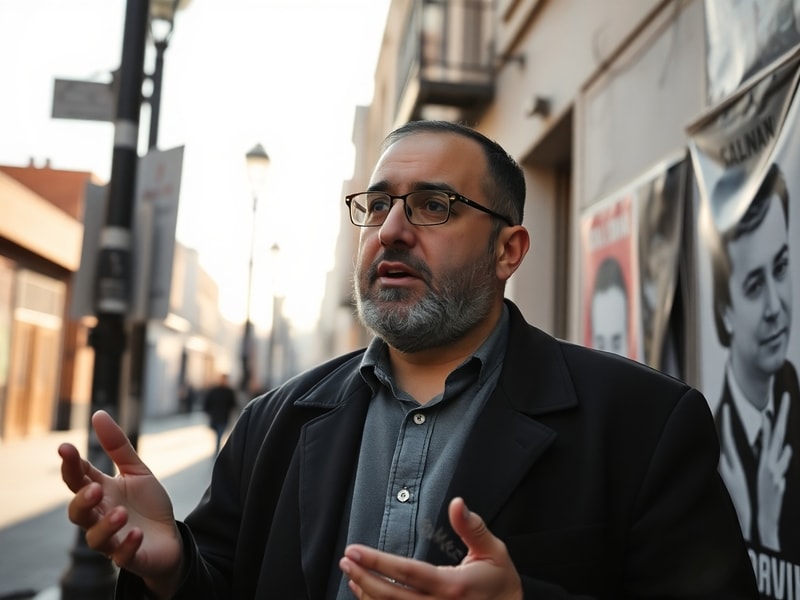
Farman Hasanov has quietly built a reputation as one of Azerbaijan’s most influential voices in contemporary art criticism and curatorial practice. Over the past decade, he has reshaped how regional and international audiences perceive Azerbaijani visual culture, blending scholarly rigor with bold public engagement. His work extends beyond traditional gallery spaces, reaching into digital platforms and public discourse, making art more accessible without compromising its depth.
From Baku to the Global Stage: Hasanov’s Early Career and Vision
Hasanov began his career in the early 2000s, a time when Azerbaijan’s art scene was still finding its footing after the collapse of the Soviet Union. Unlike many of his contemporaries who pursued careers abroad, he chose to stay in Baku, determined to nurture a local ecosystem that could dialogue with global trends. His early writing focused on the intersections between tradition and modernity in Azerbaijani art, often challenging the dominance of Soviet-influenced aesthetics still lingering in institutional practices.
By the mid-2010s, Hasanov had become a regular contributor to leading art publications and a sought-after commentator on cultural policy. His 2016 essay collection, Mirrors of Identity: Art in Post-Soviet Azerbaijan, remains a landmark text, offering a critical framework for understanding how Azerbaijani artists navigate identity, memory, and nationhood. The book was praised for its refusal to simplify complex narratives, instead presenting art as a living archive of unresolved tensions.
Key Contributions to Azerbaijani Art Criticism
Hasanov’s influence can be seen across several domains:
- Reclaiming Narrative Authority: He repositioned Azerbaijani art criticism from the periphery to the center of international art discourse, ensuring local voices were not sidelined in favor of Western curators or critics.
- Bridging Art and Technology: Hasanov was among the first in the region to explore digital art’s role in cultural identity, curating exhibitions that merged traditional media with virtual reality and AI-generated works.
- Policy and Advocacy: He played a pivotal role in shaping Azerbaijan’s cultural policy frameworks, particularly in advocating for increased funding and institutional support for emerging artists.
- Public Engagement: Through podcasts, public lectures, and social media, Hasanov demystified contemporary art for non-specialist audiences, fostering a more inclusive cultural dialogue.
The Digital Turn: Hasanov’s Role in the Online Art Ecosystem
The rise of social media in the 2010s presented both an opportunity and a challenge for Hasanov. While digital platforms democratized access to art, they also risked reducing complex works to soundbites and viral moments. Hasanov navigated this landscape by leveraging platforms like Instagram and YouTube not as replacements for critical thought, but as extensions of it. His Art & Echo video series, for instance, breaks down exhibitions and trends in under five minutes, yet never sacrifices depth for brevity.
This approach has had broader implications. By making art criticism visually engaging and platform-native, Hasanov has inspired a new generation of Azerbaijani critics to adopt multimedia storytelling. His influence is visible in the growing number of regional art influencers who blend curation with commentary, creating a hybrid model that blurs the line between academic writing and viral content.
Yet Hasanov remains cautious about the pitfalls of digital engagement. In a 2022 interview, he warned that “the algorithm rewards speed over substance,” urging artists and critics to resist the pressure to produce content for clicks rather than meaning. This tension—between accessibility and integrity—lies at the heart of his digital strategy.
Broader Implications: Art Criticism in the 21st Century
Hasanov’s career reflects a broader shift in global art criticism: the movement from gatekeeping to gate-opening. Traditional art criticism, once the domain of elite institutions and tenure-track academics, is increasingly democratized by digital platforms and independent voices. Hasanov embodies this shift, using his platform to amplify marginalized artists and challenge canonical narratives without abandoning rigor.
His work also highlights the geopolitical dimensions of art criticism. As Azerbaijan’s cultural presence grows on the global stage—through biennales, art fairs, and collaborations—critics like Hasanov play a crucial role in shaping how the country is perceived. His criticism often interrogates the politics of representation, questioning who gets to decide what constitutes “Azerbaijani art” and for whom it is intended.
Moreover, Hasanov’s engagement with digital art and new media reflects a wider trend in contemporary curation. As physical and virtual spaces converge, critics must develop fluency in digital aesthetics and audience behavior. Hasanov’s ability to straddle both worlds positions him as a key thinker in this evolving landscape.
Challenges and Criticisms
Of course, Hasanov’s approach has not been without controversy. Some traditionalists argue that his public-facing style risks oversimplifying complex artistic concepts. Others critique his occasional forays into advocacy as blurring the line between criticism and activism. Hasanov has responded by emphasizing transparency: he acknowledges when his writing serves a broader agenda, whether cultural or political, but insists on maintaining intellectual honesty.
Another challenge is the sustainability of such models. As cultural institutions face funding cuts and the attention economy intensifies, critics increasingly rely on personal brands rather than institutional support. Hasanov’s success suggests a path forward—but one that demands constant adaptation and, crucially, a willingness to engage with audiences beyond the usual art-world circles.
Looking Ahead: Hasanov’s Ongoing Influence
As Azerbaijan prepares to host major cultural events in the coming years, Hasanov’s role as a cultural interlocutor will only grow in importance. His recent appointment to the board of the Baku Art Week signals a new phase in his career: one that blends curation, criticism, and cultural diplomacy.
Looking further ahead, Hasanov’s legacy may lie in his ability to redefine what it means to be an art critic in the 21st century—not just as an interpreter of art, but as a facilitator of cultural exchange. In an era where art is increasingly commodified and reduced to spectacle, his insistence on complexity and context feels both radical and necessary.
For younger artists and critics in Azerbaijan and beyond, Hasanov offers a model of engaged, accessible, and uncompromising practice. His career demonstrates that criticism can be both intellectually rigorous and publicly resonant—a balance that remains elusive yet increasingly vital.
As digital platforms evolve and geopolitical tensions reshape cultural narratives, figures like Farman Hasanov remind us that art criticism is not a passive act of description, but an active force in shaping how we see the world—and ourselves within it.