What the Strawberry Moon Reveals About Nature’s Rhythms
The June full moon, known as the Strawberry Moon, arrives each year as a luminous marker of seasonal change. Unlike its honeyed name suggests, the moon does not turn the color of berries. Instead, its title comes from the Algonquin tribes of North America, who associated the full moon with the short window to harvest strawberries. This celestial event, occurring in late spring or early summer, signals a moment of transition—when days stretch longer and the earth awakens fully to warmth.
This year’s Strawberry Moon reaches peak illumination on June 21, coinciding with the summer solstice in the Northern Hemisphere. It’s a rare alignment that hasn’t occurred since 1985 and won’t repeat until 2062. The convergence amplifies the moon’s presence, making it appear larger and brighter against the already extended daylight. Astronomers call this phenomenon a “supermoon,” where the moon’s orbit brings it slightly closer to Earth, enhancing its visual impact.
Astronomers measure the moon’s distance at about 222,000 miles during this phase, compared to its average 238,000 miles. While casual observers might not notice the difference, the Strawberry Moon often appears up to 14% larger and 30% brighter than a typical full moon. This optical illusion, combined with atmospheric conditions during early summer, creates a spectacle that has inspired cultures, guided agricultural cycles, and even influenced folklore for centuries.
The Science Behind the Name: From Algonquin Roots to Modern Skywatching
The term “Strawberry Moon” was first recorded in the Old Farmer’s Almanac, which compiled Native American moon names to preserve cultural knowledge. These names reflect practical relationships with the environment: April’s Pink Moon marked the blooming of wild ground phlox, May’s Flower Moon celebrated the return of blossoms, and June’s Strawberry Moon honored the ripening of one of the season’s first fruits. Other cultures assigned different meanings—the Europeans called it the Rose Moon, while some Asian traditions viewed it as the Lotus Moon.
Science offers a different lens. The June full moon typically rises low in the sky during the summer solstice, creating an optical effect known as the “moon illusion.” When the moon is near the horizon, our brains compare it to objects like trees or buildings, making it seem disproportionately large. This phenomenon is purely perceptual—photographs taken at the same time show the moon remains the same size. Yet the illusion persists, reminding us how human perception shapes our experience of nature.
For astronomers, the Strawberry Moon is more than a visual treat. It offers an opportunity to study the moon’s libration—the slight wobble in its orbit that allows us to see slightly more of its surface over time. Amateur stargazers can use this event to practice lunar photography, capturing details of craters and maria that are often washed out by brighter moonlight. The moon’s position also affects tides, creating slightly higher “spring tides” during full and new moons. These gravitational interactions remind us of the delicate balance between Earth and its satellite.
Cultural and Symbolic Meaning: More Than Just a Pretty Moon
The Strawberry Moon holds deep symbolic weight across indigenous traditions. For the Ojibwe people, the moon marked the beginning of the “Strawberry Moon Ceremony,” a time to give thanks for the earth’s bounty and share stories under the night sky. The moon was seen as a protector, guiding plants, animals, and people through the growing season. In some traditions, the moon’s light was believed to purify intentions, making it a powerful time for reflection and renewal.
In modern times, the Strawberry Moon has taken on new meanings. It appears in social media feeds as a backdrop for summer solstice festivals, yoga retreats, and even music festivals. The juxtaposition of ancient tradition and contemporary culture highlights how celestial events continue to shape human behavior. While some dismiss such gatherings as mere aesthetic trends, they reflect a deeper human need to connect with cycles larger than ourselves—whether through meditation, art, or communal celebration.
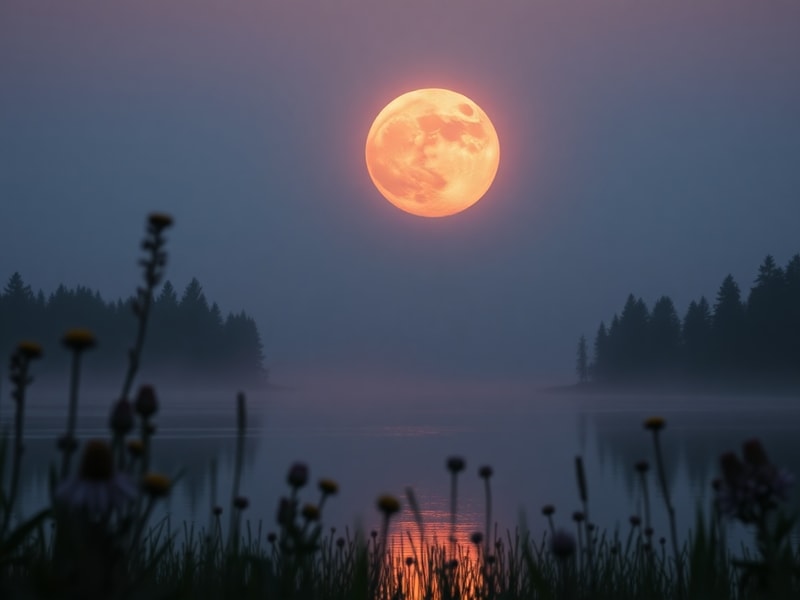
Even in literature and film, the Strawberry Moon serves as a metaphor for fleeting moments of beauty. Poets describe it as a “silver lantern” hanging over the horizon, while photographers chase its glow over landscapes like lakes or forests. These artistic interpretations reveal how the moon transcends its scientific identity, becoming a vessel for emotion and imagination. The Strawberry Moon, in particular, evokes nostalgia for childhood summers, the promise of harvest, and the quiet magic of long daylight hours.
How to Experience the Strawberry Moon This Year
To witness the Strawberry Moon at its peak, look southeast just after sunset on June 21. The moon will rise fully illuminated and remain visible all night. For the best viewing experience, find an open space away from city lights—parks, beaches, or rural areas offer ideal conditions. Bring a blanket or reclining chair, and allow your eyes 20 minutes to adjust to the darkness. If clouds obscure the view, the moon will still appear bright and round the night before and after.
A pair of binoculars or a small telescope can enhance the experience, revealing lunar maria—the dark plains formed by ancient volcanic activity—and the bright rays of craters like Tycho. For those who prefer to stay indoors, several astronomy apps like Stellarium or SkyView offer real-time tracking and augmented reality features to identify lunar landmarks. NASA’s website also provides live streams for viewers in regions with poor weather.
Photographers can experiment with long-exposure shots to capture the moon’s glow against a landscape. A tripod and a camera with manual settings are recommended. Start with an ISO of 100-400, a shutter speed of 1/125 or faster, and a wide aperture (f/2.8–f/5.6) to avoid overexposure. For a creative twist, try framing the moon behind a local landmark like a lighthouse, tree, or historic building. These compositions turn a simple photograph into a story.
If you miss this year’s Strawberry Moon, mark your calendar for next year’s occurrence on June 10, 2025. While it won’t align with the solstice again until 2062, each summer brings its own version of this luminous event. Whether you view it as a scientific curiosity, a cultural touchstone, or a moment of personal reflection, the Strawberry Moon reminds us that even in our fast-paced world, nature continues to offer rhythms worth pausing for.
Quick Tips for Strawberry Moon Viewing
- Timing: Look southeast at sunset on June 21 for the most dramatic rise.
- Location: Choose a dark spot away from artificial lights for optimal visibility.
- Equipment: Binoculars or a camera with manual settings can enhance details.
- Weather: Check forecasts; even partial cloud cover can obscure the view.
- Share the moment: Invite friends or family to join you—celestial events are better with others.
The Strawberry Moon is more than a seasonal marker—it’s a bridge between science and symbolism, tradition and modernity. As it hangs low in the summer sky, it invites us to slow down, look up, and reconnect with the natural world. In an age of constant connectivity, moments like these are rare treasures worth savoring.