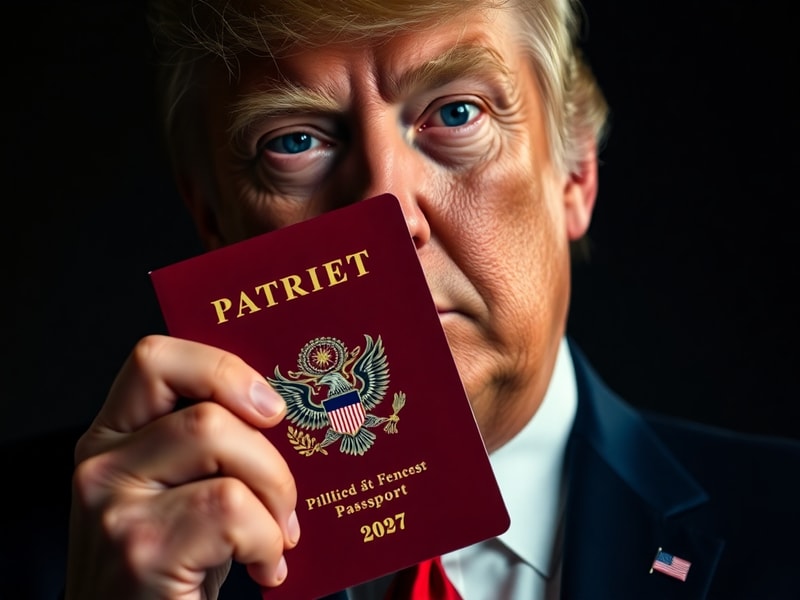
The Trump Patriot Passport design has become one of the most debated political merchandise items of recent years. What began as a niche product for staunch supporters has evolved into a symbol of broader cultural and political divides. The passport, often marketed as a “real” document for patriotic Americans, blends parody with provocative messaging. Its design and distribution reflect deeper tensions about national identity, free speech, and political expression in the digital age.
The Rise of Political Parody Merchandise
Political parody merchandise is not new, but the Trump Patriot Passport stands out due to its deliberate mimicry of official government documents. Created by private vendors, these passports mimic the format of real travel documents, complete with a red cover, eagle emblem, and faux stamps. They typically include slogans like “United States of America” and “Patriot Passport” in bold lettering. The design intentionally blurs the line between satire and sincerity, appealing to consumers who want to express their political views through unconventional means.
Sales of these passports surged during election cycles and major political events. Vendors leverage social media platforms to market the product, often targeting audiences who feel disenfranchised or frustrated with mainstream institutions. The passport serves as both a novelty item and a statement—a way to reclaim agency in a political landscape that many perceive as increasingly hostile or unresponsive.
Critics argue that such merchandise trivializes government documents and undermines public trust in institutions. Supporters, however, view it as harmless satire or even a form of protest against what they see as an overreaching state. The debate highlights how political merchandise has become a battleground for cultural narratives, where even inanimate objects carry symbolic weight.
A Global Perspective on Political Symbolism
The Trump Patriot Passport resonates beyond U.S. borders, reflecting a global trend where political merchandise transcends national boundaries. Similar parody passports and identity documents have emerged in other countries, often tied to movements that challenge traditional power structures. For instance, in Europe, nationalist groups have sold satirical “citizenship” documents to rally supporters around anti-immigration or Eurosceptic causes.
This phenomenon underscores a broader shift in how political movements communicate. In an era of digital connectivity, symbols and slogans can spread rapidly, often bypassing traditional media gatekeepers. The passport, with its familiar format, becomes a portable billboard—a way to carry a political message into everyday spaces like airports, cafes, or public transit.
Yet, the global appeal of such merchandise also raises questions about cultural relativism. What resonates as patriotic humor in one country may be perceived as offensive or inflammatory in another. The Trump Patriot Passport, for example, has been embraced by some as a celebration of American exceptionalism, while others see it as a divisive symbol of exclusion. This duality speaks to the complex role of humor in politics—a tool that can both unite and polarize.
Cultural and Legal Implications
The design and distribution of the Trump Patriot Passport have sparked discussions about the boundaries of political expression. While parody is protected under free speech laws in many jurisdictions, the line between satire and fraud can become blurred. Some vendors have faced legal challenges for selling items that resemble official documents too closely, raising concerns about potential misuse.
For instance, there have been anecdotal reports of individuals attempting to use these passports as identification during travel, only to be denied boarding or questioned by authorities. Such incidents highlight the risks of creating merchandise that mimics government-issued documents. Even if the intent is humorous, the consequences can be serious—both legally and reputationally—for both sellers and buyers.
Beyond legal concerns, the passport also reflects broader cultural anxieties about authenticity and authority. In a world where trust in institutions is declining, many people seek alternative ways to assert their identity and values. The passport becomes a tangible artifact of this search—a document that claims legitimacy without the oversight of a state. This phenomenon is not unique to the United States; similar trends can be observed in movements that reject traditional citizenship in favor of self-declared sovereignty.
The Trump Patriot Passport is more than a novelty item; it is a cultural artifact that encapsulates the tensions of our time. Whether viewed as a bold statement of political defiance or a tasteless provocation, its existence forces us to confront questions about the role of humor, power, and identity in modern society. As political divisions deepen, such merchandise will likely continue to evolve, adapting to new contexts and audiences.
For those interested in the intersection of politics and culture, the Trump Patriot Passport offers a case study in how symbols shape public discourse. It challenges us to consider not just what we believe, but how we choose to express those beliefs—even in the most unexpected of forms.
Where to Find Political Memorabilia
If you’re intrigued by the world of political merchandise, there are several places to explore beyond the Trump Patriot Passport. Many independent artists and vendors create satirical or protest-themed items that capture the spirit of contemporary movements. These range from T-shirts and posters to more unconventional pieces like custom pins or even DIY kits for crafting your own political documents.
For a curated selection of politically themed merchandise, consider visiting dedicated online marketplaces or specialty stores. Websites like Dave’s Locker News often feature collections that blend humor with activism, offering a unique way to engage with current events. Whether you’re a collector, a supporter, or simply a curious observer, these items provide a tangible connection to the cultural conversations of our time.
As with any form of expression, the key is to approach political merchandise with a critical eye. Ask yourself: What message is this item sending? Who is the intended audience? And how does it fit into the broader landscape of political discourse? The answers may surprise you—and they might just change the way you see the world around you.