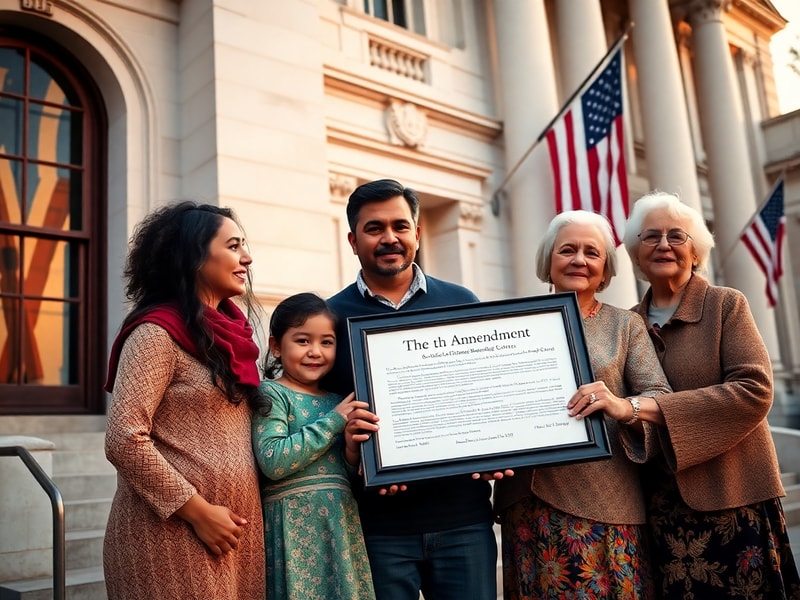
The Legal Foundation of Birthright Citizenship in the U.S.
The principle of birthright citizenship in the United States is enshrined in the Constitution and has shaped the nation’s identity for over 150 years. This concept guarantees citizenship to anyone born on U.S. soil, regardless of their parents’ immigration status. The legal foundation traces back to the Fourteenth Amendment, ratified in 1868, which states: “All persons born or naturalized in the United States, and subject to the jurisdiction thereof, are citizens of the United States and of the state wherein they reside.”
The amendment was a direct response to the Dred Scott decision of 1857, which had denied citizenship to Black Americans. Its framers, including Senator John Conness of California and Representative John Bingham of Ohio, intended to ensure equal protection under the law for formerly enslaved people and their descendants. Over time, the Supreme Court has repeatedly upheld this interpretation, most notably in United States v. Wong Kim Ark (1898), which ruled that the children of Chinese immigrants—even those ineligible for naturalization at the time—were citizens by birth.
The Original Intent Behind the 14th Amendment
Understanding the intent of the Fourteenth Amendment requires looking beyond modern political debates. The framers were primarily concerned with ending racial discrimination in citizenship, not immigration policy. Senator Jacob Howard, a key figure in drafting the amendment, explicitly stated during debates that it applied to “every person born within the United States,” including children of noncitizens. He emphasized that the phrase “subject to the jurisdiction thereof” excluded only children of foreign diplomats or hostile occupying forces—groups not subject to U.S. laws.
This interpretation was not without controversy even in the 19th century. Some lawmakers feared that birthright citizenship could lead to an influx of immigrants whose loyalties lay elsewhere. Yet the Supreme Court’s ruling in Wong Kim Ark settled the issue for over a century, reinforcing that birthright citizenship was a non-negotiable pillar of American law. The decision made clear that the Fourteenth Amendment applied to all children born on U.S. soil, regardless of their parents’ legal status.
Legal Challenges and Political Debates
Despite its long-standing legal precedent, birthright citizenship has faced persistent challenges in recent decades. Politicians and legal scholars have periodically questioned whether the Constitution requires automatic citizenship at birth, particularly as immigration has become a polarizing issue. In 2015, then-candidate Donald Trump suggested ending birthright citizenship through executive action, arguing it encouraged illegal immigration. More recently, some lawmakers have proposed the Birthright Citizenship Act of 2023, which seeks to redefine “subject to the jurisdiction thereof” to exclude children of undocumented immigrants.
The most significant legal challenge came in 2020, when the Trump administration attempted to reinterpret the Fourteenth Amendment via regulation. The Department of Homeland Security proposed a rule that would have denied citizenship to children of undocumented parents. However, the policy was blocked by federal courts, which reaffirmed that the Constitution’s plain language protected birthright citizenship. Legal experts overwhelmingly agreed that such a reinterpretation would require a constitutional amendment—a near-impossible hurdle given the need for two-thirds approval in both houses of Congress and ratification by three-fourths of states.
Key Legal Precedents Upholding Birthright Citizenship
Several landmark cases have solidified the legal foundation of birthright citizenship:
- Dred Scott v. Sandford (1857) – Initially denied citizenship to Black Americans, but overturned by the Fourteenth Amendment.
- United States v. Wong Kim Ark (1898) – Confirmed that children of noncitizens, including those ineligible for naturalization, are citizens by birth.
- Plyler v. Doe (1982) – Ruled that states cannot deny public education to undocumented children, reinforcing the principle of equal protection under the Fourteenth Amendment.
- Flores v. Lynch (2016) – Extended protections to unaccompanied minors, including those without legal status, under the same constitutional framework.
These rulings collectively demonstrate that the Supreme Court has consistently interpreted the Fourteenth Amendment as guaranteeing birthright citizenship, regardless of parental immigration status. Any attempt to alter this interpretation would require a fundamental shift in constitutional law—a shift that legal scholars widely regard as unlikely without a constitutional amendment.
Broader Implications of Birthright Citizenship
The debate over birthright citizenship extends far beyond legal technicalities. It touches on fundamental questions about national identity, immigration policy, and the role of government in shaping who belongs. Supporters of birthright citizenship argue that it aligns with America’s tradition as a nation of immigrants, where citizenship is a birthright rather than a privilege tied to ancestry or wealth. They point to the economic contributions of immigrant families and the ethical imperative of treating all children equally under the law.
Critics, however, contend that birthright citizenship creates perverse incentives for illegal immigration. Some argue that it encourages parents to enter the U.S. illegally with the expectation that their children will automatically gain citizenship. This perspective often cites studies showing that undocumented immigrants are more likely to settle in states with birthright citizenship, potentially straining local resources. Opponents also highlight cases where children of foreign diplomats or tourists—who may never reside in the U.S. long-term—automatically receive citizenship, raising questions about whether such outcomes align with the original intent of the Fourteenth Amendment.
The Economic and Social Impact
The economic implications of birthright citizenship are complex and often misunderstood. Studies by the National Academy of Sciences and the Cato Institute suggest that children born to undocumented immigrants tend to have lower educational attainment and higher rates of poverty in early life. However, their long-term economic contributions often outweigh initial costs. A 2020 study by the National Bureau of Economic Research found that second-generation immigrants (including those with birthright citizenship) contribute significantly more in taxes over their lifetimes than they receive in benefits, particularly as they enter the workforce and start families.
Socially, birthright citizenship reinforces the idea that America is a nation of opportunity, where legal status does not determine one’s potential. This principle has been central to the country’s self-image, even as debates over immigration have intensified. However, the policy also creates tensions in communities where undocumented immigrants live alongside citizens, often in legal gray areas. For example, parents may work illegally while their children are citizens, leading to family separations in deportation cases—a contradiction that critics argue undermines the integrity of the law.
The Future of Birthright Citizenship in America
Despite repeated attempts to challenge it, birthright citizenship remains a cornerstone of U.S. law. The Supreme Court has shown little appetite for revisiting the issue, and public opinion remains divided but largely supportive of the status quo. Polls from the Pew Research Center indicate that about 60% of Americans oppose ending birthright citizenship, while support is higher among younger generations. This suggests that, for now, the policy is more likely to endure than to change.
However, the debate is far from settled. Political movements on both sides continue to push for reform, whether through legislative action, executive orders, or long-term constitutional amendments. Some states have explored ways to circumvent birthright citizenship by denying benefits to children of undocumented immigrants, though such measures have consistently been struck down by federal courts. The most plausible path to change would require a constitutional amendment, which would demand an unprecedented level of bipartisan consensus—a prospect that seems remote in today’s polarized political climate.
What Would Ending Birthright Citizenship Look Like?
If birthright citizenship were to end, the process would likely unfold in one of three ways:
- Constitutional Amendment – Requires two-thirds approval in both the House and Senate, followed by ratification by three-fourths of state legislatures. This is considered highly unlikely due to the difficulty of achieving such broad consensus.
- Supreme Court Reversal – The Court could reinterpret the Fourteenth Amendment, though this would require overturning long-standing precedent, which is rare without a clear shift in constitutional understanding.
- Executive Action – A president could attempt to reinterpret the amendment via regulation, as the Trump administration tried in 2020. However, such efforts would face immediate legal challenges and likely be struck down by the courts.
Given these obstacles, most legal experts believe birthright citizenship will remain intact for the foreseeable future. Yet the debate itself reveals deeper tensions about America’s identity: Is the country a nation of laws, where citizenship is earned, or a nation of ideals, where birth alone confers belonging? The answer may depend as much on cultural shifts as on legal ones.
The conversation around birthright citizenship is ultimately a reflection of broader anxieties about immigration, national security, and the future of American democracy. While the legal framework remains stable, the political and social battles over who deserves to be an American are far from over. For now, the Fourteenth Amendment stands as a testament to the nation’s founding ideals—even as those ideals continue to be tested.
For further reading on related topics, explore our Politics and News categories, where we analyze the intersection of law, policy, and public discourse in real time.