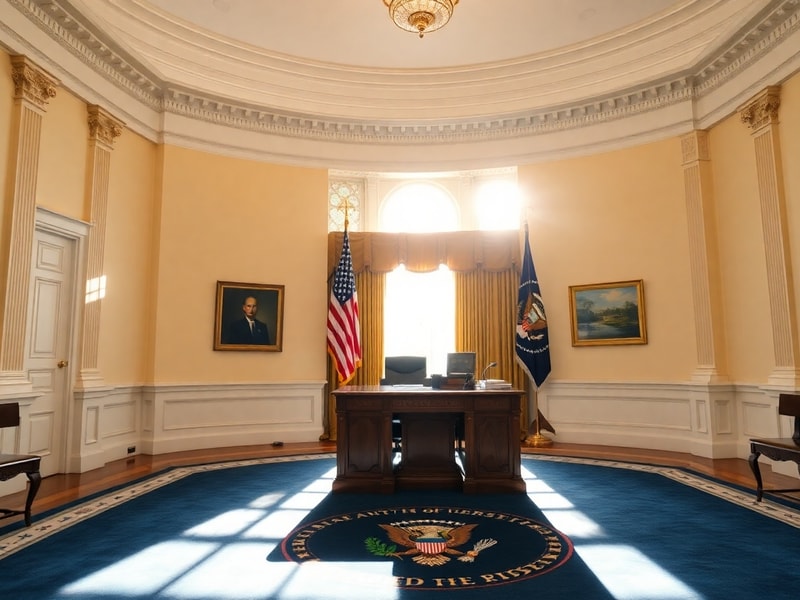
The Oval Office stands as one of the most recognizable and symbolic spaces in global politics. Located in the West Wing of the White House, it serves as the primary workspace for the President of the United States. Its distinctive oval shape, designed to facilitate conversation, has witnessed pivotal moments in American history. From policy decisions to televised addresses, the office carries immense weight as a stage for leadership.
The room’s origins trace back to 1909, when President William Howard Taft expanded the White House and commissioned the first Oval Office. Taft, who favored round tables for discussions, saw the oval design as a practical solution to create better seating arrangements. Over the decades, the office has been rebuilt, relocated, and redesigned multiple times, reflecting the evolving needs and styles of each administration. Despite these changes, its core purpose remains unchanged: to serve as the nerve center of the executive branch.
The Design and Symbolism of the Oval Office
The Oval Office’s architecture and decor are far from arbitrary. Every piece of furniture, artwork, and color scheme is carefully chosen to convey messages—both overt and subtle. The office typically features a Resolute Desk, originally crafted from timber salvaged from HMS Resolute, a British ship abandoned in the Arctic and later returned to Queen Victoria. This desk has been used by nearly every president since Rutherford B. Hayes, symbolizing continuity and resilience.
Beyond furniture, the office’s decor often reflects the president’s priorities. For example, Ronald Reagan incorporated Western art and furniture to emphasize his roots, while Barack Obama displayed busts of Martin Luther King Jr. and Rosa Parks to underscore his commitment to civil rights. The color scheme also matters: blue, used by presidents like John F. Kennedy and Joe Biden, evokes calm and stability, while warmer tones, favored by George W. Bush, project energy and decisiveness.
Even the rug at the center of the room carries meaning. A new rug is often designed for each administration, featuring the president’s name, the words “The White House,” and sometimes subtle motifs reflecting their agenda. These details transform the Oval Office from a mere workspace into a carefully curated symbol of authority and vision.
Moments That Defined the Oval Office
Few rooms have hosted as many historic moments as the Oval Office. On December 8, 1941, Franklin D. Roosevelt addressed the nation from this room following the attack on Pearl Harbor, declaring December 7 a “date which will live in infamy.” His words galvanized a nation and set the course for America’s entry into World War II. Decades later, Lyndon B. Johnson signed the Civil Rights Act of 1964 in the Oval Office, a landmark moment in the nation’s struggle for equality.
Television has amplified the Oval Office’s impact. John F. Kennedy’s calm demeanor during the Cuban Missile Crisis, broadcast from this room, reassured a frightened public. Similarly, Richard Nixon’s 1971 address announcing his plan to visit China marked a turning point in Cold War diplomacy. More recently, Donald Trump’s 2020 announcement of the Abraham Accords normalization between Israel and several Arab states was made from the Oval Office, signaling a shift in Middle Eastern geopolitics.
These moments highlight the Oval Office’s dual role: a place of governance and a stage for history. The room’s walls have absorbed urgent phone calls, tense negotiations, and moments of triumph, making it a living archive of American leadership.
The Evolving Role of the Oval Office in Modern Politics
In the digital age, the Oval Office has adapted to new forms of communication. While its physical presence remains unchanged, its symbolic reach has expanded globally through live broadcasts and social media. Presidents now use the office to deliver rapid responses to crises, host virtual summits, and even conduct interviews with international journalists—all without leaving the room.
Yet, the office’s traditional functions endure. It remains the site of high-stakes meetings with foreign leaders, such as the 2015 Iran nuclear deal negotiations under Barack Obama. It also serves as a backdrop for ceremonial events, from pardoning turkeys at Thanksgiving to signing bipartisan legislation into law. These rituals reinforce the office’s role as a bridge between the presidency and the American people.
The Oval Office has also become a stage for personal branding. Presidents often use its backdrop to project strength, empathy, or resolve. For instance, George W. Bush’s bullhorn speech atop the rubble of Ground Zero in 2001 was framed by the Oval Office’s windows, symbolizing leadership in crisis. Meanwhile, Joe Biden’s recent addresses on climate change and economic recovery have leveraged the room’s solemnity to underscore gravity.
Controversies and Criticisms
Despite its iconic status, the Oval Office is not without controversy. Some critics argue that its grandeur can foster an aura of untouchability around the presidency, distancing leaders from the public they serve. Others point to its role in enabling imperial presidencies, where power becomes concentrated in a single office rather than shared across institutions.
Physical security has also been a recurring concern. The office’s windows and doors are reinforced with bulletproof glass, and access is tightly controlled. Yet, breaches have occurred, most notably in 2014 when an armed intruder scaled a fence and entered the White House before being apprehended. These incidents highlight the vulnerabilities of even the most secure spaces.
Additionally, the office’s design has faced criticism for being impractical. Its oval shape limits wall space for bookshelves and displays, and its size—approximately 3,000 square feet—can feel cramped for modern administrations. Some presidents have opted to work from other areas of the White House when additional space or privacy is needed.
Presidential Personalities and the Oval Office
Every president leaves a unique imprint on the Oval Office, both literally and figuratively. Some, like Jimmy Carter, preferred a minimalist approach, while others, like Donald Trump, filled the room with personal memorabilia and bold decor choices. These preferences often reflect deeper aspects of their leadership styles.
For example, Bill Clinton’s Oval Office featured a saxophone, a nod to his love of jazz and informal public persona. George H.W. Bush, a former director of Central Intelligence, decorated the room with maps and globes, emphasizing his global outlook. These personal touches make the Oval Office not just a symbol of power, but a reflection of the individual who occupies it.
The office also adapts to technological changes. Modern presidents have incorporated advanced communication systems, secure video conferencing tools, and digital briefing systems to manage crises in real time. Yet, despite these upgrades, the Oval Office retains an air of tradition, blending old-world gravitas with cutting-edge functionality.
Notable Oval Office Upgrades Over the Decades
- 1940s: Introduction of air conditioning and soundproofing to manage the growing demands of wartime leadership.
- 1960s: Installation of secure communication lines for the Cuban Missile Crisis and other Cold War-era challenges.
- 1990s: Integration of computer systems and digital record-keeping under Bill Clinton’s administration.
- 2010s: Addition of advanced cybersecurity measures and encrypted communications following high-profile leaks.
Conclusion: The Oval Office as a Living Symbol
The Oval Office endures as a powerful symbol of American democracy. Its walls have witnessed decisions that shaped the course of history, from wars to civil rights milestones. Yet, it is more than a relic; it is a dynamic space that evolves with each administration, reflecting the priorities and personalities of those who occupy it.
As the presidency continues to adapt to new challenges, the Oval Office will likely remain at its center. Whether through televised addresses, high-stakes negotiations, or quiet moments of reflection, it will continue to serve as the stage where the nation’s fate is discussed and decided. For better or worse, the Oval Office is not just a room—it is the heartbeat of the executive branch.
For those interested in exploring more about the intersection of politics and culture, visit our Politics category or dive into our History archives for deeper context.