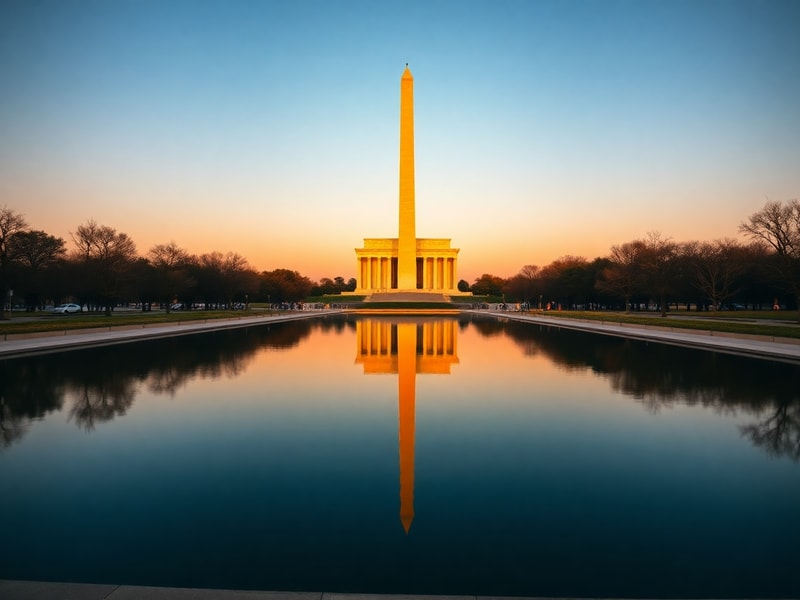
The Washington Monument stands as one of the most recognizable structures in the United States, a towering obelisk dedicated to the nation’s first president, George Washington. Completed in 1884 after decades of planning and construction challenges, the monument is not just an architectural marvel but also a testament to American perseverance. Rising 555 feet above the National Mall in Washington, D.C., it held the title of the world’s tallest structure until the Eiffel Tower surpassed it in 1889.
Its construction began in 1848 but faced numerous setbacks, including funding shortages and the Civil War, which halted work for nearly 25 years. The monument’s design, a simple yet elegant obelisk, was chosen to reflect the timeless values Washington represented. Today, it remains a focal point for both tourists and historians, offering insights into 19th-century engineering and the enduring legacy of America’s founding.
The Monument’s Design and Construction
The Washington Monument’s design was inspired by ancient Egyptian obelisks, a choice that symbolized Washington’s lasting impact on the nation. Architect Robert Mills envisioned a grand structure surrounded by a circular colonnade, though financial constraints led to a simplified version. The obelisk itself is built from three types of stone: Maryland marble, sandstone, and granite, each chosen for its durability and aesthetic appeal.
Construction began on July 4, 1848, with the laying of the cornerstone. However, by 1854, funds ran out, and work stopped at just 150 feet. When construction resumed in 1877, engineers faced the challenge of aligning the new marble blocks with the existing structure. The solution came from a former Army engineer, Thomas Lincoln Casey, who used a system of iron rods and concrete to stabilize the monument as it grew. The final capstone was placed on December 6, 1884, and the monument was officially dedicated on February 21, 1885.
The monument’s interior features an elevator and 897 steps, though public access is limited to the elevator ride to the observation deck. The walls are lined with commemorative stones donated by states, foreign governments, and even Native American tribes, each inscribed with a tribute to Washington.
Historical Significance and Cultural Impact
The Washington Monument has played a central role in American history, serving as a gathering place for protests, celebrations, and memorials. During the Civil War, it became a symbol of national unity, with President Abraham Lincoln visiting the unfinished structure in 1861. In the 20th century, it witnessed pivotal moments such as the 1963 March on Washington, where Martin Luther King Jr. delivered his iconic “I Have a Dream” speech just a few miles away.
Beyond its historical importance, the monument has also inspired countless works of art, literature, and media. It appears in films, paintings, and even comic books, often representing the ideals of democracy and freedom. Its prominence in the National Mall ensures that it remains a must-see landmark for visitors from around the world.
In recent years, the monument has undergone preservation efforts to address wear from weather and environmental factors. Engineers have repaired cracks in the marble and reinforced the foundation, ensuring that it continues to stand as a symbol of American resilience for future generations.
Visitor Experience and Practical Information
For those planning a visit, the Washington Monument is open daily, with timed tickets required for entry. The monument’s observation deck offers panoramic views of Washington, D.C., providing a unique perspective on the city’s layout and landmarks. Visitors can also explore the surrounding National Mall, which includes other iconic sites like the Lincoln Memorial and the U.S. Capitol.
Here’s what you need to know before your visit:
- Location: National Mall, Washington, D.C.
- Hours: Open daily from 9:00 AM to 5:00 PM (extended hours in summer)
- Admission: Free, but timed tickets are required for entry to the monument.
- Accessibility: The monument is wheelchair accessible, with an elevator providing access to the observation deck.
- Nearby Attractions: Lincoln Memorial, Reflecting Pool, Smithsonian Museums.
While the monument itself is a highlight, the surrounding area offers plenty of opportunities for exploration. Visitors can take guided tours, visit nearby museums, or simply enjoy a stroll along the Reflecting Pool. The monument also hosts special events, such as evening ranger talks and seasonal illuminations.
For those interested in the monument’s history, the Culture section of Dave’s Locker provides further reading on the symbolism and cultural impact of American landmarks. Additionally, the Travel category offers tips for exploring Washington, D.C., and other historic sites across the country.
A Lasting Legacy
The Washington Monument is more than just a tall structure—it is a symbol of American history, engineering ingenuity, and national pride. From its humble beginnings to its completion after decades of effort, the monument embodies the perseverance and determination of the American people. Today, it stands as a reminder of the nation’s founding principles and the enduring legacy of George Washington.
As the National Mall continues to evolve, the Washington Monument remains a constant presence, a silent witness to the passage of time and the changing tides of history. Whether viewed from a distance or explored up close, it offers a tangible connection to the past and a source of inspiration for the future.