Few places in the world carry the weight of history, art, and political intrigue quite like Versailles. Beyond its gilded mirrors and manicured gardens, the palace represents a turning point in European power dynamics, artistic achievement, and even modern governance. Its halls have witnessed the rise and fall of empires, the birth of artistic movements, and the evolution of public perception about monarchy itself.
The Origins of Versailles: From Hunting Lodge to Seat of Power
Construction of Versailles began in 1623, when Louis XIII ordered a modest hunting lodge to be built on the outskirts of Paris. By the time his son, Louis XIV, took the throne in 1643, the property had already expanded into a small château. But it was the Sun King who transformed Versailles into something far grander—an architectural masterpiece designed to consolidate absolute power.
The palace’s expansion was not merely about aesthetics. Every element, from the Hall of Mirrors to the meticulously aligned gardens, was crafted to reinforce Louis XIV’s divine right to rule. The relocation of the royal court from Paris to Versailles in 1682 was a deliberate move to distance the monarchy from the volatile urban politics of the capital. The palace became a controlled environment where the king could observe, reward, and manipulate the nobility under the guise of opulence.
Versailles was not built in a day. The project spanned decades, involving thousands of workers, architects like Louis Le Vau and Jules Hardouin-Mansart, and landscape designer André Le Nôtre. The result was a physical manifestation of royal extravagance—one that would later inspire both admiration and backlash across Europe.
The Palace as a Stage for Diplomacy and Revolution
Versailles was more than a residence; it was a theater where Europe’s most critical political dramas unfolded. The Treaty of Versailles, signed in 1783, ended the American Revolutionary War, setting a precedent for international diplomacy. Yet just five years later, the same halls that had hosted lavish banquets for aristocrats became the epicenter of revolutionary fervor.
The Women’s March on Versailles in October 1789 marked a turning point in the French Revolution. Thousands of Parisian women, along with National Guard soldiers, marched to the palace to demand bread and force the royal family’s return to Paris. The event symbolized the collapse of the ancien régime’s legitimacy. Within years, the monarchy would be abolished, and Louis XVI and Marie Antoinette would face the guillotine.
This duality—Versailles as both a symbol of oppression and a stage for monumental change—has left an indelible mark on its legacy. Today, the palace stands as a reminder of how power structures can shift, sometimes violently, in response to public will.
Key Moments in Versailles’ Political Role
- 1682: Louis XIV moves the royal court to Versailles, establishing it as the political center of France.
- 1715: After Louis XIV’s death, the regency government briefly moves back to Paris, but Versailles remains a symbol of royal authority.
- 1783: The Treaty of Paris, ending the American Revolution, is signed in the Hall of Mirrors.
- 1789: The Women’s March forces the royal family to relocate to Paris, marking the beginning of the Revolution.
- 1871: The German Empire is proclaimed in Versailles, reversing the humiliation of France after the Franco-Prussian War.
- 1919: The Treaty of Versailles is signed, formally ending World War I and reshaping the global order.
Versailles as Cultural Icon: Art, Propaganda, and Modern Influence
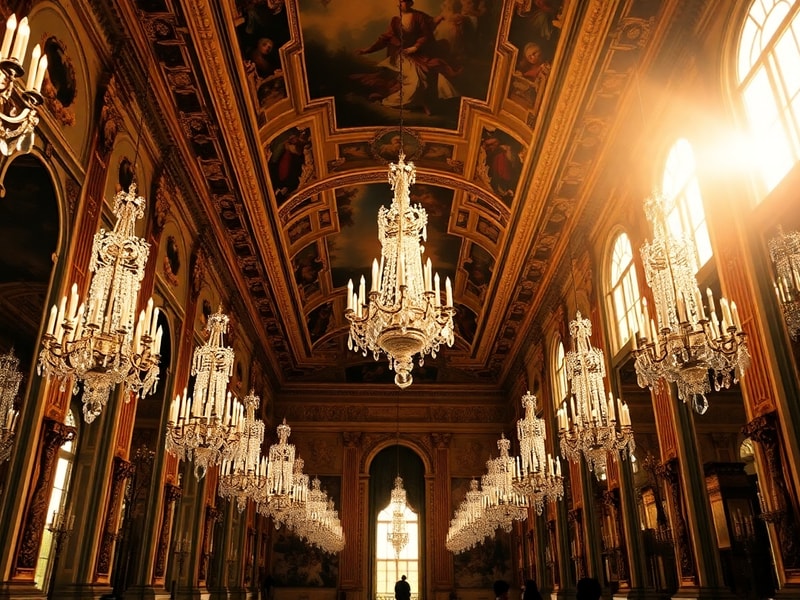
The palace’s influence extends far beyond its historical role. Versailles became a blueprint for how art and architecture could serve political propaganda. The Hall of Mirrors, with its 357 mirrors and chandeliers, was designed to overwhelm visitors with light and reflection—literally and metaphorically. Every detail, from the gilded stucco to the painted ceilings depicting Louis XIV’s victories, reinforced the idea of an unassailable monarchy.
In the 20th century, Versailles took on new meanings. During World War I, the Treaty of Versailles (1919) imposed harsh reparations on Germany, sowing the seeds for future conflict. The palace itself suffered damage during the war, as it was used as a military hospital. Later, it became a site for reconciliation, hosting ceremonies to mend Franco-German relations.
Today, Versailles is a UNESCO World Heritage Site and one of the most visited landmarks in France. Its cultural footprint is evident in films like Marie Antoinette (2006), which reimagines the palace as a stage for decadence and tragedy, and in video games such as Assassin’s Creed Unity, where players explore its halls in a fictionalized version of revolutionary Paris.
Visiting Versailles Today: What to See and Why It Matters
A visit to Versailles is less about ticking off tourist attractions and more about immersing oneself in a living museum of power, art, and revolution. The palace’s architecture alone is worth the trip, but its true significance lies in its layers of history. Visitors can walk the same paths as kings and revolutionaries, stand in the Hall of Mirrors where history was made, and wander through gardens designed to reflect the cosmos itself.
For those unable to travel, digital reconstructions and virtual tours offer a glimpse into Versailles’ past. These tools allow historians, artists, and the public to engage with the palace in new ways, ensuring its legacy endures beyond physical boundaries.
Whether viewed as a monument to absolutism, a catalyst for revolution, or a symbol of cultural resilience, Versailles remains a touchstone for understanding the complexities of power. Its story is one of grandeur and downfall, art and politics, tradition and upheaval—a narrative that continues to captivate and challenge us.
Essential Highlights for First-Time Visitors
- The Hall of Mirrors: The palace’s most famous room, where the Treaty of Versailles was signed and where light and power converge.
- The Gardens of Versailles: Designed by André Le Nôtre, the gardens span over 800 hectares and feature fountains, groves, and the iconic Grand Canal.
- Marie Antoinette’s Estate: A contrast to the palace’s opulence, this private retreat offers insight into the queen’s life away from court.
- The Royal Opera: One of the finest examples of Baroque architecture, showcasing the palace’s role as a cultural hub.
- The Grand Trianon: A smaller palace where Louis XIV could escape the pressures of court life.
Versailles is more than a relic of the past. It is a mirror held up to history itself, reflecting the ambitions, failures, and transformations of those who shaped—and were shaped by—its walls.
For further exploration of cultural landmarks and historical analysis, visit our Culture and Travel sections.