Diego Maradona: The Life, Legacy, and Myth of a Football Legend
Diego Armando Maradona was more than a footballer. He was a myth wrapped in a jersey, a man whose left foot could bend reality and whose life outside the pitch became as dramatic as any of his matches. Born on October 30, 1960, in the Villa Fiorito neighborhood of Buenos Aires, he rose from the dusty streets of Argentina to become one of the most electrifying figures in sports history. His talent was undeniable, but it was his audacity, flair, and unapologetic defiance that turned him into a global icon.
From Villa Fiorito to Buenos Aires stardom
Maradona grew up in poverty, the fifth of eight children in a family that struggled to make ends meet. At just eight years old, he joined Los Cebollitas, a youth team in Argentinos Juniors, where his prodigious dribbling and vision began to turn heads. By 14, he was training with the first team. His professional debut came at 15, and by 18, he was already the youngest player in the Primera División. His performances for Argentinos Juniors and later Boca Juniors in Argentina showcased a level of skill that seemed almost supernatural.
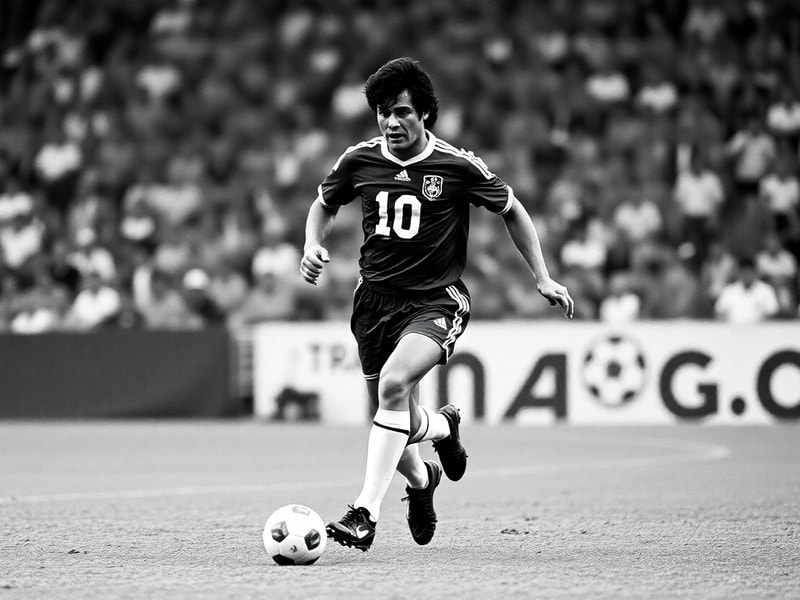
His style was chaotic yet controlled—a blend of low center of gravity, lightning reflexes, and a magnetic personality that made defenders look foolish. He didn’t just play the game; he rewrote its rules. In 1981, Maradona led Boca Juniors to the league title, cementing his reputation as a player capable of single-handedly deciding matches. Yet it was clear early on that his ambitions stretched far beyond Argentina’s borders.
The Barcelona years: Triumph and turmoil
In 1982, Maradona moved to FC Barcelona for a world-record fee at the time. The transition to European football was rocky. Injuries, disciplinary issues, and conflicts with club management derailed what should have been a defining chapter. His time at Barça was marred by hepatitis and a brutal tackle by Athletic Bilbao’s Andoni Goikoetxea that left him with a broken ankle. The injury sidelined him for months and forced him to fight his way back.
Despite the setbacks, Maradona’s individual brilliance shone through. His dribbling in tight spaces and ability to create chances from nothing were unmatched. But Barcelona’s hierarchy grew frustrated with his rebellious streak and the club’s inability to build a competitive squad around him. After two tumultuous seasons, he left for Napoli in 1984—a move that would redefine both his career and the club’s destiny.
Napoli: A love affair written in gold
When Maradona arrived at SSC Napoli, the club was a mid-table struggler in Serie A. Southern Italy’s passion for football was intense, but Napoli’s fanbase was hungry for greatness. Maradona delivered beyond their wildest dreams. In his first season, he led the team to an 8th-place finish, a vast improvement from their previous seasons. By 1987, he guided Napoli to their first-ever Serie A title, ending Juventus and AC Milan’s dominance.
The 1987-88 season was historic. Napoli secured their first Scudetto with Maradona at the heart of everything—scoring 15 goals and providing countless assists. The following year, they added the UEFA Cup, further cementing their place in European football. But Maradona’s impact went beyond trophies. He became a symbol of defiance for Naples’ working class, a figure who challenged the northern elite of Italian football and embodied the city’s grit and creativity.
His relationship with the Napoli fans was almost spiritual. They sang his name, tattooed his face on their skin, and saw him as one of their own. His infamous “Hand of God” goal against England in the 1986 World Cup was mirrored in Naples, where he was both adored and controversial. Yet, to the Neapolitans, he was untouchable—a messiah in blue.
The 1986 World Cup: A legend cemented
The 1986 FIFA World Cup in Mexico was Maradona’s coronation. He didn’t just play in the tournament; he dominated it. In the quarterfinal against England, he scored two of the most famous goals in football history in a span of five minutes. The first, the “Hand of God,” was a blatant handball that fooled the referee. The second, voted the Goal of the Century in a 2002 FIFA poll, was a 60-meter solo run past five England players. Together, they encapsulated Maradona’s duality—brilliant and flawed, divine and human.
He went on to captain Argentina to victory, delivering the World Cup to a nation still recovering from the Falklands War. His performances were a masterclass in leadership, creativity, and sheer willpower. In the final against West Germany, he set up the winning goal and was named Player of the Tournament. The World Cup was the pinnacle of his career, a moment that transcended sport and entered the realm of myth.
Yet, the tournament also highlighted the darker side of Maradona’s persona. His aggression, his penchant for theatrics, and his refusal to play by conventional rules made him a polarizing figure. While millions revered him, others saw him as a cheat or a loose cannon. The “Hand of God” became shorthand for his willingness to bend the rules to win—a trait that defined both his genius and his controversies.
Life beyond football: Triumph and tragedy
Maradona’s post-retirement life was as turbulent as his playing career. After leaving Napoli in 1991 following a doping ban, he played for Sevilla, Newell’s Old Boys, and Boca Juniors before retiring in 1997. His struggles with drug addiction became public, leading to multiple stints in rehab and run-ins with the law. He was hospitalized numerous times for heart issues, a consequence of years of substance abuse and a lifestyle that prioritized excess over moderation.
Despite his personal demons, Maradona remained a cultural force. He managed the Argentine national team during the 2010 World Cup in South Africa, leading them to the quarterfinals. He also coached clubs like Al Wasl in the UAE and Dorados in Mexico, though his managerial career lacked the same magic as his playing days. His outspoken nature made him a frequent commentator on football and politics, often voicing support for left-wing movements and criticizing FIFA and the establishment.
In his later years, Maradona’s health declined sharply. He underwent emergency brain surgery in 2020 and suffered a heart attack in November 2020, which led to his death at the age of 60. The outpouring of grief from fans worldwide was a testament to his enduring legacy. In Naples, tens of thousands lined the streets to pay their respects as his coffin passed by. In Argentina, the national team wore black armbands in his honor during a World Cup qualifier.
Maradona’s enduring legacy
Maradona’s influence extends far beyond the pitch. He was a symbol of rebellion, a figure who challenged authority and redefined what it meant to be a football hero. His life was a tapestry of triumph and tragedy, joy and pain, genius and folly. He inspired generations of players who dared to be different, who played with flair and fearlessness rather than rigid tactics.
His legacy is visible in the streets of Naples, where murals of his face still adorn buildings. It’s in the hearts of Argentine fans, who see him as a national treasure. It’s in the way modern players like Lionel Messi and Cristiano Ronaldo, while representing different eras, both cite Maradona as an inspiration. His dribbling, his vision, and his ability to single-handedly change games set a standard that few have matched.
Yet, Maradona’s story also serves as a cautionary tale. His battles with addiction and his refusal to conform to the expectations of authority figures ultimately cut his life short. His legacy is not just one of trophies and accolades but of the human cost of greatness. He was a man who gave everything to the game and to his fans, often at the expense of his own well-being.
Maradona’s life reminds us that heroes are not perfect. They are complex, flawed, and deeply human. His story is a reminder of the power of sport to elevate individuals to mythic status, but also of the fragility of that same myth when faced with the realities of life. He was, and always will be, the people’s champion—a man who played by his own rules and, in doing so, changed the game forever.