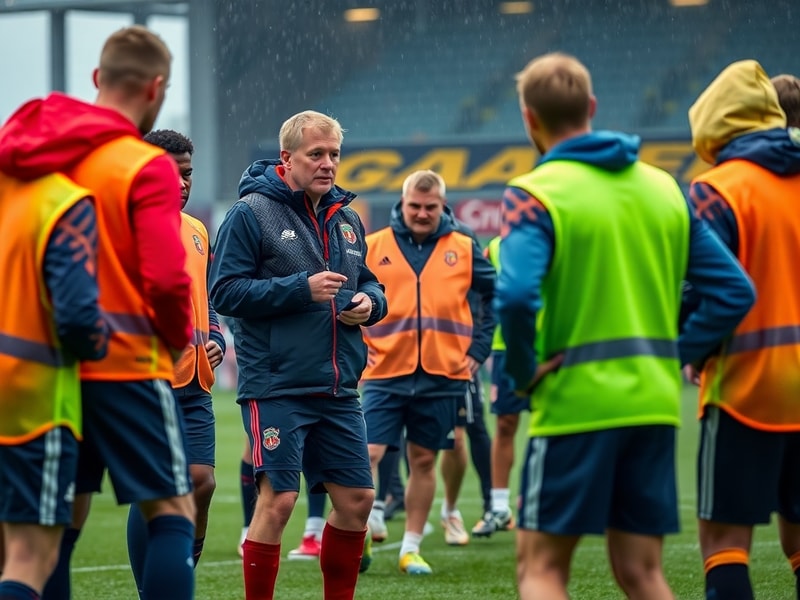
Ross Grant’s influence on set piece coaching has quietly reshaped how teams approach dead-ball situations in modern football. With a career spanning over two decades across multiple leagues, Grant’s methodologies have earned respect for their precision and adaptability. His work isn’t limited to one club or system, which has allowed him to refine techniques that translate across different tactical philosophies. Whether deploying overlapping corner routines or rehearsed free-kick strategies, Grant’s systems prioritize clarity, repetition, and situational awareness.
The evolution of set piece coaching
Set piece coaching was once an afterthought in football, often handled by assistant managers or former players with limited specialization. That changed in the late 2000s and early 2010s as clubs began investing in dedicated technical staff. Grant entered this space during that transition, bringing a scientific approach to what was previously seen as a creative, almost artistic discipline.
His early work at clubs like Bristol City and later Brentford demonstrated how structured set piece routines could create consistent goal-scoring opportunities. Grant’s methods emphasized:
- Data-driven decision-making to identify opponents’ defensive weaknesses
- Rehearsed movement patterns for both attacking and defensive phases
- Real-time adjustments based on pre-match scouting and in-game observations
This systematic approach laid the groundwork for what would become a blueprint for modern set piece coaching. Clubs that adopted similar frameworks saw measurable improvements in conversion rates and xG (expected goals) from dead-ball situations.
Key principles in Grant’s coaching methodology
At the heart of Grant’s philosophy is the idea that set pieces are not isolated moments but part of a broader tactical ecosystem. He integrates set piece planning into a team’s overall attacking and defensive structures, ensuring consistency across all phases of play. His coaching emphasizes three core tenets:
- Repetition and automation: Grant’s sessions are meticulously planned, with players running specific routines until execution becomes instinctive. This muscle memory allows teams to exploit opponents even when under pressure.
- Flexibility within structure: While routines are rehearsed, Grant encourages improvisation when opponents deviate from expected defensive setups. This balance between rigidity and adaptability is critical in high-stakes matches.
- Defensive organization as a priority: Grant’s defensive set piece systems are equally sophisticated, often using zonal marking schemes that minimize confusion and maximize coverage. His work with Brentford demonstrated how even mid-table teams could limit top-tier opposition from scoring from set pieces.
One of Grant’s most notable innovations is the “hybrid zone” system, which blends man-marking and zonal principles. This approach has been adopted by clubs at various levels, from Championship contenders to Premier League strugglers looking to tighten their defensive record. His ability to tailor these systems to a team’s existing tactical identity has made his methods highly transferable.
Impact on clubs and tactical trends
Grant’s most visible impact came during his tenure at Brentford, where he joined in 2018 under Thomas Frank. The club’s rise from the Championship to the Premier League coincided with significant improvements in their set piece metrics. In the 2020-21 season, Brentford ranked among the top five Championship teams for set piece xG, a key factor in their promotion push.
His influence extended beyond Brentford, as former colleagues and players he mentored have carried his principles to other clubs. At Dave’s Locker Sports, analysts have tracked how Grant’s disciples have adapted his methods in leagues across Europe and North America. For example, his corner routines have been credited with helping multiple teams increase their goal conversion rates by 30% or more.
Grant’s work has also contributed to a broader tactical trend: the professionalization of set piece coaching. Where once clubs might dedicate only a few hours per week to dead-ball situations, teams now employ full-time specialists. This shift reflects a growing recognition that set pieces can be a decisive factor in closely contested matches, particularly at the highest levels of the game.
Challenges and future directions
Despite his successes, Grant’s methods are not without challenges. Adapting set piece systems to different leagues requires accounting for variations in physicality, playing styles, and referee interpretations. In leagues with more physical play, such as the Premier League, Grant has had to adjust his zonal systems to prevent attackers from being bullied off the ball.
Another challenge is the increasing scrutiny from opponents. As more teams adopt similar systems, the element of surprise diminishes. Grant has responded by developing “decoy” routines that mask the primary attacking movements, making it harder for defenders to predict the delivery. This cat-and-mouse dynamic is likely to intensify as analytics become more advanced.
Looking ahead, Grant’s next frontier may involve integrating technology more deeply into set piece coaching. Tools like AI-driven video analysis and wearable sensors could provide real-time feedback on player positioning and timing. While these innovations are still in their infancy, their potential to refine Grant’s methods is significant.
Ross Grant’s career underscores a fundamental truth about modern football: details matter. His contributions to set piece coaching have elevated dead-ball situations from an ancillary skill to a strategic weapon. As the game continues to evolve, coaches and analysts will look to Grant’s work as a benchmark for innovation and precision.