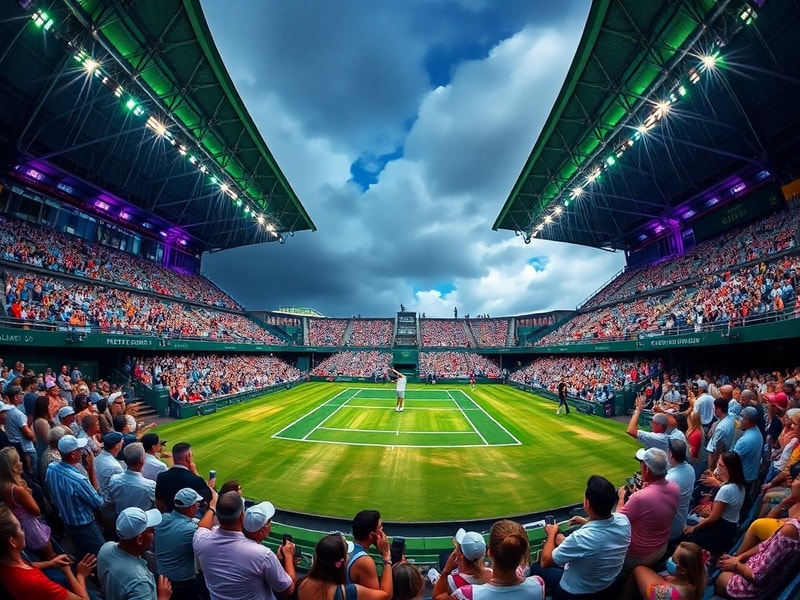
Wimbledon 2026: Tradition Meets Innovation in Tennis’ Grandest Stage
Wimbledon 2026: A New Era of Tradition and Innovation on the Horizon
The All England Lawn Tennis Club has begun laying the groundwork for Wimbledon 2026, an edition that promises to blend centuries-old heritage with forward-looking changes. While the tournament’s core values—excellence, inclusivity, and prestige—remain unchanged, the 2026 staging is set to be one of the most technologically advanced and environmentally conscious editions in history. With construction already underway on expanded broadcast facilities and sustainability upgrades, the stage is being set for a summer of tennis that will captivate both purists and digital natives alike.
This year’s preparations follow a pattern of steady evolution rather than revolution. Wimbledon has long balanced tradition with adaptation, and 2026 will mark the halfway point between the club’s 150th anniversary in 2027 and its last major modernization cycle. Organizers are quietly implementing innovations that will subtly transform the spectator experience while maintaining the tournament’s iconic aesthetic—think Centre Court’s unchanged green-and-purple color scheme, but with enhanced connectivity and accessibility.
The club’s leadership has emphasized that 2026 will not be about radical reinvention, but about “elevating the essence” of Wimbledon. That ethos is evident in the ongoing £150 million investment in infrastructure, which includes upgrades to the No. 1 Court roof, expanded player facilities, and a new energy-efficient refrigeration system for Centre Court’s retractable roof. These improvements aim to reduce the tournament’s carbon footprint while ensuring that top players can perform under optimal conditions, regardless of weather disruptions.
Sustainability Takes Centre Stage
Wimbledon’s commitment to sustainability has become a cornerstone of its identity in recent years, and 2026 will see this ethos reach new heights. The All England Club has pledged to make the tournament 50% more energy efficient by 2026, building on its 2023 target of reducing emissions by 50% compared to 2019 levels. This includes transitioning to 100% renewable electricity across all courts, club buildings, and broadcast operations—a significant leap from the current 60% sourced from wind and solar.
Waste reduction is another key focus. The club has partnered with local waste management firms to implement a zero-waste-to-landfill policy for 2026, targeting a 90% diversion rate. This means all food packaging, cups, and even tennis ball tubes will be compostable or recyclable. Players and staff will receive reusable water bottles, and fans will be encouraged to bring their own containers to refill stations, reducing single-use plastic consumption by an estimated 30%.
These efforts align with the broader sustainability goals of the tennis ecosystem. The ATP and WTA have both committed to net-zero emissions by 2040, and Wimbledon’s initiatives serve as a model for other Grand Slam tournaments. The club’s sustainability manager, Heather Cracknell, noted in a recent interview that “Wimbledon 2026 will be the first major sporting event in the UK to achieve BREEAM Excellent certification for its operational venues—a benchmark for green event management.”
The tournament’s food program will also reflect this shift. A new “Hyper Local” dining initiative will source 40% of ingredients from within a 50-mile radius, cutting transport emissions and supporting regional farmers. Expect to see more plant-based options on menus, including a signature “Wimbledon Vegan Bake” designed by a Michelin-starred chef. These changes aren’t just about environmental impact; they’re redefining the culinary experience for over half a million visitors.
Technology and Fan Experience: A Quiet Revolution
While Wimbledon is often associated with tradition, the 2026 edition will quietly integrate technology to enhance the fan experience without disrupting the tournament’s timeless atmosphere. One of the most anticipated upgrades is the expansion of 5G and Wi-Fi 6E coverage across the grounds, ensuring seamless connectivity for the 500,000+ fans expected to attend. This will enable real-time match statistics, augmented reality (AR) overlays for court cameras, and even AI-powered crowd flow predictions to reduce bottlenecks at entrances and food stalls.
The tournament’s official app will undergo a major overhaul for 2026, introducing features like “AR Court Explorer,” which allows users to point their phones at any court to see live scores, player stats, and historical highlights. The app will also integrate with Wimbledon’s new digital ticketing system, which uses blockchain to prevent fraud and streamline entry. Organizers have confirmed that all tickets for 2026 will be NFT-based, a move aimed at enhancing security and enabling secondary market verification—a first for a Grand Slam event.
For those watching from home, broadcast enhancements will offer a more immersive experience. BBC Sport, the tournament’s primary broadcaster, has announced plans to debut “AI Commentary Assistant,” a system that provides real-time insights and player analytics during live matches. While traditional commentary will remain, this AI tool will offer viewers deeper context, such as shot accuracy trends or physiological data from players. The goal is to make home viewing as engaging as being in the stands—without losing the human touch that defines Wimbledon’s broadcast legacy.
The club is also experimenting with holographic replays for Centre Court, allowing fans to interact with 3D reconstructions of key points from multiple angles. This technology, still in its pilot phase, could eventually replace traditional video reviews, offering a more intuitive way to analyze controversial calls. While not yet confirmed for 2026, the All England Club has hinted that select matches may feature holographic highlights in the grounds’ fan zones.
On-Court Dynamics: Rising Stars and Veteran Showdowns
The 2026 Wimbledon Championships will unfold against the backdrop of a generational shift in tennis. The tour’s next wave of stars—Carlos Alcaraz, Jannik Sinner, Coco Gauff, and Aryna Sabalenka—are all entering their peak years, and expectations are high for a potential clash of titans. Alcaraz, fresh off his 2025 Wimbledon title, is the favorite to defend his crown, but the path to the final will be fraught with challenges. His rivalry with Sinner, who has dominated on hard courts but is still finding his footing on grass, could define the men’s draw. Meanwhile, Gauff and Sabalenka will headline a deep women’s field, with both players aiming to add Wimbledon to their growing list of Grand Slam trophies.
Veterans like Novak Djokovic and Serena Williams have not yet announced their retirement plans, leaving open the possibility of another epic showdown. Djokovic, now 40, has hinted that 2026 could be his final Wimbledon, making every match a potential farewell tour. Serena, meanwhile, has spoken about a potential return to competitive play, though her schedule remains uncertain. If either—or both—decide to play, their presence would elevate the tournament’s drama and nostalgia factor.
The 2026 edition will also introduce a new tiebreak format in the final sets of all matches, a change that could add unpredictability to long, grueling encounters. The first-to-10-points tiebreak at 6-6 in the final set has been trialed in lower-tier tournaments but will make its Grand Slam debut at Wimbledon. This rule aims to shorten matches and reduce player fatigue, though critics argue it could rob the sport of some of its most dramatic moments. Whether fans and players embrace the change remains to be seen, but it’s a development that will shape the narrative of 2026.
Junior and wheelchair events will also see increased visibility in 2026, with expanded broadcast coverage and a dedicated social media campaign. The All England Club has committed to parity in prize money for all events, a move that reflects the growing professionalism of para-sport tennis. Rising stars like Diede de Groot and Alfie Hewett will be among the favorites, and their matches in the grounds’ smaller courts could become unexpected highlights for spectators.
The Business of Wimbledon: A Global Spectacle
Wimbledon 2026 is not just a sporting event; it’s a global economic engine. The tournament generates over £300 million in revenue annually, with sponsorships, broadcasting rights, and ticket sales forming the backbone of its financial success. For 2026, the club has secured long-term deals with key partners like IBM, Rolex, and Ralph Lauren, ensuring stability in an era of fluctuating sports marketing budgets. IBM’s continued sponsorship includes expanded AI and data analytics services, while Rolex’s partnership will see the brand’s signature gold and green prominently featured in new timekeeping systems across the grounds.
Ticketing remains one of Wimbledon’s most complex challenges. The club’s public ballot, which offers the only guaranteed way to secure tickets, saw a record 1.1 million applications in 2024. For 2026, organizers have introduced a dynamic pricing model for resale tickets, aiming to curb touting while ensuring fair access. Fans can also enter a lottery for “last-minute” tickets released 48 hours before each match, a system designed to fill empty seats while maintaining transparency. Despite these efforts, demand will far outstrip supply, and the secondary market will likely see prices soar for marquee matches.
The tournament’s commercial ecosystem extends beyond the grounds. Wimbledon’s official merchandise, produced in collaboration with Ralph Lauren, will feature limited-edition pieces for 2026, including a retro-inspired collection celebrating the club’s 149-year history. Meanwhile, local businesses in Wimbledon Village and Southfields are preparing for a tourism boom, with hotels and restaurants offering special packages tied to the tournament. The economic impact on London’s southwest is estimated at £120 million, with ripple effects felt across hospitality, retail, and transport sectors.
Sponsorship innovation is also on display. For the first time, Wimbledon will feature a “Sustainability Partner,” with Patagonia joining as the official supplier for eco-friendly apparel and equipment. The partnership includes a joint campaign to promote sustainable fashion, with Patagonia donating a portion of sales to local conservation projects. This reflects a broader trend in sports sponsorship, where brands are aligning with values rather than just visibility.
As the countdown to Wimbledon 2026 continues, one thing is clear: the tournament will be a masterclass in balancing innovation with tradition. Whether it’s the quiet hum of solar panels powering Centre Court, the holographic replays on the concourse, or the next generation of tennis stars stepping into the spotlight, the 2026 edition will offer something for everyone. For purists, the white clothing and strawberries-and-cream will remain untouched. For the rest, Wimbledon will be redefining what it means to be both timeless and cutting-edge.
As the All England Club’s chief executive, Sally Bolton, put it: “We’re not changing Wimbledon. We’re ensuring it evolves in a way that honors its past while embracing the future.” That philosophy may well define the tournament’s legacy for decades to come.
What to Watch For in 2026
For fans planning ahead, here are a few key storylines to follow as Wimbledon 2026 approaches:
- Novak Djokovic’s Potential Farewell: Will the Serbian legend play what could be his final Wimbledon? His form and motivation will be closely scrutinized in the lead-up.
- Alcaraz vs. Sinner Rivalry: Their contrasting styles and personalities make this a must-watch matchup, especially if they meet in the final.
- Sustainability Milestones: Keep an eye on the energy and waste reduction initiatives—Wimbledon’s progress could set a new standard for sports events.
- New Technology Rollouts: From AI commentary to holographic replays, the tech upgrades could redefine how fans experience the tournament.
- Wildcard Surprises: Wimbledon’s tradition of awarding wildcards to British players and grass-court specialists often leads to compelling underdog stories.
Whether you’re a tennis aficionado, a sustainability advocate, or a tech enthusiast, Wimbledon 2026 promises to deliver something unforgettable. Mark your calendars for late June—and prepare for a fortnight that will blend history, innovation, and pure sporting drama.