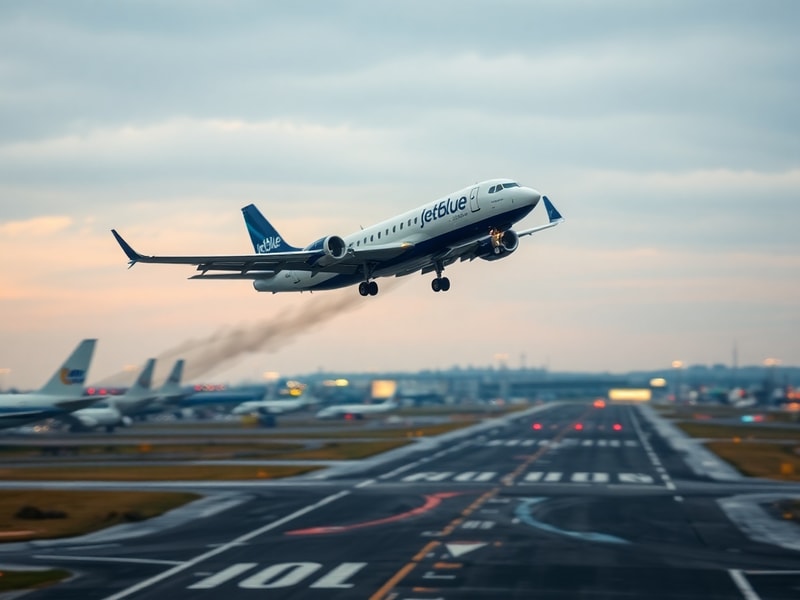
The Federal Aviation Administration grounded all JetBlue departures at New York’s John F. Kennedy International Airport late Tuesday after a commercial aircraft collided with a drone mid-flight. The incident, first reported by air traffic controllers, occurred at approximately 8:15 p.m. local time as Flight 1248 prepared for takeoff. Initial radar data showed an unusual object in the departure path, followed by a sudden altitude deviation from the aircraft. While the plane landed safely shortly after, the encounter raised immediate concerns about both passenger safety and the growing threat of unauthorized drones near major airports.
What Happened at JFK
According to preliminary reports from the FAA and JetBlue, the collision was not catastrophic but caused visible damage to the right wing of the Airbus A321 operating the flight. Passengers reported hearing a loud thud during takeoff, followed by a brief vibration. The crew completed standard emergency procedures and landed the aircraft without further incident. Airport authorities later confirmed the presence of drone debris near the runway.
Air traffic control transcripts reveal that the tower had not authorized any drone flights in the restricted zone at the time. This suggests the drone was operating illegally, either by accident or intent. The FAA has launched a full investigation, coordinating with local law enforcement and the FBI to trace the drone’s origin. Security footage from the airport is being reviewed to identify potential launch points.
Timeline of Events
- 7:50 p.m. – Flight 1248 pushed back from gate B18 at JFK.
- 8:05 p.m. – Aircraft begins taxiing to runway 31L.
- 8:12 p.m. – Tower clears Flight 1248 for takeoff.
- 8:15 p.m. – Radar shows altitude deviation; pilot reports “possible strike.”
- 8:22 p.m. – Aircraft lands safely; emergency response initiated.
- 8:45 p.m. – Airport temporarily closes runway; all JetBlue departures halted.
Why This Matters Beyond the Incident
This is not an isolated case. Over the past 18 months, the FAA has recorded more than 400 drone incursions near U.S. airports, with 22 classified as “high-risk” due to proximity to manned aircraft. While most encounters result in no damage, the potential for catastrophic failure increases with larger drones or multiple impacts. The JetBlue incident underscores a critical vulnerability in aviation security: current counter-drone systems are reactive, not preventive.
Unlike military-grade radar, most commercial airports rely on visual observation and pilot reports to detect drones. Even advanced systems like the FAA’s ASIAS program have limited real-time tracking capabilities for small unmanned aerial vehicles (UAVs). This gap is especially concerning as drone technology becomes cheaper and more accessible. A hobbyist-grade quadcopter can cost less than $500 but carry enough momentum at 60 mph to shatter cockpit glass or disable a wing.
Broader Risks in Aviation Safety
Industry analysts warn that the JetBlue incident could signal a new phase in aviation threats. Unlike birds, which are soft and compressible, drones are rigid and often contain lithium batteries—materials that can penetrate aircraft structures. The National Transportation Safety Board (NTSB) has previously highlighted the risks in a 2021 safety alert, stating that drone strikes could cause “catastrophic damage” to critical flight systems.
Insurance data from aviation underwriters reveals a 300% increase in drone-related claims since 2020. Most involve near-misses, but the JetBlue case marks the first publicly confirmed collision involving a major U.S. airline. If such events become more frequent, airlines may face higher premiums, operational delays, and stricter regulatory oversight—all of which could ripple through the travel industry.
Regulatory Gaps and Possible Solutions
Current FAA regulations prohibit drone flights within five miles of an airport without explicit authorization. Yet enforcement remains inconsistent. The agency relies on a patchwork of local law enforcement, the Department of Homeland Security, and public tip lines—none of which offer real-time tracking. Meanwhile, the drone industry continues to expand, with over 850,000 registered UAVs in the U.S. as of 2024.
Several airports, including London Heathrow and Dubai International, have deployed counter-drone systems like radar jammers and GPS spoofers to disrupt unauthorized flights. However, these technologies are expensive and face legal challenges due to potential interference with other aviation signals. In the U.S., the FAA has approved only a handful of pilot programs, leaving most airports unprotected.
What Could Change Now
Industry experts anticipate three likely outcomes from the JetBlue incident:
- Accelerated Deployment of Detection Networks: Airports may adopt AI-powered drone detection systems that integrate with existing radar and ADS-B networks.
- Stricter Penalties for Illegal Drone Use: Congress is considering bills that would increase fines to $100,000 per violation and introduce mandatory jail time for reckless operators.
- Mandatory Drone Registration for All UAVs: A universal tracking database could help authorities trace rogue drones within minutes of an incident.
Yet even these measures may not be enough. The rise of AI-powered drones capable of autonomous flight poses a new challenge. A drone equipped with obstacle avoidance could intentionally target aircraft, evading traditional countermeasures. Without coordinated federal investment in detection and deterrence, the aviation industry remains exposed.
Looking Ahead: A New Normal for Air Travel
The JetBlue incident is a wake-up call, but it’s not the first—and it won’t be the last. As drones become more sophisticated, the risk of a high-impact collision grows. The question is no longer whether such an event will occur, but when—and how the industry will respond. Airlines, regulators, and technology providers must collaborate to develop proactive solutions before the next near-miss becomes a tragedy.
For now, passengers can expect more delays and heightened security at major airports. The FAA has already issued a temporary flight restriction (TFR) over JFK, and similar measures may follow at other high-risk hubs. Travelers are advised to allow extra time and monitor airline notifications for updates.
One thing is clear: the era of passive airspace protection is over. The JetBlue drone collision is a turning point—and the clock is ticking.