Stefanos Tsitsipas: Career, Playing Style, and Future Outlook
Stefanos Tsitsipas has carved out a reputation as one of tennis’s most compelling figures, blending raw power with cerebral shot-making. At just 25, he has already reached three Grand Slam finals, including the 2021 French Open, and spent over 100 weeks inside the ATP top 10. His rise from a junior prodigy to a tour leader has been marked by both breathtaking victories and moments of frustration, creating a career narrative that continues to captivate fans worldwide.
The early years and junior dominance
Born in Athens in 1998 to Greek and Russian parents, Tsitsipas was introduced to tennis early by his father, Apostolos, a former professional. The family later relocated to Belgium to immerse the youngster in a more competitive training environment. By age 17, Tsitsipas had captured the 2016 French Open junior title, becoming only the second Greek player to win a Grand Slam junior event. That victory signaled the arrival of a player with the technical foundation and mental fortitude to compete at the highest level.
His junior success translated quickly into the professional ranks. In 2017, he qualified for the Australian Open main draw and stunned the field by defeating Grigor Dimitrov in the first round. The match showcased his mature game—fluid one-handed backhand, explosive serve, and calm demeanor under pressure—qualities that would become hallmarks of his senior career. That breakthrough earned him the ATP’s Most Improved Player award in 2018 and set the stage for a rapid ascent.
Playing style and technical strengths
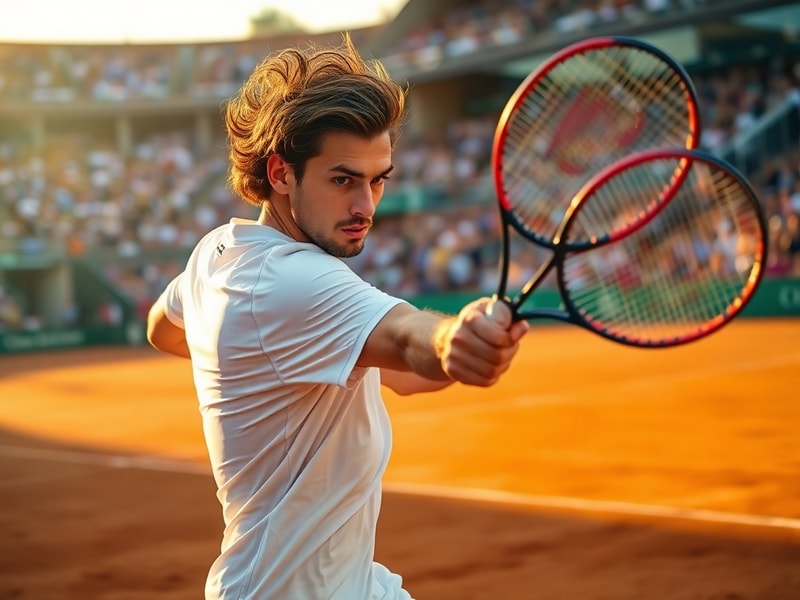
Tsitsipas’s game is built on versatility. His forehand, often struck with heavy topspin and acute angles, can dictate play from either wing. The one-handed backhand remains one of the cleanest in the game, allowing him to redirect pace and open the court with surgical precision. His serve, while not overwhelming in speed, is tactically nuanced, frequently set up to provoke weak returns or set up third-shot attacks.
What truly distinguishes Tsitsipas is his ability to play in multiple tempos. He can trade baseline rallies with power hitters like Daniil Medvedev or Rafael Nadal, then seamlessly transition into drop-shot and net play to catch opponents off guard. This tactical flexibility was on full display during his 2021 French Open run, where he outmaneuvered clay-court specialists with a mix of deep groundstrokes and delicate touch. His self-described “mentality of a chess player” reflects a player who thrives on anticipation and pattern recognition rather than sheer athleticism alone.
That said, his game is not without limitations. Critics point to a tendency to overuse the drop shot—sometimes at inopportune moments—and a serve that can be exposed under pressure. Yet these are the trade-offs of a creative, risk-positive style that prioritizes artistry over brute force.
Career highlights and Grand Slam moments
Tsitsipas’s career has already delivered several landmark moments. His 2019 Australian Open semifinal run, where he defeated Roger Federer in straight sets before falling to Rafael Nadal, announced his arrival on the sport’s biggest stage. The following year brought a first Masters 1000 title in Toronto, where he defeated Novak Djokovic in the semifinals before beating Andrey Rublev in the final. That victory propelled him to a career-high ranking of world No. 3.
His 2021 French Open campaign remains his most memorable. En route to the final, he defeated Federer in a five-set thriller, Djokovic in a four-set quarterfinal, and Medvedev in a five-set semifinal. Though he ultimately fell to Nadal in the final, the performance cemented his status as a legitimate contender on clay and a serious threat across all surfaces. Tsitsipas has since added titles at the Monte-Carlo Masters and the ATP Finals, further solidifying his place among the sport’s elite.
Despite these achievements, consistency has been a recurring challenge. Between breakthroughs, he has endured prolonged slumps, including a 2022 season where injuries and form fluctuations kept him outside the top 5. Yet his ability to regroup and return to contention—most notably with a 2023 Australian Open semifinal and a Masters 1000 title in Madrid—demonstrates the resilience that defines his professional identity.
Off-court influence and personality
Tsitsipas’s appeal extends beyond the baseline. He is one of the most eloquent and media-savvy players on tour, often speaking thoughtfully about the mental aspects of competition and the pressures of modern stardom. His multilingual fluency—fluent in Greek, Russian, and English—has helped him connect with diverse audiences, while his warm, approachable demeanor has made him a fan favorite.
He is also deeply involved in charitable initiatives. Through the Tsitsipas Foundation, he supports youth sports programs in Greece and education initiatives for underprivileged children. In 2020, he auctioned personal memorabilia to raise funds for COVID-19 relief efforts, demonstrating a commitment to social responsibility that resonates with younger fans.
His relationship with his family remains a central pillar of his life. His mother, Julia Apostoli, a former professional on the WTA tour, has been a vocal supporter, while his younger siblings, Petros and Pavlos, have followed in his footsteps. This close-knit dynamic has provided both emotional stability and a competitive drive that fuels his on-court ambitions.
Looking ahead: the road to 2025 and beyond
As Tsitsipas enters his late 20s, the questions surrounding his legacy intensify. Can he finally break through for his first Grand Slam title? Can he maintain the consistency required to challenge for multiple majors in a single season? And can he adapt his game to neutralize the next generation of power baseliners?
His preparation for the 2025 season reflects a mature, forward-looking approach. He has worked with new coaching staff, including former top-10 player Marc Rosset, to refine his serve mechanics and enhance his net play. He has also expanded his physical training to improve durability, a key factor in navigating the demanding ATP schedule. These adjustments suggest a player focused not just on short-term results, but on building a sustainable, high-performance career.
Tsitsipas’s journey—marked by brilliance, inconsistency, and relentless self-improvement—offers a blueprint for modern athletic success. He represents a bridge between the classical elegance of Federer and the physical dominance of Alcaraz, embodying the evolving identity of professional tennis. Whether he ultimately joins the pantheon of all-time greats or remains a formidable contender, his impact on the sport is already assured.
For fans and analysts alike, Tsitsipas remains a player worth watching—not just for what he achieves, but for how he achieves it. In an era where power often trumps artistry, he continues to prove that tennis is still a game of finesse, strategy, and heart.