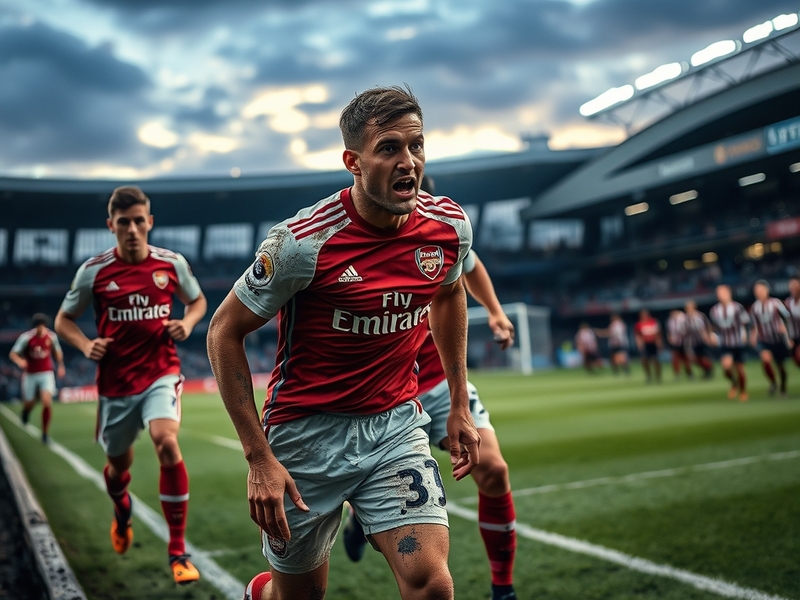
Arsenal’s visit to Como last weekend delivered more than just a three-point haul. The 2-0 victory extended Mikel Arteta’s side’s unbeaten run to 14 matches across all competitions, but the performance revealed subtle shifts in personnel, rhythm and tactical flexibility that could prove decisive in the Premier League title race. While the media focused on the scoreline, the underlying details—Emile Smith Rowe’s industry, Declan Rice’s box-to-box surge and the rear-guard resilience—painted a picture of a squad deepening its tactical toolbox just as the schedule intensifies.
First-half control sets the tone
Arteta’s side dominated possession from the opening whistle, probing Como’s compact 5-3-2 shape with quick one-twos in midfield. Arsenal’s midfield trio of Rice, Martin Ødegaard and Smith Rowe pressed in a 4-2-3-1 hybrid, forcing Como’s double pivot into hurried clearances. The opening goal arrived in the 23rd minute when Rice intercepted a loose pass on the left half-space, advanced 30 yards and threaded a low cross to Leandro Trossard, whose first-time finish clipped the far post and nestled inside the post.
Como barely registered a shot in the first half, their longest spell of pressure lasting less than 90 seconds. The away side’s defensive line, marshaled by Gabriel Magalhães and William Saliba, stayed compact, compressing space between the lines and cutting off direct passes to their lone striker. The statistics reflected the dominance: 68% possession, 14 shots, six on target—figures that underlined how Como’s game plan was effectively neutralized before the interval.
Smith Rowe’s cameo offers fresh hope
Emile Smith Rowe’s 65th-minute introduction marked a subtle but significant shift. Arteta clearly views the former youth captain as a tactical wildcard rather than a luxury—his ability to occupy half-spaces, link play and press aggressively adds a dimension Milan Tierney and Fabio Vieira simply cannot replicate. Within three minutes of coming on, Smith Rowe glided into the left half-space, received a quick lay-off from Rice and curled a low drive that Como’s keeper barely touched. The shot was saved, but the intent was unmistakable: Arsenal now have a genuine No. 10 option who can unlock low blocks without compromising defensive structure.
Smith Rowe’s role mirrors Arsenal’s wider strategy: maintain defensive solidity while keeping the attacking roster fluid. The substitution also hinted at Arteta’s rotation plans ahead of the congested December schedule; with Bukayo Saka and Gabriel Jesus carrying minutes in Serie A and the Champions League, the bench now features genuine game-changers rather than mere squad fillers. If Smith Rowe can replicate this level of impact off the bench on a regular basis, Arsenal’s late-season surge becomes even more plausible.
Defensive resilience masks minor personnel concerns
Como’s second-half resurgence was brief but noteworthy. The Serie A side switched to a 3-4-3 in the 55th minute, flooding the midfield with runners and forcing Arsenal’s full-backs—particularly Ben White on the right—into repeated recovery runs. The turning point came when Saliba misjudged a long ball, allowing a Como attacker to latch onto the ball in the final third. The resulting cross forced a crucial last-ditch block from Declan Rice, a moment that crystallized the midfielder’s new role: no longer a traditional destroyer, Rice is now the team’s deepest-lying creator, recycling possession from deep positions.
Minor defensive wobbles notwithstanding, Arsenal’s backline remains the Premier League’s most reliable. Saliba’s composure under pressure, Gabriel’s aerial dominance and goalkeeper Aaron Ramsdale’s one-on-one save from a Como tap-in in the 78th minute collectively underlined why Arteta’s side have conceded just twice in their last eight matches. The clean sheet also extended Arsenal’s streak of consecutive away league games without defeat to 21, a record that underscores the squad’s mental fortitude in hostile environments.
Tactical tweaks hint at title-race readiness
Arteta’s post-match comments focused on “small details”—the extra pass in midfield, the higher press triggers, the disciplined positional rotations. These granular improvements matter more than headline statistics. Against teams like Como, who set up to absorb pressure, Arsenal’s ability to manufacture openings through collective movement often decides games. The introduction of Smith Rowe, the box-to-box surge from Rice and the late defensive shifts all point to a squad that is evolving tactically without sacrificing its core identity.
Looking ahead to the festive fixture pile-up, Arteta’s squad now has a blueprint: control games through midfield dominance, rotate intelligently and keep defensive errors to an absolute minimum. The Como victory, while impressive, is merely one data point in a broader narrative—one where Arsenal are steadily assembling the tools required to compete on multiple fronts. The title race remains unpredictable, but Arteta’s side are quietly assembling the kind of resilience and flexibility that often decides league campaigns.
What’s next for Arsenal?
With the Premier League resuming this weekend, Arsenal face a pivotal run of fixtures against Brighton, Liverpool and Manchester United. The Como win suggests momentum is shifting in the right direction, but the true test lies in domestic competition. Arteta’s squad now has the psychological edge of an unbeaten streak, the tactical versatility to adapt mid-game and the depth to rotate without losing intensity. If these traits hold up under the brightest lights, the Gunners may yet find themselves in the Premier League title conversation come May.
For neutral fans and pundits alike, the real story isn’t just the scoreline—it’s the quiet evolution of a squad that refuses to stand still. Whether that evolution translates into silverware remains to be seen, but the signs are encouraging.