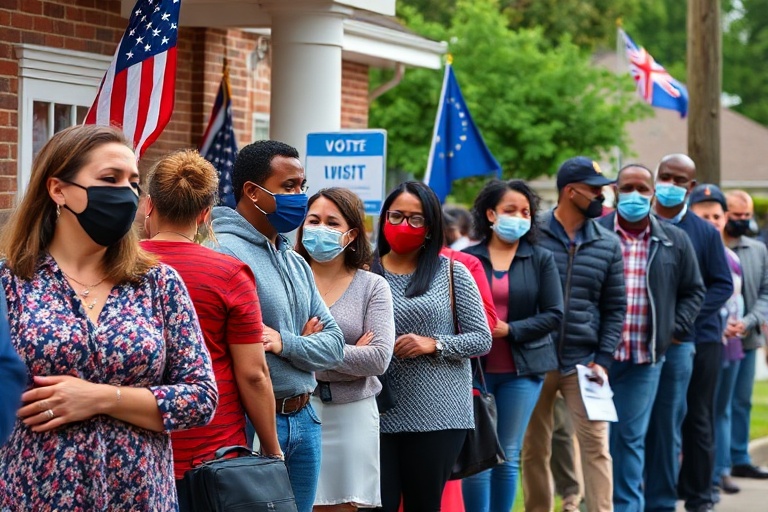
Georgia’s elections have quietly emerged as a case study in democratic resilience, drawing attention from political scientists worldwide. Between its strategic location at the crossroads of Europe and Asia and its turbulent post-Soviet history, the country offers a real-time laboratory for observing how electoral integrity evolves under pressure. What happens in Tbilisi often echoes beyond the Caucasus, influencing perceptions of democracy from Brussels to Washington.
The Historical Roots of Georgia’s Electoral Journey
Georgia’s relationship with voting is deeply tied to its Soviet past and its struggle for sovereignty. After declaring independence from the USSR in 1991, the country held its first presidential election in 1991, a chaotic affair marred by accusations of fraud and political violence. The Rose Revolution of 2003, sparked by disputed parliamentary elections, marked a turning point. It became one of the first post-Soviet states to undergo a peaceful transfer of power through mass protest, setting a precedent for democratic mobilization in the region.
This legacy of civic engagement has left a lasting imprint. Today, Georgians vote not just to choose leaders, but to affirm their place in a broader European identity. The 2012 parliamentary elections, widely praised by international observers, signaled a shift toward greater transparency. Yet challenges persist—especially in regions like South Ossetia and Abkhazia, where conflict and Russian influence complicate the electoral process.
Key Milestones in Georgian Electoral History
- 1991: First presidential election after independence, followed by political instability.
- 2003: Rose Revolution protests election fraud, leading to the resignation of President Eduard Shevardnadze.
- 2012: Opposition coalition Georgian Dream wins parliamentary majority, marking the first peaceful transfer of power.
- 2018: Presidential elections transition to a fully parliamentary system, reducing the president’s powers.
- 2020: Parliamentary elections held during the COVID-19 pandemic, with disputed results and opposition boycotts.
Voter Participation: A Cultural Tapestry
Voting in Georgia is more than a civic duty—it’s a cultural act. In rural villages, elders often guide younger family members to polling stations, reinforcing generational ties to the process. Urban centers like Tbilisi and Batumi pulse with youth-led campaigns, where social media plays a pivotal role in mobilizing first-time voters. This blend of tradition and modernity reflects Georgia’s dual identity: proudly Georgian yet aspiring to European standards.
Yet participation varies sharply across regions. In the capital, turnout often exceeds 50%, while in breakaway territories like Abkhazia, elections are boycotted or ignored due to ongoing conflict. This disparity underscores a broader tension: Georgia’s democracy is still being built, block by block, in areas both recognized and contested.
The Role of Civil Society and Observation Groups
Independent election monitoring has become a cornerstone of trust in Georgia’s voting system. Organizations like the International Society for Fair Elections and Democracy (ISFED) deploy thousands of observers to polling stations on election day. Their reports, while not always perfect, provide a counterbalance to state narratives. In 2020, ISFED documented over 200 violations, from voter intimidation to improper ballot handling—evidence that even well-established democracies face cracks in the system.
This civic vigilance is not unique to Georgia. From Ukraine to Kyrgyzstan, post-Soviet states have seen civil society take the lead in defending electoral integrity. In Georgia, the presence of international observers from the OSCE and the EU adds another layer of accountability, reinforcing the idea that democracy is not a local affair, but a global standard.
The Global Echo: Why Georgia Matters Beyond Its Borders
Georgia’s elections resonate far beyond the Caucasus. As a candidate for EU membership, the country’s democratic performance is scrutinized in Brussels boardrooms and Strasbourg chambers. Each election cycle becomes a test: Can Georgia align its institutions with European norms? The answer affects not just its 3.7 million citizens, but the bloc’s credibility in integrating diverse post-Soviet states.
Internationally, Georgia serves as a bellwether for democratic resilience. Its experience with hybrid threats—disinformation campaigns, foreign interference, and legal reforms that weaken checks and balances—mirrors challenges faced by countries from Brazil to the Philippines. When Georgia strengthens its electoral framework, it sends a signal. When it backslides, the repercussions are felt globally.
Lessons from Georgia for Emerging Democracies
Georgia’s journey offers several insights for nations navigating democratic transitions:
- Civil society is indispensable: Independent monitoring groups act as a safeguard against manipulation.
- Youth engagement is transformative: Digital campaigns and grassroots movements can redefine voter turnout.
- Transparency builds trust: Even small reforms, like live election results streaming, can enhance credibility.
- Context matters: Democracy cannot be imported wholesale—it must adapt to local histories and conflicts.
These lessons are increasingly relevant as democracy faces pressure worldwide. According to Freedom House, global freedom declined for the 17th consecutive year in 2023. In this climate, Georgia’s struggles and successes offer a blueprint—or a cautionary tale—depending on how the story unfolds.
Looking Ahead: The Future of Voting in Georgia
The 2024 parliamentary elections loom large, with opposition parties regrouping and international partners watching closely. Reform efforts continue, from digital voter rolls to anti-corruption measures, but skepticism lingers. Can Georgia balance European aspirations with internal divisions? The answer may lie in how it handles its next electoral test.
One thing is clear: the world is watching. Whether through the lens of geopolitics, human rights, or democratic theory, Georgia’s votes are more than numbers—they are a statement. Each ballot cast is a vote for self-determination, for resilience, and perhaps, for a future where democracy is not just a promise, but a practice.
As Georgia moves forward, its citizens—and the international community—will continue to shape the narrative. The lesson for all is simple: democracy is not a destination, but a daily choice. And in Georgia, that choice is being made, one vote at a time.