The term “eclipse” conjures up a rare and dramatic alignment: the moon gliding between Earth and sun or the Earth positioning itself between the sun and moon, briefly blotting out light or casting a coppery glow. These events are not merely celestial curiosities; they are predictable demonstrations of cosmic geometry that have shaped calendars, inspired mythologies, and driven scientific breakthroughs. From ancient Babylonian clay tablets to modern NASA live streams, eclipses have compelled humanity to look upward and outward. Their rarity in any given place—often decades apart—makes each occurrence a communal event, uniting skywatchers across cities and continents.
How eclipses work: the mechanics behind the magic
At its core, an eclipse is a shadow play. A solar eclipse occurs when the new moon passes directly between the sun and Earth, casting a shadow that sweeps across the planet’s surface. The darkest part, the umbra, produces totality; the lighter outer shadow, the penumbra, creates a partial eclipse. Conversely, a lunar eclipse happens during a full moon when Earth blocks sunlight from reaching the moon, turning it a reddish hue—often called a “blood moon.”
The geometry is precise: the orbits of the moon and Earth are tilted about 5 degrees relative to each other, which is why eclipses don’t occur every month. They happen only when the sun, Earth, and moon align along the line of nodes—the intersection points of the two orbital planes. This alignment occurs roughly twice a year, producing two to five solar eclipses and a similar number of lunar eclipses, though total solar eclipses are visible from any single location only about once every 375 years on average.
Types of eclipses and what to expect
Solar eclipses come in three main varieties:
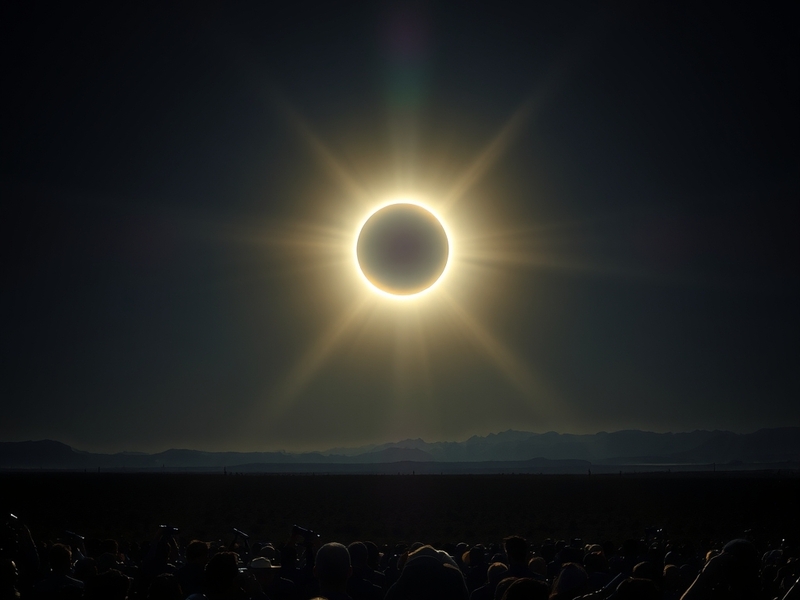
- Total solar eclipse: The moon completely covers the sun, revealing the solar corona—a wispy outer atmosphere usually hidden by daylight. Day briefly turns to twilight, temperatures drop, and stars may become visible.
- Annular solar eclipse: The moon is too far from Earth to cover the sun fully, leaving a “ring of fire” visible around the lunar silhouette. The sky remains bright, and the corona is not seen.
- Partial solar eclipse: Only part of the sun is obscured. This is the most common type, but it lacks the drama of totality.
Lunar eclipses are simpler to observe since they are visible from anywhere on Earth’s night side. They can be total, partial, or penumbral—where only the faint outer shadow dims the moon. The reddish color during totality comes from Earth’s atmosphere scattering blue light and filtering red light into the umbra, a phenomenon known as Rayleigh scattering.
Historical eclipses that changed the course of science
Eclipses have punctuated scientific history with moments of revelation. In 1919, during a total solar eclipse observed from Príncipe and Sobral, British astronomer Arthur Eddington confirmed Einstein’s theory of general relativity by showing that starlight bent near the sun—an effect predicted by the curvature of spacetime. Newspapers hailed it as the eclipse that proved Einstein right, shifting the scientific paradigm.
Centuries earlier, the ancient Greeks used a lunar eclipse in 413 BCE to mislead the Syracusans during the Peloponnesian War. The Athenian fleet, delayed by the eclipse, launched a surprise attack that ultimately led to a decisive Spartan victory. The eclipse became a tactical tool, illustrating how celestial events could influence human history.
Even earlier, Chinese records from 1302 BCE describe an eclipse using the term “Shi,” meaning “to eat,” reflecting a belief that a celestial dragon was devouring the sun. Such records, meticulously kept by court astronomers, now help modern scholars refine calculations of Earth’s rotation and historical chronologies.
How to safely observe an eclipse—and where to see the next one
Safety is paramount during solar eclipses. Looking directly at the sun without protection can cause permanent eye damage. The only safe way to view a partial or annular eclipse is through certified solar filters, such as ISO-certified eclipse glasses or a solar viewer. During totality, however, it is safe to remove eye protection briefly—but only when the sun is completely covered.
For lunar eclipses, no special equipment is needed. The event unfolds slowly over hours, and the moon’s dimming is visible to the naked eye. Binoculars or a small telescope can enhance the view of lunar surface features as they darken and redden.
Upcoming eclipses offer prime viewing opportunities:
- October 2, 2024: An annular solar eclipse will cross parts of South America, including southern Chile and Argentina, with a “ring of fire” visible along a narrow path.
- March 29, 2025: A partial solar eclipse will be visible across Europe, Asia, Africa, and North America, with the best views in the Arctic and parts of northern Russia.
- September 7, 2025: A total lunar eclipse will be fully visible from Europe, Africa, Asia, and Australia, offering a striking blood moon for millions.
For those planning to travel, destinations like the Atacama Desert in Chile or the Scottish Highlands offer both clear skies and dramatic landscapes. Many astronomy clubs and science organizations host public viewing parties with telescopes and experts on hand.
Eclipses in culture: myth, art, and modern mythmaking
Across cultures, eclipses have been interpreted as omens, divine messages, or cosmic battles. In Hindu tradition, the demon Rahu attempts to devour the sun or moon during an eclipse, only to have them slip from his grasp. Ancient Norse mythology describes wolves chasing the sun and moon, occasionally catching them and causing an eclipse until the gods intervene. In Chinese folklore, drummers would bang pots and pans to scare away the celestial dragon.
Eclipses have also inspired art. The 1860 total solar eclipse, witnessed by astronomer James Ferguson and artist Maria Mitchell, was captured in sketches and paintings that blended scientific observation with aesthetic wonder. In modern times, eclipse chasers document their journeys on social media, turning transient events into viral moments. The 2017 “Great American Eclipse” generated over 1.8 million Instagram posts and boosted tourism in towns along the path of totality.
Today, eclipses are often framed as unifying events—a rare chance to pause and witness the mechanics of the universe. They appear in films, literature, and even corporate branding, symbolizing transformation or revelation. Yet beneath the symbolism lies a deeper truth: eclipses remind us that we are part of a larger system, governed by predictable yet awe-inspiring laws.
Whether studied through the lens of physics, history, or culture, eclipses transcend their momentary darkness. They are fleeting windows into the grand architecture of space and time. For those who chase them, they become pilgrimages; for those who witness them by chance, they linger as memories of wonder. In an age of digital saturation, an eclipse offers something rare: a shared, unmediated encounter with the cosmos—silent, spectacular, and humbling.