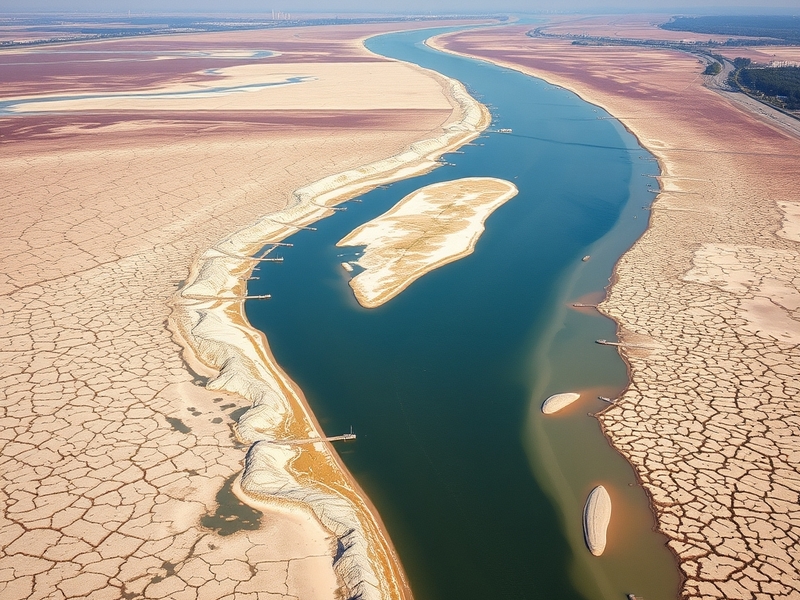
Few natural arteries have shaped civilization as profoundly as the Danube. Stretching 2,850 kilometers from Germany’s Black Forest to the Black Sea, it winds through ten nations, nourishing ancient vineyards, imperial capitals, and industrial corridors alike. Yet beneath its romantic veneer, the river’s water levels tell a story of vulnerability—one where climate shifts, human ambition, and fragile ecosystems collide. As seasons fluctuate and extreme weather becomes more common, the Danube’s fluctuating levels are more than a hydrological concern; they are a barometer for Europe’s environmental and economic future.
The Danube’s Seasonal Pulse: When Water Levels Rise and Fall
The Danube’s rhythm is defined by snowmelt in spring, summer droughts, and autumn rains. Historically, high water in late spring and early summer—peaking in June—supported agriculture and transport, while low levels in late summer often grounded ships and exposed sandbars. But these patterns are shifting. Data from the International Commission for the Protection of the Danube River (ICPDR) shows that average summer flows have declined by 10–15% over the past three decades, with some tributaries like the Tisza and Sava seeing even steeper drops. Winter thaws are arriving earlier, compressing peak flows into shorter windows and leaving rivers vulnerable to mid-summer shortages.
This seasonality isn’t just a climate anomaly—it’s a cultural disruption. In Hungary, the annual Budapest Wine Festival traditionally takes place in September along the Danube’s banks, when water levels are low enough to reveal the riverbed’s rocky terraces. But in 2022, record-low levels forced organizers to relocate parts of the event. Similarly, in Serbia, the Guča Trumpet Festival, a cornerstone of Balkan folk culture, relies on steady river access for attendees and vendors. When the Danube’s levels dip below navigable thresholds, entire communities face logistical and economic strain.
The Danube’s seasonal story is now written in extremes: sudden floods followed by prolonged droughts. In 2013, catastrophic flooding along the upper Danube displaced over 10,000 people and caused €12 billion in damages across Germany, Austria, and the Czech Republic. Just three years later, parts of the river fell to historic lows, halting shipping traffic and leaving over 200 vessels stranded near the Port of Giurgiu in Romania. These oscillations reveal a river struggling to adapt to a new climate reality—one where stability is increasingly rare.
Trade at Risk: How Low Water Levels Disrupt Europe’s Economic Backbone
The Danube is Europe’s second-longest river and a vital trade route, carrying over 100 million tons of goods annually between Central and Southeast Europe. When water levels drop, the consequences ripple across industries. In 2018, a severe drought reduced the river’s depth to just 1.2 meters in some sections, forcing cargo ships to carry only 20–30% of their usual loads. The resulting shipping delays cost businesses in Austria, Slovakia, and Hungary an estimated €150 million in lost revenue. Industries from automotive to agriculture—especially grain and oilseed exports—felt the pinch.
The vulnerability is structural. Unlike the Rhine, which has been dredged and engineered to maintain depth, much of the Danube remains in a more natural state. While this preserves biodiversity, it also makes the river more sensitive to climate variability. According to the Danube Commission, low water events now occur twice as frequently as they did in the 1960s. This trend poses a direct threat to Europe’s supply chains, particularly as the continent seeks to reduce reliance on road and rail transport.
Not all impacts are economic. Low water levels also expose toxic sediments long buried in riverbeds, threatening drinking water supplies. In 2021, dredging near the Serbian town of Prahovo uncovered high concentrations of heavy metals, prompting temporary bans on water extraction. The Danube’s health is not just an environmental issue—it’s a public safety concern that transcends borders.
To mitigate risk, governments and private operators are investing in adaptation. Austria has installed mobile dredgers to clear critical bottlenecks, while Romania and Bulgaria are piloting predictive modeling systems to forecast water levels up to six months in advance. Still, experts warn that without coordinated regional action, the river’s role as Europe’s economic lifeline could weaken significantly in the coming decades.
Cultural Currents: The Danube as a Symbol of Resilience and Memory
The Danube has always been more than a river. It’s a cultural highway, a border, a muse, and a witness to empires. From the Roman legions who marched along its banks to the Jewish communities of Budapest who once relied on its waters during Passover, the Danube carries layers of memory. When water levels fall, they don’t just reveal stones and sand—they expose fragments of history. In 2022, low water levels near the Serbian town of Golubac uncovered remnants of a medieval fortress submerged for centuries. Archaeologists scrambled to document the site before it was reclaimed by the river.
But the Danube’s cultural significance runs deeper. It flows through four national capitals—Vienna, Bratislava, Budapest, and Belgrade—each shaping its identity around the river. In Vienna, the Danube Canal has become a hub for nightlife and innovation, while Budapest’s iconic Duna (Danube) promenade is a UNESCO-listed treasure. When water levels rise too high, as they did during the 2013 floods, entire neighborhoods in these cities face evacuation. When they fall too low, as in 2018, the river’s symbolic power wanes—its mythic presence diminished by exposed mudflats and grounded boats.
The Danube also holds spiritual meaning. In Romanian folklore, the river is associated with the mythical Zânele—water nymphs who guard its depths. During droughts, local elders in the Danube Delta perform rituals to appease the river spirits, blending pagan tradition with Orthodox Christian prayer. These practices underscore a profound truth: communities along the Danube don’t just depend on the river—they revere it. Low water levels aren’t just an inconvenience; they are a cultural rupture.
Looking Ahead: Can the Danube Adapt Before It’s Too Late?
The Danube’s future hinges on a delicate balance between human needs and ecological integrity. While engineering solutions like dredging and reservoir construction can provide short-term relief, they often come at an environmental cost. For instance, the Gabčíkovo-Nagymaros Dams, built in the 1990s to stabilize flows, disrupted fish migration and altered sediment patterns, leading to erosion downstream. Today, conservationists advocate for nature-based solutions: restoring wetlands, reconnecting floodplains, and promoting sustainable agriculture along the river’s banks.
International cooperation remains the river’s best hope. The Danube River Basin District, managed by the ICPDR, brings together 14 countries to coordinate water management, pollution control, and climate adaptation. Recent initiatives include the Danube Strategy, a €300 million EU-funded program to improve navigation, reduce flood risk, and enhance biodiversity. Yet challenges persist. National priorities often clash—Hungary’s push for more dams conflicts with Croatia’s focus on preserving the Mura River’s wild character. Meanwhile, climate change continues to outpace policy responses.
As Europe grapples with energy transitions and food security, the Danube’s health will increasingly determine the continent’s resilience. The river’s water levels are no longer just a seasonal concern; they are a litmus test for Europe’s ability to govern shared resources in an age of uncertainty. From the vineyards of Wachau to the shipyards of Galați, the message is clear: the Danube’s future is Europe’s future.
One thing is certain—the river will keep flowing. The question is whether humanity will learn to listen.