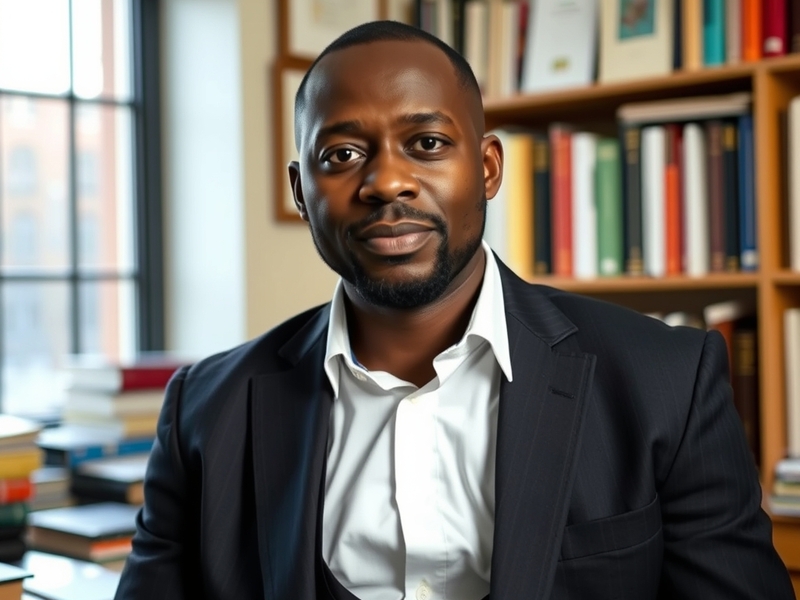
Jason Arday, the youngest Black professor in British history, has spent his career breaking barriers in academia while challenging systemic inequities in education. Appointed to a full professorship at Durham University in 2021 at age 37, Arday didn’t just shatter ceilings—he redesigned the architecture of higher education itself. His work focuses on racial justice in universities, decolonizing curricula, and creating pathways for underrepresented groups in academia.
From Teaching Assistant to Full Professor
Arday’s journey to the top of British academia was anything but conventional. Born in 1984 in Clapham, South London, he grew up in a working-class family where higher education wasn’t the norm. After leaving school with average grades, he worked as a teaching assistant in special needs education, a role that sparked his passion for pedagogy. His real breakthrough came when he pursued a PhD in education at the University of Cambridge, where his research on institutional racism in British universities caught the attention of senior academics.
His appointment to a lectureship at the University of Roehampton in 2014 marked the beginning of his rapid ascent. By 2021, he had become the youngest Black professor in the UK, a title that carried symbolic weight far beyond his CV. “Representation matters,” Arday has said. “When students see someone who looks like them in a position of authority, it changes what they believe is possible.” His rise wasn’t just personal—it signaled a shift in how British universities were beginning to confront their own complicity in systemic racism.
The Academic’s Mission: Decolonizing Universities
Arday’s work extends beyond individual achievement. He has positioned himself as a leading voice in the movement to decolonize higher education, arguing that British universities were built on colonial ideologies and remain structurally biased against Black and minority ethnic scholars. His research highlights how Eurocentric curricula, lack of diversity in faculty, and unconscious bias in hiring practices perpetuate inequality.
One of his most significant contributions has been in teacher training. Arday developed frameworks for educators to recognize and address racial bias in their classrooms. His Education category page on Dave’s Locker aggregates similar resources, offering practical tools for teachers navigating these complex issues. His 2022 book, Being an Antiracist Educator, became a key text in teacher-training programs across the UK, blending theory with actionable strategies.
Arday’s approach isn’t just about critiquing the system—it’s about rebuilding it. He advocates for mandatory anti-racism training for university staff, diversifying reading lists to include non-Western scholars, and creating mentorship programs for Black academics. These aren’t fringe demands; they’re becoming mainstream expectations in progressive academic circles.
A Critic of the Academy’s Slow Pace of Change
Despite his influence, Arday hasn’t shied away from criticizing the very institutions he’s part of. He has frequently called out the “performative allyship” of universities that make public commitments to diversity while maintaining exclusionary practices behind closed doors. In a 2023 interview with The Guardian, he described the sector as “still stuck in the 1960s when it comes to racial equity.”
His most pointed critique targets the lack of Black professors in senior leadership roles. While Black academics make up 2.5% of UK university staff, they represent just 1% of professors—a statistic Arday describes as “a damning indictment of institutional inertia.” He points to data showing that Black academics are more likely to be hired on fixed-term contracts and less likely to be promoted, even when their research output matches or exceeds that of their white peers.
Arday’s activism extends to policy. He has advised the UK government on its Race Disparity Audit and worked with organizations like the University and College Union to push for structural reforms. His influence is reshaping how universities measure success—not just by citation counts or grant income, but by their impact on social mobility and racial equity.
The Broader Implications of Arday’s Work
Arday’s career forces a confrontation with uncomfortable truths about British academia. His success story, while inspiring, underscores a painful reality: it should never have taken this long for a Black professor to reach the top. His work isn’t just about individual achievement; it’s about exposing the gaps in a system that claims to value meritocracy while systematically excluding talent based on race.
For other marginalized groups in academia, Arday’s rise offers a blueprint for navigating a system designed to keep them out. His mentorship of early-career Black scholars has created a ripple effect, with many now occupying positions he once fought to enter. This generational shift is crucial—change in academia moves at a glacial pace, but it moves faster when those at the top actively pull others up with them.
Arday’s impact also extends to the students he teaches. At Durham, he has redesigned modules on race and education, incorporating the voices of Black scholars, activists, and theorists who have historically been sidelined. Students of color, in particular, have reported feeling more seen and supported in his classrooms—a testament to the power of representation in education.
The challenges ahead are significant. Universities still grapple with how to implement meaningful change rather than superficial gestures. Arday’s work serves as both a roadmap and a warning: progress is possible, but it requires sustained pressure, accountability, and a willingness to confront uncomfortable truths. His career proves that one person can shift the dial—but systemic change demands collective action.
As Arday continues to challenge the status quo, his legacy will be measured not just by the titles he holds, but by the doors he opens for others. In an era where universities are increasingly under scrutiny for their role in perpetuating inequality, his voice remains indispensable. The question now is whether the academy is ready to listen—and act—on what he’s saying.
Key Takeaways on Jason Arday’s Impact
- Youngest Black professor in British history, appointed at Durham University in 2021.
- Focuses on racial justice in higher education, including decolonizing curricula and diversifying faculty.
- Advocates for mandatory anti-racism training, diversified reading lists, and mentorship programs for underrepresented scholars.
- Criticizes performative allyship and slow pace of change in British universities.
- His mentorship is creating a new generation of Black academics, reshaping the landscape of higher education.
Arday’s story is a reminder that progress in academia isn’t just about intellectual contributions—it’s about confronting power, privilege, and the systems that uphold them. His work challenges us to ask: What does it mean for an institution to truly value diversity? And how long will it take for the answers to match the rhetoric?