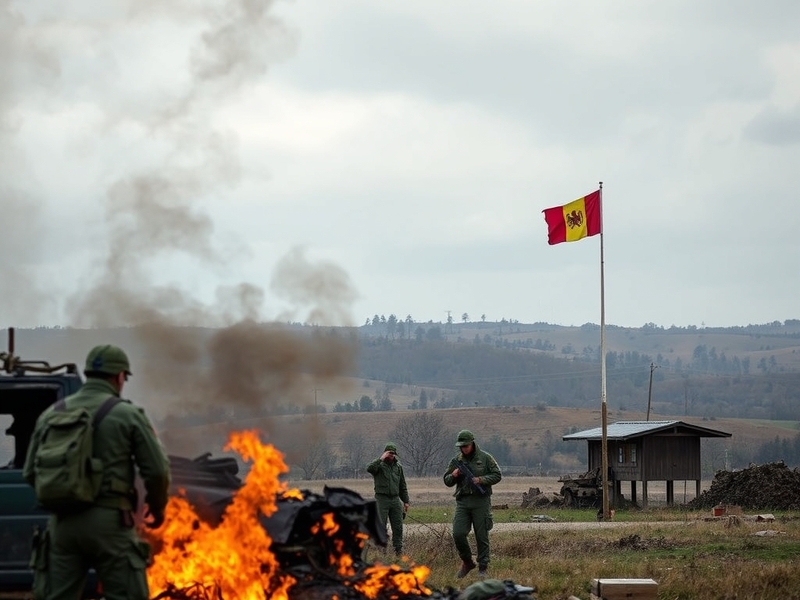
The recent drone strike near Moldova’s border with Ukraine has raised fresh concerns about the spillover effects of Russia’s war into neighboring countries. On the morning of October 15, two Russian-made drones crossed into Moldovan airspace, triggering air raid sirens in the breakaway region of Transnistria and prompting an emergency response from Chisinau. While no injuries were reported, the incident underscores the fragile stability of a country that has managed to remain neutral despite its proximity to one of Europe’s most violent conflicts in decades.
Moldova’s government quickly condemned the violation as a deliberate provocation. President Maia Sandu described the incursion as an attempt to destabilize the region, emphasizing that such actions risk dragging neutral nations into a conflict they have actively sought to avoid. The drones, believed to be reconnaissance models, were reportedly shot down by Moldovan air defenses before they could reach deeper into the country. International observers, including NATO and the EU, have called for restraint while urging both sides to respect Moldova’s sovereignty.
This is not the first time Transnistria—a sliver of land along Moldova’s eastern border, technically part of Moldova but under de facto Russian control since the 1990s—has been a flashpoint. The region hosts a Russian military presence and functions as a semi-independent entity backed by Moscow. Analysts suggest the drone strike may have been aimed at testing Moldova’s defenses or sending a message to Ukraine about Russia’s willingness to expand the battlefield. Whatever the intent, the incident has forced Chisinau to rethink its security posture at a time when it is already grappling with energy shortages and political divisions.
Transnistria: A Frozen Conflict with Global Implications
Transnistria’s status remains one of Europe’s most enduring unresolved disputes. Following the collapse of the Soviet Union, the region declared independence after a brief but bloody war between Moldovan forces and Russian-backed separatists. Despite multiple rounds of negotiations, no peace treaty has ever been signed. Today, Transnistria operates like a mini-state—with its own government, currency, and military—yet remains unrecognized by the international community.
The presence of around 1,500 Russian troops stationed in Transnistria has long been a point of contention. Moscow insists the forces are there to protect Russian-speaking civilians and maintain peace, but Chisinau views them as an illegal occupation. The recent drone strike has amplified these tensions, raising fears that Russia could use Transnistria as a staging ground for further incursions into Ukraine or Moldova itself.
For Moldova, the challenge is balancing neutrality with self-defense. The country has avoided direct involvement in the war but has become increasingly reliant on Western aid and military support. In September, Moldova signed a defense cooperation agreement with France, signaling a shift toward closer ties with NATO-aligned nations. Yet public opinion remains divided, with some citizens wary of provoking Russia and others demanding stronger measures to deter aggression.
Analysts warn that the drone strike could mark a turning point. If Russia escalates operations in Transnistria, Moldova may have little choice but to abandon its neutral stance—a move that could draw it into the war or force it to seek even greater protection from the West. The incident also highlights the broader risks of proxy conflicts in Eastern Europe, where unresolved territorial disputes continue to simmer beneath the surface of geopolitical tensions.
Regional Reactions: Fear, Defiance, and Diplomatic Chess
The international response to the drone strike has been swift but cautious. NATO issued a statement calling on Russia to respect Moldova’s territorial integrity, while the EU reiterated its support for Chisinau’s sovereignty. Ukraine, which shares a long and porous border with Moldova, accused Russia of deliberately escalating tensions to divert attention from its stalled offensive in the east.
Within Moldova, reactions have been mixed. In Chisinau, protesters gathered outside government buildings, demanding stronger action against Russian aggression. Meanwhile, in Tiraspol—the capital of Transnistria—local officials downplayed the incident, calling it a routine border violation rather than a deliberate attack. The divide reflects the deep political and ethnic rifts that have plagued Moldova for decades.
Analysts point out that Russia’s strategy may be less about outright invasion and more about psychological pressure. By probing Moldova’s defenses and testing Western resolve, Moscow could be probing for weaknesses in the region’s collective security framework. The drone strike, therefore, is not just a military incident but a calculated move in a larger geopolitical game.
For neighboring countries like Romania and Bulgaria, the implications are clear. Both are NATO members and have already taken steps to bolster their own defenses. Romania, in particular, has increased patrols along its border with Moldova, while Bulgaria has called for greater EU coordination to prevent further escalation. The fear is that if Russia succeeds in destabilizing Moldova, the entire Black Sea region could become a new front in the war.
What’s Next for Moldova? Neutrality Under Pressure
Moldova’s path forward is fraught with uncertainty. The government has so far resisted calls to join NATO or allow foreign troops on its soil, fearing it could provoke Russia. Yet the drone strike has forced a reckoning: neutrality may no longer be a viable option if the conflict continues to spill across borders.
One potential outcome is increased military cooperation with the West. Moldova has already received non-lethal aid from the U.S. and EU, including medical supplies and cybersecurity support. There are also discussions about expanding intelligence-sharing programs to monitor Russian movements in Transnistria. Such steps could help deter further provocations but would also risk drawing Moldova deeper into the war’s orbit.
Another possibility is a renewed push for a political solution. Some analysts suggest that the drone strike could be a signal from Moscow that it is open to negotiations—albeit on its own terms. If that’s the case, Moldova may find itself pressured to make concessions, such as recognizing Transnistria’s autonomy or limiting its defense ties with the West. Either way, the stakes are high.
For the Moldovan people, the drone strike is a stark reminder of how fragile peace can be. The country has spent years trying to build a stable, European future, only to find itself once again caught in the crossfire of a larger conflict. The question now is whether Chisinau can navigate this crisis without sacrificing its hard-won neutrality—or whether the war will eventually force it to choose a side.
Key Takeaways from the Moldova Border Incident
- The drone strike near Moldova’s border with Ukraine highlights the risks of spillover from the war.
- Transnistria’s unresolved status makes it a potential flashpoint for further escalation.
- Moldova’s neutrality is under pressure as it seeks to balance Western support with avoiding direct conflict.
- International actors like NATO and the EU have condemned the violation but stopped short of direct intervention.
- The incident underscores the broader fragility of Eastern Europe’s post-Cold War security architecture.
As the war in Ukraine drags on, the ripple effects continue to reshape the region’s political and military landscape. Moldova, once a bystander to the conflict, now finds itself at the center of a new crisis—one that could redefine its future and test the limits of Europe’s ability to contain the war’s spread.