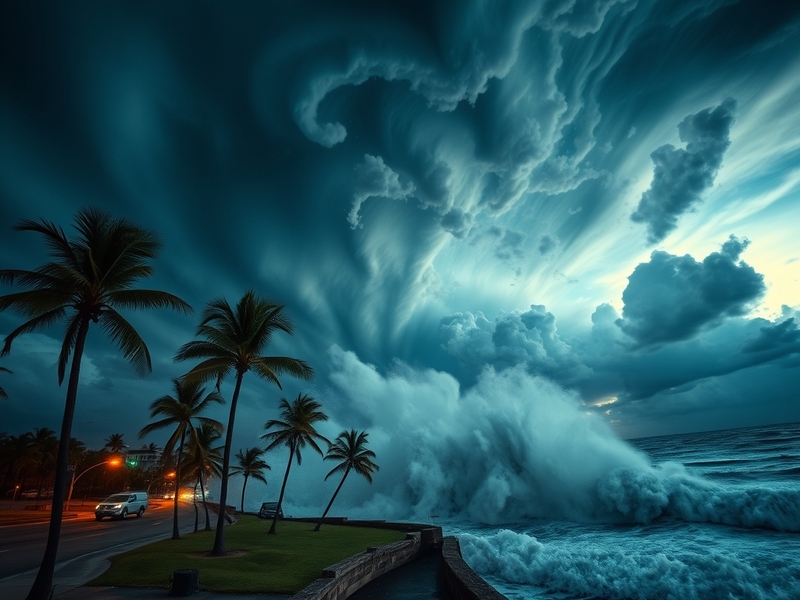
Hurricanes rank among Earth’s most powerful and destructive natural phenomena, capable of reshaping coastlines, flooding cities, and leaving lasting scars on communities. These massive rotating storms form over warm ocean waters, drawing energy from heat and moisture to grow into systems that can span hundreds of miles. While modern forecasting has improved warning times, hurricanes still claim lives and cause billions in damage each year. Understanding how these storms develop, move, and intensify helps communities prepare and stay safer when the next one approaches.
How Hurricanes Form and Strengthen
Hurricanes begin as tropical disturbances—clusters of thunderstorms over warm ocean water, typically above 80°F (27°C). When conditions are right, these disturbances can organize into tropical depressions, then tropical storms, and eventually hurricanes. The process hinges on several key factors: warm sea surface temperatures, low wind shear, high humidity, and a pre-existing weather disturbance. Once winds exceed 74 mph, the storm earns the name hurricane, with categories ranging from 1 to 5 on the Saffir-Simpson scale based on wind speed and potential damage.
Not all tropical storms become hurricanes. Wind shear—changes in wind speed or direction with altitude—can tear apart developing systems by tilting their structure. Conversely, low shear allows storms to build vertically, stacking thunderclouds and intensifying circulation. Moisture availability also plays a critical role; dry air can weaken or even dissipate a storm by disrupting cloud formation. The Atlantic hurricane season runs from June to November, with peak activity between mid-August and October when ocean temperatures are warmest.
Tracking and Predicting Hurricane Paths
Modern hurricane forecasting relies on satellite imagery, reconnaissance aircraft, and advanced computer models. The National Hurricane Center (NHC) in Miami issues official forecasts and warnings for the Atlantic and eastern Pacific basins. Forecasters use data from geostationary satellites to monitor storm development in real time, while “Hurricane Hunters”—pilots flying into storms—collect critical measurements like wind speed, pressure, and temperature at different altitudes.
Computer models simulate atmospheric conditions to predict a storm’s track and intensity. While track forecasts have improved significantly—today’s 5-day track errors are about half of what they were in the 1990s—intensity forecasts remain challenging. Rapid intensification, when a storm gains 35+ mph in wind speed in 24 hours, still surprises forecasters and residents alike. For example, Hurricane Ian in 2022 rapidly intensified before striking Florida, catching some coastal areas off guard. Tools like the Science section on Dave’s Locker provide deeper context on atmospheric science and storm behavior.
- Satellites provide continuous monitoring and early detection.
- Reconnaissance aircraft drop instruments called dropsondes into storms to measure conditions.
- Computer models like the GFS and ECMWF help project future storm movement.
- Buoy networks and coastal radar supplement data in high-risk zones.
The Human and Economic Toll of Major Hurricanes
The most powerful hurricanes can generate storm surges—walls of seawater pushed ashore by the storm’s winds—that cause catastrophic flooding. Storm surge is responsible for about half of all hurricane-related deaths in the U.S. and often accounts for the highest financial losses. Hurricane Katrina in 2005, for instance, produced a 28-foot storm surge that breached levees in New Orleans, leading to over 1,800 deaths and $190 billion in damages. More recently, Hurricane Ian in 2022 brought a 15-foot surge to Fort Myers Beach, destroying homes and businesses.
Beyond surge, hurricanes bring destructive winds, inland flooding from heavy rain, and tornadoes. Economic impacts ripple across industries—agriculture, tourism, and supply chains can suffer for years. Puerto Rico’s economy, for example, has struggled to recover fully after Hurricane Maria in 2017, which knocked out power for nearly a year in some areas and caused an estimated $90 billion in damage. Recovery efforts often face delays due to insurance disputes, infrastructure damage, and population displacement.
Vulnerable populations—low-income families, elderly residents, and those with disabilities—are disproportionately affected by hurricanes. Evacuation routes may be inaccessible, and temporary shelters can become overcrowded. Social vulnerability maps now help emergency managers identify at-risk neighborhoods and allocate resources more effectively. Investing in resilient infrastructure—such as elevated homes, flood barriers, and microgrids—can reduce long-term costs and save lives.
Climate Change and the Future of Hurricanes
Scientific consensus indicates that climate change is influencing hurricane behavior. Warmer ocean temperatures provide more energy for storms, potentially leading to stronger hurricanes. Studies suggest that the proportion of high-intensity Category 4 and 5 storms has increased over the past four decades. While the total number of tropical storms may not rise significantly, the most intense hurricanes are becoming more frequent.
Climate models also project that hurricanes may move more slowly, lingering over coastal areas and dumping heavier rainfall. Slower-moving storms like Hurricane Harvey in 2017 dumped over 60 inches of rain in parts of Texas, causing catastrophic inland flooding. Additionally, rising sea levels exacerbate storm surge impacts, making coastal flooding more severe even from weaker storms. These trends highlight the need for both climate mitigation—reducing greenhouse gas emissions—and adaptation—building resilient communities.
Researchers are exploring how to improve early warning systems and emergency response. Innovations like AI-driven forecast models and real-time flood sensors are being tested to provide faster, more localized alerts. Public awareness campaigns now emphasize not just wind speeds, but also storm surge and rainfall totals, which are often deadlier than winds alone. Education remains a powerful tool in reducing hurricane-related fatalities.
Hurricanes are a stark reminder of nature’s power and humanity’s vulnerability. While we cannot control the storms that form over the ocean, we can control how prepared we are when they strike. Advances in science and technology continue to improve forecasts, but preparation, community planning, and climate action remain essential. By understanding the risks and investing in resilience, we can reduce the toll these storms take on lives and livelihoods. The next time a hurricane threatens, early action and informed decisions could make all the difference.