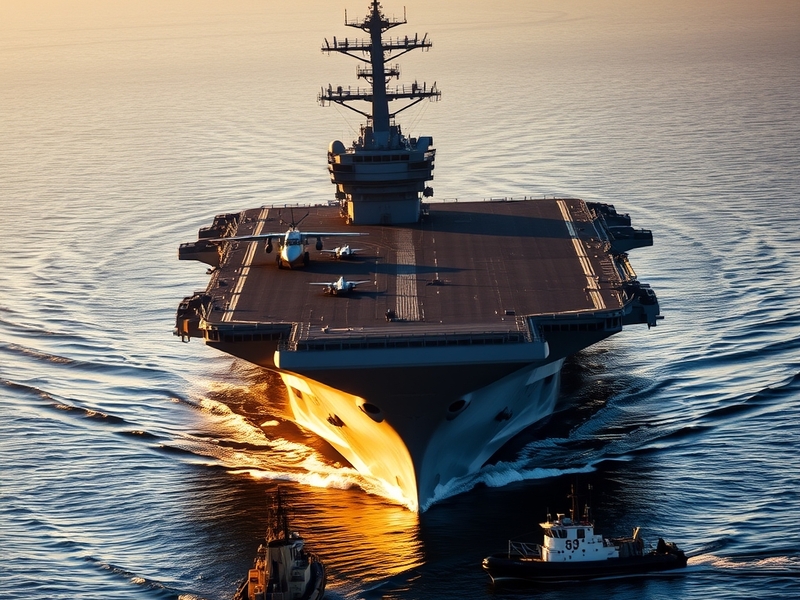
The USS Abraham Lincoln (CVN-72) stands as a monumental symbol of American naval power, a 100,000-ton behemoth capable of projecting force across the globe with its 60-plus aircraft and 5,000-person crew. Commissioned in 1989, this Nimitz-class supercarrier has become a cornerstone of U.S. military operations, from combat missions in the Persian Gulf to humanitarian relief after natural disasters. Its nuclear propulsion system allows it to operate independently for over 20 years without refueling, a capability that has redefined modern naval warfare.
Designed to dominate the seas, the Abraham Lincoln carries a lethal mix of F/A-18 Super Hornets, E-2D Hawkeyes, and MH-60 Seahawk helicopters. Its flight deck spans four acres, making it one of the most recognizable vessels in the world. The carrier’s history is marked by pivotal moments, including its role in enforcing no-fly zones over Iraq in the 1990s and its rapid deployment after the 9/11 attacks. These operations underscore its strategic importance in maintaining global stability.
The Birth and Design of a Naval Titan
The USS Abraham Lincoln was built at Newport News Shipbuilding in Virginia, where construction began in 1984. Named after the 16th U.S. president, the carrier was launched in 1988 and commissioned the following year. Its design incorporates cutting-edge technology, including advanced radar systems, a sophisticated command-and-control network, and reinforced steel to withstand extreme conditions. The ship’s nuclear reactors, provided by Bechtel, enable it to reach speeds of over 30 knots while generating enough electricity to power a small city.
One of the carrier’s most distinctive features is its electromagnetic aircraft launch system (EMALS), which replaced traditional steam catapults. This system uses linear induction motors to accelerate aircraft more efficiently, reducing maintenance and increasing sortie rates. The Abraham Lincoln was the first carrier to deploy this technology, setting a new standard for naval aviation. Its hangar bay can store up to 60 aircraft, while the deck can launch and recover planes simultaneously, a feat of engineering that few other nations can replicate.
Operational History: From War Zones to Disaster Relief
The USS Abraham Lincoln has seen action in nearly every major U.S. conflict since the Gulf War. In 1991, it enforced no-fly zones over Iraq as part of Operation Southern Watch, a mission that lasted for more than a decade. During the Iraq War in 2003, the carrier launched over 1,000 sorties, playing a critical role in the initial invasion. Its air wing also supported operations in Afghanistan, demonstrating its versatility in both land and sea conflicts.
Beyond combat, the Abraham Lincoln has been a lifeline in humanitarian crises. After the 2004 Indian Ocean tsunami, the carrier was one of the first ships on the scene, delivering medical supplies and search-and-rescue teams to Indonesia. Similarly, in 2010, it responded to the Haiti earthquake, providing critical aid and evacuation support. These missions highlight the carrier’s dual role as both a warship and a humanitarian asset, a rare combination in modern navies.
The carrier’s most famous deployment came in 2003 when it was diverted to the Persian Gulf during the Iraq War. Its presence was so significant that it became a symbol of American resolve, earning the nickname “Abe” among sailors and the public alike. The deployment also marked the first time a carrier strike group operated in a combat zone without a traditional battle group escort, showcasing the Abraham Lincoln’s self-sufficiency.
Modern Upgrades and Future Role
To keep pace with evolving threats, the USS Abraham Lincoln underwent a $3 billion mid-life refueling and complex overhaul (RCOH) between 2013 and 2017. This overhaul extended its service life by 25 years and included upgrades to its radar, communication systems, and aircraft launch capabilities. The carrier’s air wing was also updated to include the F-35C Lightning II, ensuring it remains relevant in an era of stealth technology and hypersonic missiles.
The Abraham Lincoln’s future missions are likely to focus on the Indo-Pacific region, where tensions with China are rising. Its ability to project power without relying on foreign bases makes it an invaluable asset in a contested environment. The carrier’s recent deployments to the South China Sea have drawn international attention, underscoring its role in maintaining freedom of navigation in critical waterways.
The U.S. Navy plans to keep the Abraham Lincoln in service until at least 2042, with additional upgrades to its systems and armament. These enhancements will include advanced cyber defenses, directed-energy weapons, and next-generation drones. As the carrier enters its fourth decade, it continues to evolve, proving that even the most advanced warships must adapt to stay ahead.
A Legacy of Service and Sacrifice
The USS Abraham Lincoln’s crew is as much a part of its legacy as its steel hull. Over the years, thousands of sailors have served aboard the carrier, many of whom have gone on to command their own ships or serve in high-ranking positions. The ship’s namesake, Abraham Lincoln, is remembered for preserving the Union and abolishing slavery, values that resonate with the carrier’s crew. This connection to history adds a layer of meaning to its service, making it more than just a machine of war.
The carrier has also been the site of unforgettable moments, such as the 2004 “Mission Accomplished” speech by then-President George W. Bush, which marked the end of major combat operations in Iraq. While the speech itself became controversial, the carrier’s role in the conflict remains a testament to its operational excellence. The Abraham Lincoln’s story is one of resilience, innovation, and unwavering service to the nation.
As the U.S. Navy looks to the future, the USS Abraham Lincoln will remain a cornerstone of its fleet. Its ability to adapt, combined with its storied history, ensures that it will continue to shape naval warfare for decades to come. For those who serve aboard it, the carrier is more than just a ship—it’s a floating city, a fortress, and a symbol of American power.