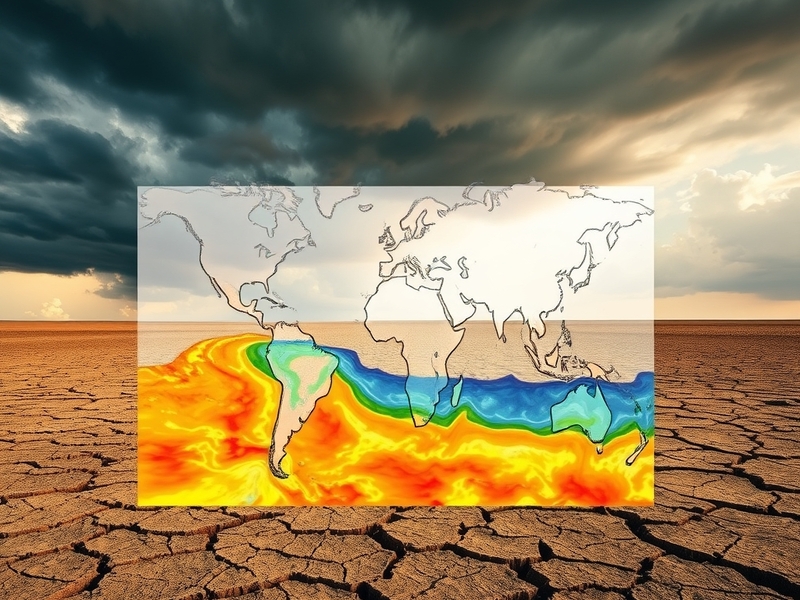
El Niño has once again taken center stage in global weather discussions, reshaping climates from the Americas to Asia and beyond. The phenomenon, characterized by unusually warm ocean temperatures in the central and eastern Pacific, disrupts typical weather patterns, bringing extreme conditions to regions that rarely experience them. As meteorologists refine their forecasts, communities brace for the ripple effects—from droughts in Australia to torrential rains in California. This year’s El Niño, though not the strongest on record, arrives with its own set of challenges, forcing governments and individuals to adapt in real time.
The Science Behind the Disruption
At its core, El Niño is a natural climate cycle that occurs every two to seven years, but human-induced climate change has intensified its impacts. Warmer ocean surfaces interact with the atmosphere, altering wind patterns and redistributing heat worldwide. The National Oceanic and Atmospheric Administration (NOAA) tracks these shifts using buoys, satellites, and computer models, providing early warnings that shape policy decisions. For farmers in Argentina, this means delayed planting seasons; for fishermen in Peru, collapsing anchovy populations.
El Niño’s counterpart, La Niña, often follows, creating a seesaw effect that meteorologists describe as the El Niño-Southern Oscillation (ENSO). The current phase, however, defies simple predictions. Some regions, like the Horn of Africa, face prolonged dry spells, while others, such as the southern United States, grapple with sudden floods. These inconsistencies highlight the complexity of global weather systems, where a single degree of warming in the Pacific can cascade into chaos thousands of miles away.
Global Impacts: From Droughts to Deluges
The consequences of El Niño stretch across continents, often in unexpected ways. In Southeast Asia, smog from slash-and-burn agriculture mingles with dry conditions, creating hazardous air quality that disrupts daily life. Meanwhile, in the Philippines, typhoons—supercharged by warmer waters—have become more frequent, testing the resilience of communities still recovering from past disasters.
Closer to home, California’s reservoirs, already strained by years of drought, now face the opposite problem. Heavy winter storms threaten to overwhelm infrastructure, raising concerns about flooding in urban areas. Emergency preparedness teams have shifted focus from wildfire prevention to flood control, a stark reminder of how quickly priorities change in a warming world.
Not all effects are negative. Some farmers in the U.S. Midwest may benefit from milder winters, while European ski resorts struggle with unseasonably warm temperatures. Even the global economy feels the strain, as supply chains for commodities like coffee and cocoa face disruptions. The World Bank estimates that El Niño can shave off up to 0.5% of global GDP during severe events, a figure that underscores the phenomenon’s far-reaching influence.
Cultural and Historical Context
El Niño is more than a scientific curiosity—it has shaped human history in ways that resonate today. Indigenous communities in the Andes, for instance, have long associated the phenomenon with the god Amaru, a serpent believed to control water. Their oral traditions warned of floods and droughts centuries before modern meteorology existed. Similarly, fishermen along Peru’s coast once relied on the sudden appearance of warm currents to predict changes in fish populations, a practice that evolved into today’s climate science.
The term “El Niño” itself originates from Spanish settlers in the 19th century, who noticed unusual warming of coastal waters around Christmas (El Niño means “the little boy” in Spanish, referring to the Christ child). Yet, it wasn’t until the 1980s that scientists recognized the global scale of its impacts. Today, the phenomenon serves as a case study in how traditional knowledge and modern technology can coexist to address climate challenges.
Preparing for an Uncertain Future
As El Niño’s effects ripple across the globe, experts emphasize the need for adaptive strategies. Cities like Jakarta and Mumbai are investing in flood barriers and drainage systems, while rural communities turn to drought-resistant crops. International aid organizations, such as the Red Cross, are pre-positioning supplies in high-risk areas, a lesson learned from past disasters.
Technology plays a crucial role in mitigation. Satellites like NOAA’s GOES-16 provide real-time data, while AI-driven models improve forecast accuracy. Yet, challenges remain. In developing nations, limited resources hinder large-scale adaptation. The World Meteorological Organization estimates that 60% of countries lack adequate early warning systems, leaving millions vulnerable.
For those interested in tracking El Niño’s progression, resources like Science channels and NOAA’s Climate.gov offer up-to-date insights. While the phenomenon itself is cyclical, its interactions with climate change suggest a future where extreme weather becomes the norm rather than the exception. The question now is not whether El Niño will return, but how prepared society will be when it does.
El Niño’s story is far from over. As communities adapt, scientists refine their models, and policymakers grapple with long-term solutions, one thing is clear: understanding this phenomenon is key to navigating an increasingly unpredictable world. Whether through ancient wisdom or cutting-edge technology, the lessons of El Niño remind us that nature’s rhythms, though powerful, can be met with resilience and ingenuity.