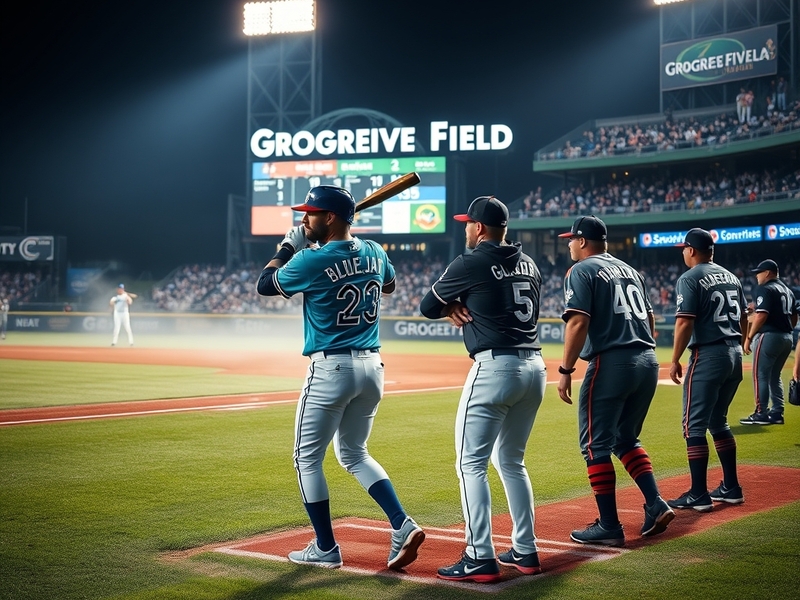
The Cleveland Guardians and the Toronto Blue Jays have carved out distinct identities in Major League Baseball, yet their recent clashes on the field have blurred the lines between rivalry and mutual respect. The Guardians, once known as the Indians, have spent the last decade rebuilding their image while maintaining a scrappy, small-market mentality. Meanwhile, the Blue Jays—flush with talent and financial muscle—have positioned themselves as perennial contenders, their roster a mix of power hitters and polished veterans. When these two teams meet, the games often transcend mere competition, offering a study in contrasts: grit versus glamour, underdogs versus favorites, and the evolving economics of baseball itself.
The Guardians’ Resilience and the Blue Jays’ Ambition
The Guardians’ approach to the 2023 season was defined by adaptability. After a surprising 2022 run to the playoffs, expectations were high, but injuries to key pitchers like Shane Bieber and Emmanuel Clase forced Cleveland to lean on its depth. The team’s bullpen became a strength, with relievers like Nick Sandlin and Trevor Stephan stepping into high-leverage roles. Offensively, José Ramírez and Andrés Giménez continued to produce at an elite level, but the Guardians’ ability to manufacture runs—through small ball, timely hitting, and aggressive baserunning—remained their signature.
The Blue Jays, on the other hand, entered the season with a clear mandate: win now. Toronto’s lineup, headlined by Vladimir Guerrero Jr. and Bo Bichette, is built for power, with the league’s fifth-best home run total in 2023. The rotation, anchored by Kevin Gausman and Alek Manoah, provided stability, while the bullpen, despite occasional hiccups, remained one of the game’s most dominant units. The Blue Jays’ front office has embraced a high-risk, high-reward strategy, trading for stars like Brandon Belt and Danny Jansen at the deadline to bolster their playoff push. This approach reflects a franchise that views itself as a championship contender, willing to spend big to close the gap on the Yankees and Red Sox.
Key Differences Between the Two Teams
- Payroll and Financial Strategy: The Guardians operate with one of the league’s smallest payrolls ($95 million in 2023), relying on player development and savvy trades. The Blue Jays, by contrast, spent $165 million in 2023, prioritizing star power and veteran stability.
- Home Run Dependency: Toronto’s offense is heavily reliant on the long ball, ranking second in the AL in home runs in 2023. Cleveland, while still potent, spreads its offensive production across contact hitting, speed, and situational awareness.
- Pitching Depth: The Guardians’ rotation features a mix of young arms and crafty veterans, while the Blue Jays’ rotation leans on power pitchers with high strikeout rates.
- Defensive Flexibility: Cleveland’s infield—featuring Giménez at second and Ramírez at third—is among the most athletic in baseball. Toronto’s defense, while improved, has been prone to lapses, particularly in the outfield.
These differences create a fascinating dynamic when the two teams meet. The Guardians often force the Blue Jays to grind out wins, using their speed and contact-hitting prowess to exploit defensive weaknesses. Toronto, meanwhile, looks to overwhelm with power, daring opponents to keep up with its offensive firepower. The mental aspect of these matchups can’t be overstated; the Guardians thrive when they force teams out of their comfort zones, while the Blue Jays’ confidence is rooted in their ability to dominate at the plate.
The 2023 Showdowns: A Microcosm of MLB’s Shifting Landscape
The Guardians and Blue Jays faced each other six times in 2023, with Toronto winning four of those games. Yet the outcomes often hinged on small moments—late-inning errors, clutch hits, or managerial decisions that swung momentum. In one memorable series in June, the Blue Jays swept a three-game set at Progressive Field, with Guerrero Jr. delivering a walk-off homer in the series finale. Cleveland’s response was telling: rather than wilting, the team regrouped, sweeping a late-August series in Toronto to keep its playoff hopes alive.
These matchups highlighted a broader trend in baseball: the erosion of traditional rivalries in favor of strategic, data-driven competition. The Guardians and Blue Jays don’t have a storied history like the Yankees-Red Sox or Dodgers-Giants, but their recent battles feel like a preview of what’s to come. As the AL Central grows more competitive—with the Tigers and Royals also flexing their muscles—the Guardians and Blue Jays represent two distinct paths to success.
What These Games Reveal About the Future of Baseball
- The Small-Market vs. Big-Market Divide: The Guardians’ success in 2023 underscores the viability of the small-market model, where smart drafting, development, and trades can compete with teams flush with cash. The Blue Jays, meanwhile, are a case study in how financial power can accelerate a rebuild—but at what cost? The luxury tax penalties they incurred in 2023 may force tough decisions in the coming years.
- The Shift’s Decline and the Rise of the Two-Way Player: Cleveland’s ability to produce versatile players like Giménez—who can hit for average, power, and play elite defense—mirrors a leaguewide trend. As defensive shifts become less prevalent due to rule changes, teams are prioritizing athletes who can impact the game in multiple ways. The Blue Jays, too, have invested in such players, though their outfield defense remains a work in progress.
- The Importance of Bullpen Depth: Both teams entered 2023 with strong bullpens, but the Guardians’ reliance on relievers like Emmanuel Clase and James Karinchak showed how critical late-inning arms are in close games. Toronto’s bullpen, while dominant at times, has been prone to meltdowns, particularly in high-leverage situations.
- The Role of Analytics in Player Evaluation: The Guardians have long been at the forefront of analytics, using data to identify undervalued players and optimize defensive alignments. The Blue Jays, though slower to adopt analytics under previous regimes, have since embraced a more data-driven approach, particularly in their pitching development and defensive positioning.
The Guardians vs. Blue Jays matchups are more than just games; they’re a reflection of baseball’s evolution. The Guardians represent the future of the sport—efficient, adaptable, and unafraid to challenge conventional wisdom. The Blue Jays, while still finding their footing in the postseason, embody the present: a team built to win now, with the resources to make it happen.
Beyond the Field: Cultural and Economic Implications
The rivalry between the Guardians and Blue Jays extends beyond the diamond. For Cleveland, a city still grappling with its identity post-industrial decline, the Guardians’ success has been a point of pride. The team’s embrace of its new name—dropping the “Indians” moniker in 2022—was a deliberate step toward inclusivity, and its on-field performance has helped heal old wounds. The Blue Jays, meanwhile, are a symbol of Toronto’s global ambitions. The franchise’s international scouting and marketing efforts have made it a darling of baseball’s global audience, particularly in Latin America and Asia.
Economically, the Guardians’ model offers a blueprint for other small-market teams. By focusing on player development and smart trades, Cleveland has built a contender without the financial constraints of larger markets. The Blue Jays, however, highlight the risks of the high-spending approach. While their payroll allows them to acquire top talent, it also limits their flexibility in the long term. The luxury tax threshold looms large, and Toronto’s ability to retain its core—Ramírez has already expressed a desire to remain with the team beyond 2023—will be a major storyline in 2024.
For fans, the Guardians and Blue Jays represent two different experiences. Cleveland’s games are often a study in efficiency, where every pitch and at-bat feels calculated. Toronto’s games are high-energy affairs, with a fanbase that expects nothing less than excellence. These differences make their matchups must-watch events, even if they lack the historical baggage of classic rivalries.
What’s Next for Both Teams?
The Guardians’ offseason plans are likely to focus on shoring up their rotation and bullpen depth. With Bieber’s contract expiring after 2024, Cleveland may explore extensions or trades to maintain its competitive window. The Blue Jays, meanwhile, face tough decisions about their core. Guerrero Jr. is arbitration-eligible after 2024, and Bichette’s long-term value will be a hot topic. Toronto’s front office must decide whether to double down on its current roster or explore blockbuster moves to take the next step.
One thing is certain: when these two teams meet again, the games will matter. Whether in the regular season or—if both make the playoffs—the postseason, the Guardians vs. Blue Jays matchups will be a clash of philosophies, a battle between the old and the new in baseball. And for fans, that’s reason enough to tune in.