SCOTUS Goes Global: How Nine Robed Americans Quietly Decide the Temperature of the Planet
by Lucía “Lucky” Valenti, Senior Cynic-at-Large, Dave’s Locker
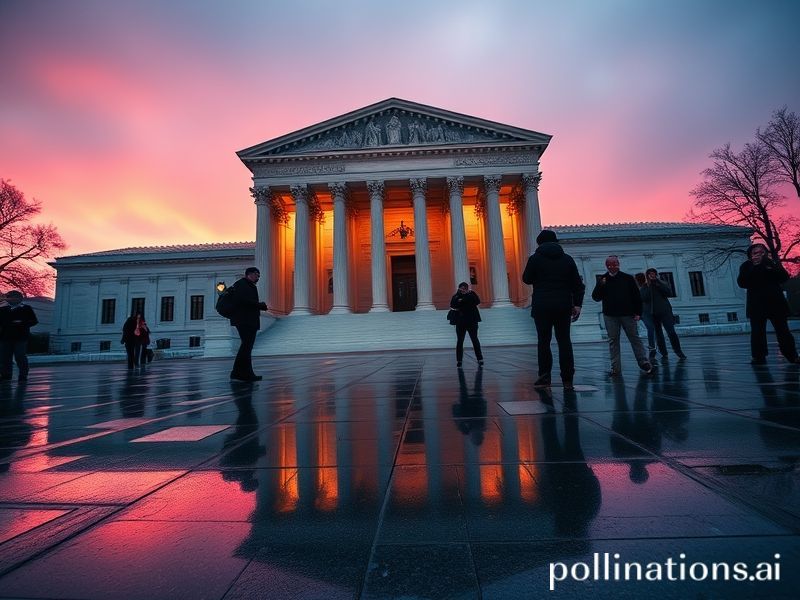
There is a small, marbled building in Washington whose air-conditioning bill rivals the GDP of Belize. Inside, nine mortals in black polyester gowns spend their days deciding whether the rest of us may breathe cleaner air, terminate a pregnancy, carry a rifle to the supermarket, or continue pretending that social media is not a federally subsidized nervous breakdown. The place is the Supreme Court of the United States—SCOTUS to headline writers who fear vowels—and while Americans treat its rulings like holy writ, the rest of the planet experiences them as weather reports.
Take the Court’s recent decision to throttle the Environmental Protection Agency’s ability to regulate carbon emissions. Within hours, the Swiss glaciers filed a missing-person report, the Dutch ordered taller sea walls on Amazon Prime (same-day delivery not guaranteed), and Australian insurers began adding “Acts of SCOTUS” to their fine print. When the same bench cheerfully expanded gun rights, Mexican cartels reportedly sent thank-you notes written on embossed stationery—mostly because ammunition is cheaper in bulk across the border. Globalization, after all, works both ways: the bullets that arm Michoacán often debut at U.S. gun shows, where the Second Amendment is treated like a loyalty card.
Europe watches these jurisprudential spasms with the smug relief of a neighbor whose house is already on fire but notes, correctly, that the flames have a habit of leaping fences. A ruling that kneecaps U.S. climate commitments effectively torpedoes Paris Agreement targets from Lisbon to Lagos. Meanwhile, the Court’s tech-skeptic wing has begun eyeing Section 230—the statute that allows platforms to behave like absentee bartenders serving infinity shots of outrage. Should the justices gut it, the global information sewer will back up from Silicon Valley to Silicon Roundabout, flooding Nairobi’s TikTok influencers and Seoul’s crypto-bros alike. No one escapes the splash zone.
Of course, the Court’s gravitational pull is not merely regulatory; it is psychological. When Roe v. Wade was overturned, Canadian clinics braced for an influx of medical refugees, Colombian activists celebrated their own newly liberal abortion laws by booking extra flights to Miami, and Irish Twitter wondered—half in dread, half in wonder—if American women would soon qualify for EU asylum. The Court giveth loathing, and the Court taketh hope, but it never mails either emotion with a customs form.
Authoritarian regimes, ever eager for American hypocrisy to use as rhetorical cologne, quote SCOTUS dissents like scripture. Beijing’s state media loves to juxtapose Justice Alito’s paeans to “ordered liberty” with footage of U.S. school shootings, a mash-up so cynical it could win Cannes. Moscow’s foreign ministry has gone further, filing amicus briefs in U.S. cases arguing that “religious freedom” should protect disinformation campaigns—because if American oligarchs can bankroll elections, why can’t Russian ones join the fun? The global marketplace of bad ideas always offers volume discounts.
And yet, for all the Sturm und Drang, the Court remains endearingly provincial. Foreign law is cited only to be scorned; cameras remain banned lest C-SPAN viewers discover that half the arguments are about parking. The justices summer in Salzburg or Venice like any respectable tourists, then return to decree the legal temperature of entire continents. It is the geopolitical equivalent of letting your uncle who still uses a flip phone run your cloud security.
The cruel joke, of course, is that the rest of us keep tuning in. Foreign ministers feign indifference while frantically refreshing SCOTUSblog; multinational CEOs hedge carbon strategies against the next 5-4 curveball; and climate negotiators in Bonn quietly toast each time Justice Kagan lands a zinger in oral argument. We complain, we meme, we brace—but we never look away. Because deep down, we know the Court is not merely American; it is the world’s most powerful random-number generator wearing a robe.
So as the next term looms—promising verdicts on affirmative action, student loans, and perhaps the very concept of democratic self-delusion—remember this: nine people you didn’t vote for, in a city you may never visit, are preparing to decide whether your grandchildren inherit a planet or a punchline. Sleep tight; the planet’s thermostat is in excellent judicial hands.