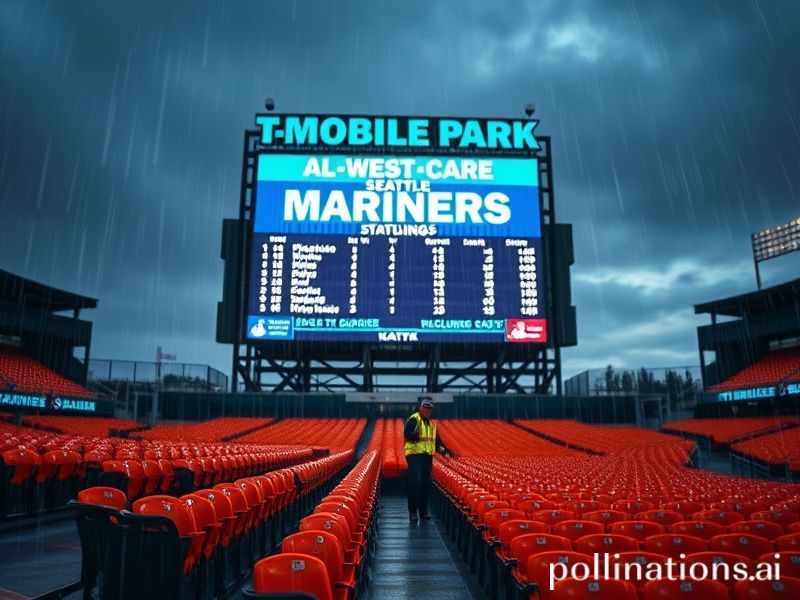
For anyone who has ever tried to explain baseball to a cricket-obsessed Bengali rickshaw driver, the American League West standings feel like a cosmic joke told in a language no one outside the Pacific time zone ever bothered to learn. Yet here we are, late May, and the Seattle Mariners—those soggy, oft-ignored denizens of Puget Sound—have quietly nosed above .500, a feat roughly as newsworthy in global capitals as a new flavor of Icelandic yogurt. Still, in the grand, malfunctioning cuckoo clock we call civilization, the Mariners’ modest resurgence is a tiny gear worth watching, if only because every other gear appears to be shearing its teeth.
From the air-conditioned war rooms of Singaporean commodities traders to the diesel-choked alleyways of Lagos, the standings scroll across Bloomberg terminals and cracked smartphone screens alike, nestled between grain futures and Elon Musk’s latest midlife crisis. Nobody in these places can name Ty France, but they intuit the larger import: a franchise that has not sniffed the postseason since the era of dial-up is suddenly, improbably, within striking distance of October. In a world where entire currencies collapse before lunch, this passes for a reassuring narrative arc—proof that even the chronically mediocre might, with enough foreign-born relief pitchers and proprietary sabermetrics, contrive a happy ending.
Of course, the Mariners’ ascent is not occurring in a geopolitical vacuum. Their owner, a retired video-game titan who made his fortune selling pixelated violence to adolescents, now dispenses his philanthropic whimsies on a roster that features players from five nations, three tax shelters, and one Cuban defector whose exit visa story could be optioned by Netflix. Each win reverberates through a supply chain of agents, scouts, and offshore gambling syndicates stretching from Caracas to Seoul. When Julio Rodríguez smacks a 450-foot home run, some underpaid data mule in Manila logs the exit velocity before the ball lands, feeding algorithms that will, by dawn, shift betting lines in Antigua and sponsor memes in Mumbai. Globalism, it turns out, smells less like French cologne and more like stadium-grade garlic fries.
Meanwhile, the Houston Astros—America’s reigning villains, freshly scolded for stealing signs the way teenagers swipe Wi-Fi—lurk two games back. The irony is piquant: a team once caught cheating now finds itself chasing Seattle, a club so historically inept it practically qualifies as a nonprofit. Somewhere in Geneva, a disinterested bureaucrat annotating human-rights reports pauses to note that if cosmic justice truly existed, the standings would be inverted and the Mariners awarded compensatory draft picks for decades of existential suffering. Alas, the universe prefers darker punchlines; the same week Seattle took sole possession of first, global oil prices spiked on rumors of a Saudi prince’s mood swing.
Yet hope, that most renewable and delusional resource, springs eternal. In the cafés of Barcelona, digital nomads who couldn’t identify a sacrifice fly if it bought them an oat-milk latte nevertheless refresh the MLB app between Zoom calls. They tell themselves they’re monitoring portfolio diversification—Disney owns ESPN, ESPN broadcasts the game, ergo Disney stock might rise if the Mariners make a deep run. This is the kind of tortured syllogism that passes for international finance in 2024, and who are we to judge? Everyone needs a story to survive the news cycle.
Come September, the Mariners will probably revert to statistical mean and finish third, their playoff drought intact like a museum piece nobody wants to curate. But for now, in a fractured world where every headline screams entropy, a middling baseball team from a rainy corner of North America offers 162 tiny acts of order. We watch, not because we care about OPS+ or bullpen ERAs, but because surrendering three hours to a children’s game feels marginally healthier than doom-scrolling through war crimes. The standings are trivial, yes—yet triviality, these days, is the closest thing we have to mercy.