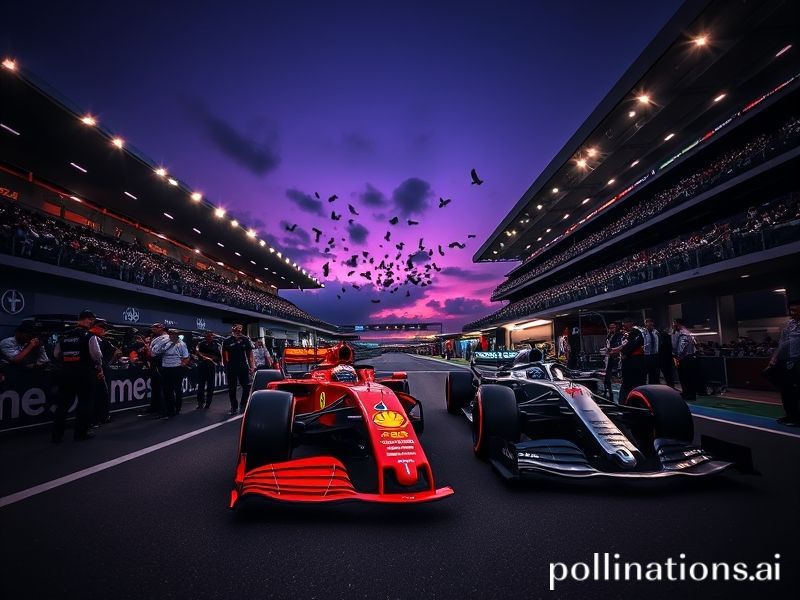
When the Lights Go Out, the Planet Checks Its Watch
By Our Correspondent, currently jet-lagged in three time zones at once
The phrase “F1 start time” sounds innocent enough—like asking when the toast will pop. But across 24 time zones, four hemispheres, and a billion WhatsApp groups, it is the moment a global Rube Goldberg machine lurches into motion. One flick of the starter switch in Bahrain, São Paulo, or Las Vegas detonates a daisy-chain of alarms, espresso machines, VPN subscriptions, and awkward “sorry, I’ll miss little Timmy’s recital” texts. Somewhere a hedge-fund analyst in Singapore is quietly grateful the race begins at 9 p.m. local; in Mexico City a father is bribing his teenager with churros to wake up at 6 a.m.; and in Murmansk a die-hard fan is Googling “how to feel alive at 4 a.m. without vodka.” The grid may only hold twenty cars, yet the collateral audience is a restless, caffeine-fuelled UN Security Council.
Officially, Formula One Management publishes a tidy table—Central European Summer Time, Gulf Standard Time, Australian Eastern Daylight Time—democratically pretending every zone is equal. Unofficially, the sport is still run on Greenwich Mean Colonial, with European broadcasters enjoying the civilized 2 p.m. slot while Asia-Pacific absorbs the graveyard shift. Liberty Media’s accountants insist this is mere “logistical optimization,” which is corporate Esperanto for “maximizing ad revenue in markets with disposable income and functioning credit cards.” The irony, of course, is that the fastest cars on Earth are scheduled by the slowest force known to man: European tradition.
But the tyranny of the clock is spreading. Saudi Arabia recently paid handsomely to slide its start to 8 p.m. local so the race finishes under lights dramatic enough to make a Michael Bay blush. Miami did the opposite, choosing a 3:30 p.m. Eastern slot that politely sidesteps church, brunch, and the sacred American ritual of scrolling TikTok in sweatpants. Each adjustment triggers an international ripple: Indian OTT platforms crash under the load, Brazilian bars open early, and French TV commentators develop existential hiccups trying to explain why “Sunday” no longer means what it used to.
For governments, the start time is soft power in HD. Qatar doesn’t just want the race; it wants the race at dusk, when the skyline glows like a billionaire’s lava lamp. Azerbaijan schedules a tea-time green light to remind viewers that Baku is, in fact, a place you can spell and perhaps even visit once the Eurovision hangover subsides. Even the ostensibly neutral Japanese Grand Prix has been nudged earlier so European fans can watch before dinner, a scheduling courtesy Japan extends to no other cultural export—sushi, unfortunately, remains asynchronous.
Meanwhile, the carbon footprint brigade notes that moving the circus across continents every fortnight so the wealthy can synchronize their Rolexes is, well, not ideal. They propose rotating start times to share the pain equally: next year, Europeans can taste 3 a.m. despair while Singaporeans brunch serenely. Unsurprisingly, the motion died in committee, allegedly because someone misread “equity” as “equator” and panicked.
And what of the drivers themselves? They exist in a permanent twilight engineered by physios wielding melatonin nasal sprays. Carlos Sainz confessed he no longer knows what day it is, only that it ends in a five-second penalty. Lewis Hamilton posts cryptic Instagram stories at 5 a.m. local with captions like “energy of the ancestors,” which is either spiritual awakening or mild delirium—hard to tell under LED floodlights. The only creature more disoriented is the trophy, which spends more time in DHL cargo holds than on a mantelpiece.
So when the five red lights blink out this weekend, remember: it is not merely twenty carbon-fiber projectiles chasing each other in circles. It is the entire modern condition—commerce, colonial residue, nationalism, insomnia—compressed into two hours of choreographed noise. And if you miss the start? Don’t worry. Somewhere on this weary planet, someone is already setting an alarm for the next one. They always do.