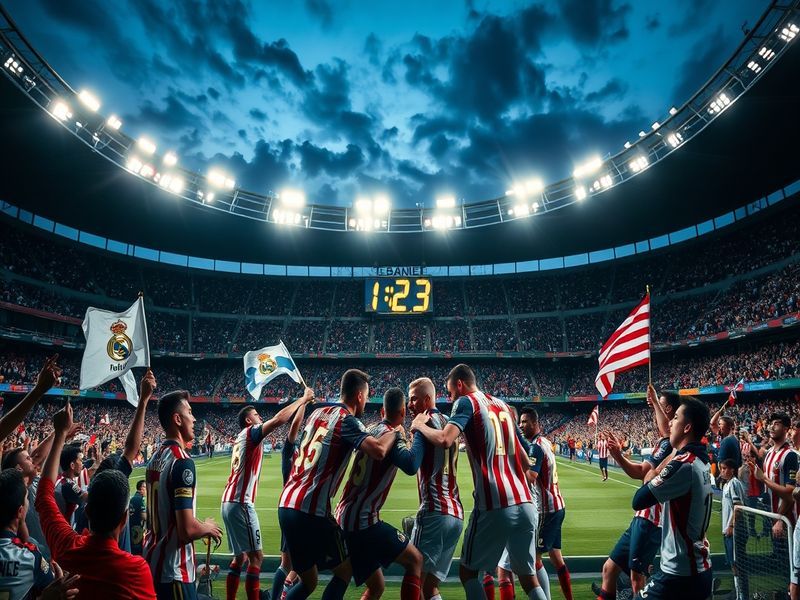
Real Madrid vs Atlético Madrid: The Rivalry That Defines Spanish Football
The clash between Real Madrid and Atlético Madrid transcends the boundaries of La Liga, embodying a rivalry that is as much about history, culture, and identity as it is about sport. These two clubs, separated by just a few kilometers in Madrid, represent diametrically opposed visions of Spanish football and, by extension, Spanish society. Their encounters—whether in domestic league battles or high-stakes European finals—capture the imagination of millions worldwide, drawing parallels to the most intense rivalries in global sports.
The tension between the clubs dates back to their founding in the early 20th century. Real Madrid, established in 1902, became the club of the establishment, enjoying close ties with the Spanish monarchy and later Franco’s regime. Atlético Madrid, founded in 1903 by three Basque students, emerged as the working-class alternative, rooted in the industrial neighborhoods of Madrid. This socio-political divide laid the groundwork for a rivalry that would evolve into one of football’s most compelling narratives.
The Historical Context: More Than Just a Derby
The Madrid Derby, or El Derbi Madrileño, is not merely a football match; it is a cultural fixture. Unlike other derbies that are confined to regional pride, this fixture carries the weight of national identity. Real Madrid, with its Galácticos era and global superstars, has long been seen as the face of Spanish football internationally. Atlético, meanwhile, has often been the underdog, a club that punches above its weight, appealing to those who value grit over glamour.
Historically, Real Madrid dominated the early decades, winning five consecutive European Cups in the 1950s, a feat unmatched at the time. Atlético, however, provided the only real challenge to that dominance, reaching the European Cup final four times in the 1960s and 1970s, though they fell short each time against Real Madrid or other European giants. The 1974 final, where Atlético lost to Bayern Munich after a replay, remains one of the most heartbreaking moments in the club’s history.
The rivalry took on a new dimension in the 21st century, particularly under Diego Simeone’s Atlético. The Argentine manager transformed the club into a defensive powerhouse, embodying the blue-collar ethos of the Rojiblancos. Under his leadership, Atlético has not only challenged Real Madrid domestically but has also emerged as their nemesis in European competitions, most notably in the 2014 and 2016 Champions League finals, both won by Real Madrid in dramatic fashion.
Key Moments in the Rivalry
- 2014 Champions League Final: Real Madrid won 4-1 after extra time, with goals from Ramos, Bale, and Marcelo. Atlético had led for much of the match, only to see Sergio Ramos level in stoppage time. The match is remembered for Real’s resilience and Atlético’s heartbreak.
- 2016 Champions League Final: A 1-1 draw after 90 minutes saw the match go to penalties, where Real triumphed 5-3. Atlético had another chance to lift the trophy but fell short once again, this time due to Cristiano Ronaldo’s decisive penalty.
- 2019-20 La Liga Title Decider: Atlético secured the league title with a 2-2 draw against Leganés, while Real Madrid finished second. The result was a symbolic triumph for Simeone’s project, proving that consistency could outweigh star power.
- 2023 Copa del Rey Final: Real Madrid won 2-1, with goals from Rodrygo and Benzema, ending Atlético’s hopes of a domestic double. The match highlighted the psychological edge Real often holds in high-pressure moments.
The Global Appeal of the Madrid Derby
The Madrid Derby’s appeal extends far beyond Spain. It is a fixture that commands attention in football markets from Europe to Asia, Africa, and the Americas. The reasons for its global popularity are multifaceted. For starters, the clubs’ histories are intertwined with the narrative of modern football. Real Madrid, with its Galácticos policy, has become synonymous with footballing excellence and star power, while Atlético’s underdog status resonates with fans who see themselves as outsiders.
Television broadcasts of the Madrid Derby reach millions of households worldwide, often outperforming other major sporting events in terms of viewership. The 2023 Champions League clash between the two clubs drew over 300 million viewers globally, underscoring the fixture’s massive appeal. Social media amplifies the excitement, with fans from Tokyo to Buenos Aires engaging in debates and discussions about tactics, players, and the psychological state of the clubs.
The rivalry also serves as a microcosm of broader cultural and political tensions in Spain. Real Madrid, often accused of being the “establishment” club, has faced criticism for its perceived alignment with the Spanish elite. Atlético, on the other hand, is seen as the club of the people, with deep roots in Madrid’s working-class communities. These perceptions are not merely anecdotal; they are reflected in the clubs’ fan bases and the way they are portrayed in Spanish media.
The Tactical Battle: Simeone vs. Ancelotti
The Madrid Derby is as much a tactical battle as it is a physical one. Diego Simeone’s Atlético is built on a foundation of defensive solidity, high pressing, and relentless work rate. The Argentine manager’s philosophy is simple: concede nothing, and wait for the opponent to make a mistake. This approach has earned Atlético the nickname “Cholo’s warriors,” a nod to their physicality and mental toughness.
Real Madrid, under Carlo Ancelotti, operates with a different philosophy. The Italian manager favours a more fluid, possession-based style, blending technical brilliance with tactical flexibility. Ancelotti’s Real Madrid is a team that adapts to its opponents, often relying on individual brilliance to unlock defenses. Players like Vinícius Jr. and Jude Bellingham embody this approach, combining flair with end product.
The contrast between the two teams is stark. Atlético’s matches are often low-scoring affairs, decided by set-pieces or moments of individual quality. Real Madrid, meanwhile, thrives in open play, with their full-backs pushing high and their midfielders dictating tempo. The tactical battle between Simeone and Ancelotti adds another layer to the rivalry, with each manager bringing a unique approach to the fixture.
In recent years, the head-to-head record has been relatively balanced, with both clubs enjoying periods of dominance. Atlético’s league title in 2021 and Real Madrid’s Champions League triumphs in 2022 and 2024 have kept the rivalry competitive. The psychological edge often swings between the two clubs, adding to the unpredictability of the fixture.
A Rivalry That Defines Generations
The Madrid Derby is more than a football match; it is a cultural institution that has shaped generations of fans. For older supporters, the rivalry evokes memories of iconic players like Alfredo Di Stéfano, Johan Cruyff, and Raúl for Real Madrid, and Luis Aragonés, Fernando Torres, and Antoine Griezmann for Atlético. For younger fans, the rivalry is defined by modern stars like Karim Benzema, Sergio Ramos, and Antoine Griezmann, who have played for both clubs.
The fixture also serves as a rite of passage for players. Winning the Madrid Derby can elevate a player’s status in the eyes of the fans, while losing can have the opposite effect. The pressure of the fixture is immense, and only the strongest players thrive in its cauldron. This pressure is part of what makes the Madrid Derby so compelling—it is a test of character as much as it is of skill.
For fans, the Madrid Derby is a chance to celebrate their identity. The chants, the banners, and the rituals that accompany the match are a testament to the passion that football can inspire. Whether it is the white and gold of Real Madrid or the red and white of Atlético, the colours of the clubs become symbols of pride, belonging, and rivalry.
Conclusion: A Rivalry That Endures
The Madrid Derby is a reminder of why football is more than just a game. It is a reflection of history, culture, and identity, a fixture that transcends the boundaries of sport. As long as Real Madrid and Atlético Madrid exist, the rivalry will endure, providing moments of joy, heartbreak, and everything in between.
For fans of the beautiful game, the Madrid Derby is not just a match to watch; it is an experience to savor. It is a chance to witness the clash of titans, the battle of ideologies, and the celebration of football in its purest form. Whether you are a Real Madrid fan, an Atlético supporter, or a neutral observer, the Madrid Derby offers something for everyone—a reminder of why football is the world’s most beloved sport.