How a Taco Truck Became an Unlikely Symbol of Global Resistance
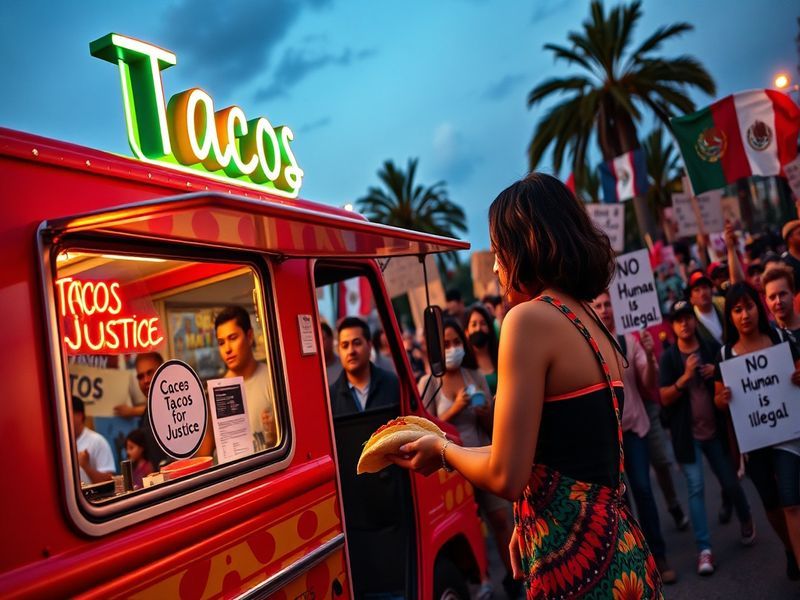
The image is unmistakable: a single taco truck parked outside a political rally, its red and white stripes contrasting sharply with the sea of red hats and American flags. This wasn’t a campaign stop—it was a protest. The truck, often branded with slogans like “Taco Trump” or “Make Tacos Great Again,” has become an unlikely emblem of dissent in multiple countries, from the United States to Mexico, and even as far as Australia. Far from partisan politics, the phenomenon reflects deeper cultural currents about migration, identity, and the globalization of street food.
What began as a local act of defiance has grown into a transnational movement. The taco truck’s presence at protests is more than a visual contrast; it’s a deliberate statement. In an era where political symbols are increasingly weaponized, food—specifically street food—has emerged as a neutral yet powerful medium for expression. Tacos, with their roots in Mexican culinary tradition, carry layers of meaning: they represent both cultural heritage and adaptability, a dish that has traveled the world while retaining its soul.
The Birth of a Symbol: From Los Angeles to the World
The “Taco Trump” truck first gained attention in 2016 outside a Donald Trump campaign rally in California. Operated by local vendors, the truck served tacos al pastor while displaying anti-Trump messages on its sides. The juxtaposition of a quintessentially Mexican dish with a political figure known for divisive immigration rhetoric created a striking image. Social media amplified its reach, turning it into a meme and a symbol of resistance.
But the idea didn’t stay in the U.S. Within months, similar trucks appeared in Mexico City, offering tacos while mocking Trump’s proposed border wall. Vendors in Australia later adopted the concept during protests against far-right politicians. The global spread of the “Taco Trump” phenomenon highlights how food trucks have evolved from mere food vendors into mobile platforms for social commentary.
According to food historian Dr. Elena Martinez, “The taco truck is a perfect vehicle for protest because it’s already a symbol of cultural fusion. It’s not just about food—it’s about who gets to claim space in a city, who belongs, and who doesn’t.” This idea resonates far beyond the U.S., where debates over immigration and national identity play out in kitchens and on sidewalks every day.
A Culinary Act of Defiance
Food has long been a tool of resistance. During the U.S. civil rights movement, sit-ins at lunch counters challenged segregation. In India, street food vendors became symbols of resistance against British colonial rule. The taco truck, in this context, is part of a continuum—a modern iteration of using everyday spaces to challenge power structures.
The appeal of the taco truck lies in its accessibility. Unlike a protest march that requires organization and permits, a food truck can appear almost anywhere. Its mobility allows it to evade censorship, slipping into the background of political events uninvited yet unavoidable. The vendors themselves often reflect the communities they serve: immigrants, entrepreneurs, and cultural hybrids who understand the power of a simple taco wrapped in a message.
Consider the case of Maria Rodriguez, a taco vendor in Austin, Texas. She started her truck, “La Resistencia,” in 2017 as a way to fund local immigrant rights organizations. “People come for the tacos, but they stay for the message,” she says. “A taco is just a taco until you put it in the right hands—and the right context.” Her story is one of dozens across the globe where food trucks have become extensions of activism.
The Cultural Significance of Street Food in Protest
Street food is inherently democratic. It’s affordable, accessible, and often created by marginalized communities. When these communities use food trucks as platforms for protest, they reclaim public space in a way that’s both literal and symbolic. The taco truck, in particular, carries global weight. In the United States, tacos are often reduced to a trendy dish, but their origins trace back to Indigenous and Spanish influences in Mexico. By repurposing this dish in protests, activists challenge narratives that erase or commodify Mexican culture.
Internationally, the taco truck’s message takes on different forms. In Berlin, a vegan taco truck appeared during a protest against anti-immigration policies, serving jackfruit-based tacos labeled “Refugee Food.” In Toronto, a Syrian refugee-operated truck distributed free tacos during a rally against Islamophobia. These examples show how food trucks transcend borders, adapting their menus and messages to local struggles while maintaining a core identity.
Food anthropologist Dr. Carlos Gutierrez notes, “The taco truck in protest is a perfect example of how food acts as both nourishment and narrative. It feeds the body while feeding the soul—and in doing so, it feeds the movement.” This dual role makes the taco truck a powerful symbol, one that’s difficult to ignore or silence.
Beyond the Meme: The Lasting Impact of Food Truck Activism
While the “Taco Trump” phenomenon began as a viral moment, its legacy is more substantial. It has inspired a wave of food-based activism, from “Taco Tuesday” fundraisers for immigrant rights groups to pop-up dinners featuring dishes from countries targeted by travel bans. The fusion of food and activism has even led to new culinary trends, such as “protest cuisine,” where chefs create dishes that tell stories of resistance.
In 2020, during the height of the Black Lives Matter protests, food trucks in several U.S. cities offered free meals to demonstrators. These weren’t just acts of solidarity; they were statements about who deserves to be fed and who gets to define a nation’s diet. The taco truck, in this context, represents a broader truth: food is never just fuel. It’s culture, identity, and power.
As the world becomes more polarized, the taco truck stands as a reminder that protest doesn’t always require a bullhorn. Sometimes, it just requires a spatula—and a willingness to serve up a little truth with every bite.
The Future of Food as Protest
The intersection of food and activism shows no signs of slowing down. As governments crack down on traditional forms of protest, creative methods like food trucks offer a way to keep dissent alive. The taco truck’s global journey—from a Los Angeles side street to protests in Berlin and beyond—proves that culinary culture is a universal language. One that can unite, provoke, and inspire.
For those who dismiss the taco truck as mere novelty, its persistence is a testament to its power. It’s not just about selling tacos. It’s about selling ideas—one plate at a time.