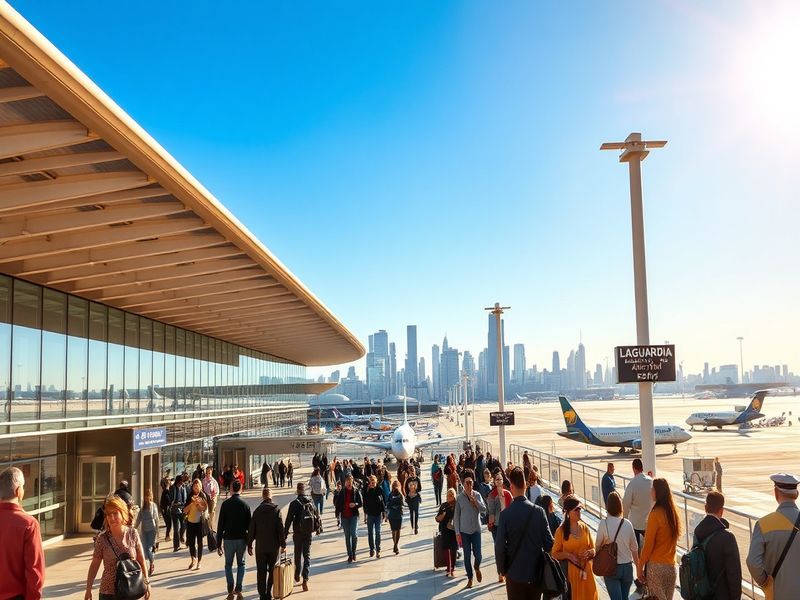
Few airports command the cultural weight of La Guardia in New York City. Named after Fiorello La Guardia, the city’s three-term mayor who championed progressive reforms during the Great Depression, the airport has grown from a modest municipal facility into a symbol of urban mobility and economic connectivity. Its history reflects not just the evolution of air travel but also the shifting priorities of a city that never sleeps.
La Guardia opened in 1939 as a replacement for the overcrowded Newark Metropolitan Airport, which had become inadequate for the growing demand of transatlantic flights. Located in the borough of Queens, the airport was an immediate marvel of modern engineering. Its Art Deco terminal, designed by architects Delano & Aldrich, featured a sleek, streamlined aesthetic that mirrored the optimism of 1930s America. The facility was built on land reclaimed from Flushing Bay and Bowery Bay, a reclamation project that itself reflected the city’s ambition to expand and modernize.
The Birth of a Transit Hub: A Response to Urban Growth
La Guardia was conceived not just as an airport, but as a civic project. At a time when air travel was still a luxury, the city invested in infrastructure to position itself as a global gateway. The airport’s original runways were designed to accommodate the largest planes of the era, including the Boeing 314 Clipper, a flying boat used for transatlantic passenger service. This strategic foresight helped establish New York as a key node in international aviation networks.
By the 1950s and 1960s, La Guardia had become a vital link in the Eastern Seaboard’s air travel system. It served as a primary gateway for European travelers entering the United States, a role that solidified its reputation as “the airport that welcomes the world.” The terminal’s design, with its sweeping curves and vertical lines, became an architectural icon, influencing airport design globally. Its success also spurred the development of other major airports, including JFK International and Newark Liberty, creating a multi-airport system that now handles over 100 million passengers annually.
The Cultural Footprint: From Film to Fashion
La Guardia’s influence extends far beyond aviation. It has embedded itself in the cultural fabric of New York and beyond. The airport has been a backdrop in countless films, from The Godfather Part II, where young Vito Corleone arrives in America, to Home Alone 2, where Kevin McCallister famously gets lost in its halls. These appearances cemented La Guardia’s place in the public imagination as a symbol of arrival, transition, and sometimes disorientation.
The airport has also played a role in fashion and design. Its mid-century modern aesthetic influenced interior and product design, with elements of its architecture appearing in furniture and graphic design of the 1950s and 1960s. Even today, the terminal’s vintage signage and color palette inspire retro-themed branding in restaurants and retail spaces across the city.
La Guardia has also been a stage for social history. During the Civil Rights Movement, it was one of the first major airports to integrate its facilities fully, reflecting broader changes in American society. Its role in connecting diverse communities—through immigration, business travel, and cultural exchange—has made it a microcosm of New York’s multicultural identity.
A Modern Transformation: Rebuilding for the Future
Despite its legacy, La Guardia faced criticism by the 21st century. Its aging infrastructure, cramped terminals, and limited runway capacity made it one of the most congested airports in the United States. In 2015, New York State and the Port Authority of New York and New Jersey announced a $8 billion redevelopment plan—the largest public works project in the state’s history. The project aimed not only to modernize the airport but to reimagine it as a 21st-century transit hub.
The redevelopment, completed in phases through 2023, introduced a new Central Terminal Building, expanded roadways, and improved public transit access. The design emphasizes sustainability, with energy-efficient systems and LEED-certified construction. The new terminal features larger gates, improved passenger amenities, and enhanced retail and dining options, reflecting the demands of today’s travelers.
One of the most notable changes was the demolition of the 1964 Marine Air Terminal, a historic structure that had served as the airport’s original terminal. The loss sparked debate about preservation versus progress, highlighting the tension between honoring the past and embracing the future. While some criticized the demolition, others argued that the new terminal’s design subtly echoes the original’s Art Deco spirit, preserving its essence in a contemporary form.
Global Comparisons: La Guardia in the World of Airports
La Guardia occupies a unique position in the global airport ecosystem. Unlike mega-hubs such as Dubai International or Hartsfield-Jackson in Atlanta, La Guardia is not a primary transcontinental transfer point. Instead, it specializes in domestic and short-haul international flights, serving routes that connect New York to cities across North America and the Caribbean. This focus makes it a critical artery for business travel, tourism, and personal connections.
In Europe, airports like London Heathrow and Charles de Gaulle in Paris play a similar role as regional gateways within larger networks. However, La Guardia’s compact size and high passenger density create a different kind of experience. Travelers often describe its efficiency and relative ease of navigation compared to sprawling mega-airports. The airport’s emphasis on domestic carriers such as Delta, American, and Southwest also shapes its identity as a hub for American air travel culture.
La Guardia also stands out for its proximity to Manhattan. Located just 8 miles from Midtown, it is more accessible than JFK or Newark, which are farther from the city center. This convenience has made it a preferred choice for business travelers and tourists alike, reinforcing its role as New York’s “working airport.”
The Human Experience: Stories from the Tarmac
Beyond statistics and architecture, La Guardia is a place of human stories. For millions of immigrants, it was the first sight of America, a moment of hope and uncertainty. For musicians and artists, it was a stage before the stage—a place to say goodbye or hello. For businesspeople, it was a second office. The airport has been a silent witness to countless life events, from reunions to farewells.
One particularly poignant example is the airport’s role during the COVID-19 pandemic. While air travel plummeted in 2020, La Guardia remained operational as an essential transit point. It became a symbol of resilience, with healthcare workers and essential personnel relying on its runways to reach the front lines. The airport’s staff, from baggage handlers to TSA agents, worked tirelessly to maintain operations under unprecedented conditions.
The airport has also been a gathering place during crises. After the 9/11 attacks, La Guardia served as a staging area for emergency responders and a temporary home for displaced families. Its resilience in the face of adversity underscored its importance not just as an economic engine, but as a civic asset.
Looking Ahead: The Next Chapter for La Guardia
As air travel continues to evolve, La Guardia faces new challenges and opportunities. The rise of sustainable aviation fuels, electric aircraft, and autonomous flight systems will require infrastructure updates. The airport is exploring ways to reduce its carbon footprint, including investments in solar energy and electric ground vehicles. These efforts are part of a broader push to align New York’s transit systems with global climate goals.
Another challenge is balancing growth with community impact. The airport’s expansion has raised concerns about noise pollution and air quality in surrounding neighborhoods like Astoria and Jackson Heights. Community groups continue to advocate for stricter environmental regulations and noise mitigation measures. These conversations reflect a broader tension in urban development: how to accommodate growth without sacrificing livability.
Despite these challenges, La Guardia’s future remains bright. As one of the busiest airports in the world, it continues to serve as a vital link for global connectivity. Its redevelopment has positioned it to meet the demands of the 21st century, while its history and culture ensure it remains a beloved institution.
Whether you’re a first-time visitor stepping off a plane from Tokyo or a lifelong New Yorker catching a shuttle to Boston, La Guardia offers more than just a connection—it offers a sense of place. It is a gateway not just to the city, but to the world itself.