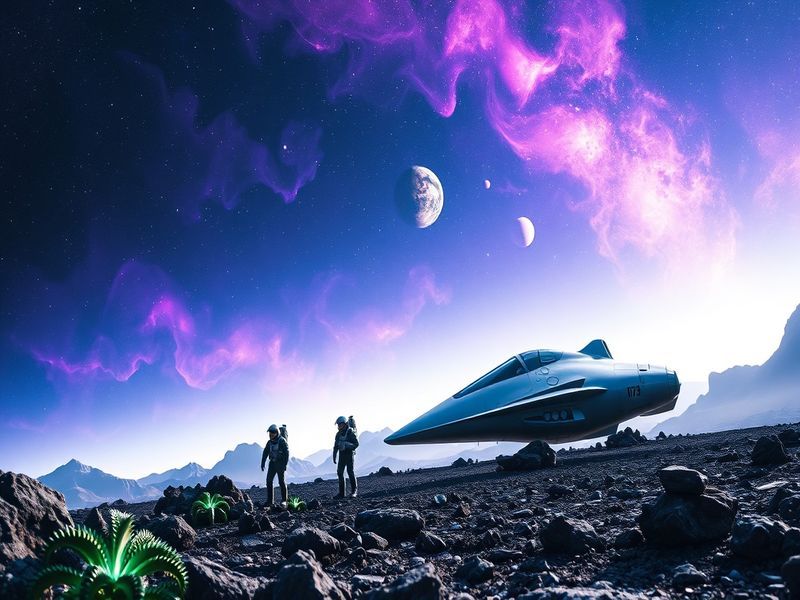
Space Exploration: Humanity’s Journey Beyond Earth Explained
Since the first artificial satellite pierced Earth’s atmosphere in 1957, humanity has maintained an unbroken chain of curiosity about what lies beyond our planet. Space exploration represents more than technological achievement—it embodies our fundamental drive to understand our place in the universe and secure the future of our species. From the first human steps on the Moon to the James Webb Space Telescope’s distant cosmic observations, each milestone has rewritten our understanding of existence while posing new questions about our cosmic destiny.
The Historical Leap: From Cold War Rivalry to Scientific Collaboration
Space exploration’s early years were defined by Cold War competition between the United States and Soviet Union. The 1961 flight of Yuri Gagarin aboard Vostok 1 marked humanity’s first orbital journey, while President Kennedy’s 1961 speech committed America to landing a man on the Moon “before this decade is out.” This geopolitical race produced rapid technological advancement, culminating in the Apollo 11 Moon landing on July 20, 1969.
The post-Apollo era saw a shift toward scientific discovery and international cooperation. The 1975 Apollo-Soyuz Test Project symbolized détente between superpowers, while the 1998 launch of the International Space Station (ISS) established humanity’s first permanent off-world research platform. Today, 24 nations have contributed to the ISS, representing a rare example of sustained peaceful international collaboration.
- 1957: Sputnik 1 becomes the first artificial satellite
- 1961: Yuri Gagarin completes first human orbital flight
- 1969: Apollo 11 lands first humans on the Moon
- 1971: First space station (Salyut 1) launches
- 1998: International Space Station construction begins
Modern Frontiers: Commercialization and Robotic Pioneers
The 21st century has democratized space exploration through commercial partnerships and robotic missions. SpaceX’s 2012 Dragon spacecraft became the first commercial vehicle to dock with the ISS, while companies like Blue Origin and Virgin Galactic are developing suborbital tourism. These developments have dramatically reduced launch costs—from $24,000 per pound to the ISS in the Space Shuttle era to under $1,500 per pound on SpaceX’s Falcon 9.
Robotic explorers have become humanity’s eyes and ears throughout the solar system. NASA’s Perseverance rover, which landed on Mars in February 2021, carries instruments designed to search for ancient microbial life and test oxygen production technologies. Meanwhile, the European Space Agency’s Rosetta mission accomplished the first soft landing on a comet nucleus in 2014, while Japan’s Hayabusa2 mission returned asteroid samples to Earth in December 2020.
These missions have revealed unexpected discoveries. Mars rovers found evidence of ancient river deltas, while Jupiter’s moon Europa shows signs of a subsurface ocean that could potentially harbor life. The New Horizons spacecraft’s 2015 flyby of Pluto transformed our understanding of dwarf planets, revealing a geologically active world with nitrogen glaciers and towering mountains of water ice.
The Moon to Mars Initiative: A New Era of Human Exploration
NASA’s Artemis program represents the most ambitious human spaceflight initiative since Apollo. The program aims to return humans to the Moon by 2026, including the first woman and person of color, while establishing sustainable lunar exploration by the decade’s end. Unlike Apollo, Artemis includes commercial and international partners, with companies like SpaceX and Blue Origin developing lunar landers and habitats.
The program’s foundation is the Lunar Gateway, a small space station orbiting the Moon that will serve as a staging point for lunar surface missions and deep space exploration. NASA’s Space Launch System (SLS) rocket and Orion spacecraft form the backbone of this effort, with the first crewed Artemis mission (Artemis II) scheduled for 2025.
These lunar ambitions serve as stepping stones toward Mars. The Moon provides a testing ground for technologies needed for long-duration spaceflight, including radiation shielding, life support systems, and in-situ resource utilization. NASA’s Mars mission architecture envisions crewed missions in the 2030s, with SpaceX’s Starship development offering a potential commercial path to the Red Planet.
Ethical Considerations and the Future of Space Exploration
As humanity extends its reach into space, ethical questions have gained prominence. Planetary protection protocols aim to prevent forward and backward contamination—protecting potential extraterrestrial life from Earth microbes, while preventing any potential Martian life from threatening Earth’s biosphere. The Outer Space Treaty of 1967 established the foundational legal framework for space activities, but modern challenges like lunar resource extraction and asteroid mining require updated international agreements.
Environmental concerns have also emerged regarding rocket launches. A single SpaceX Starship launch could emit more carbon dioxide than 300 transatlantic flights, while the growing number of satellites threatens to create orbital debris fields that could make certain orbits unusable. The Kessler Syndrome—a theoretical scenario where space debris collisions cascade uncontrollably—poses a long-term threat to space accessibility.
Looking ahead, space exploration faces both unprecedented opportunities and significant challenges. The discovery of thousands of exoplanets, some potentially habitable, has intensified the search for extraterrestrial life. Private companies are developing space-based solar power concepts that could revolutionize Earth’s energy systems, while asteroid mining companies envision extracting precious metals and rare earth elements from near-Earth objects.
However, the sustainability of these ambitions remains uncertain. The space industry must address launch costs, orbital debris mitigation, and the ethical implications of resource extraction before these dreams can become reality. International cooperation will likely determine whether space exploration remains a shared human endeavor or fragments into competing national and commercial interests.
The future of space exploration may well determine whether humanity remains confined to our home planet or becomes a multi-planetary species. Each mission, whether crewed or robotic, represents another step in humanity’s ongoing journey to understand our place in the cosmos. As we stand on the shoulders of the pioneers who first reached for the stars, we must ask ourselves what kind of future we want to build among them.
Explore more science articles on Dave’s Locker.
Read about technological innovations that shape our future.