Lindsey Buckingham: The Guitar Virtuoso Who Redefined Rock
Lindsey Buckingham: A Guitar Icon’s Enduring Legacy
Lindsey Buckingham’s name resonates through the halls of rock history as a guitarist whose fingers carved melodies into the very soul of 1970s and 1980s music. Born on October 3, 1949, in Palo Alto, California, Buckingham’s journey began not in the spotlight but in the quiet corridors of San Jose State University, where he studied art. Yet, it was the six-string that called to him, shaping a career that would redefine the role of the guitarist in rock music.
Buckingham’s rise to fame came through an unexpected collaboration with Stevie Nicks. The two met in high school, but it wasn’t until they formed Fleetwood Mac with Mick Fleetwood and John McVie that their chemistry became legendary. Buckingham’s intricate guitar work and Nicks’ ethereal vocals created a sound that transcended genres, from blues-rock to pop. Albums like Rumours (1977) didn’t just dominate charts; they became cultural touchstones, selling over 40 million copies worldwide and cementing Fleetwood Mac as one of the greatest bands of all time.
The Guitar as His Voice
Buckingham’s playing style was a fusion of technical precision and raw emotion. He didn’t just play notes; he told stories. His fingerpicking on tracks like “Landslide” and his aggressive yet melodic solos in “Go Your Own Way” showcased a versatility that few guitarists could match. Unlike the shredding virtuosos of the era, Buckingham prioritized feel over speed, a choice that made his music accessible yet profoundly expressive.
His 1981 solo album Law and Order further highlighted his ability to blend rock, new wave, and even avant-garde influences. Tracks like “Trouble” and “Itch” demonstrated his knack for crafting hooks that lingered long after the music stopped. Even as Fleetwood Mac’s lineup shifted and evolved, Buckingham’s guitar remained a constant, a testament to his adaptability and enduring relevance.
Beyond the Strings: Buckingham’s Role in Shaping Modern Rock
Buckingham’s impact extends beyond his playing. As a producer, he shaped the sound of Fleetwood Mac’s later albums, including Tango in the Night (1987), which spawned hits like “Big Love” and “Everywhere.” His production choices—layering synths with organic instrumentation—helped bridge the gap between classic rock and the emerging synth-pop movement of the 1980s.
In the 1990s and 2000s, Buckingham continued to push boundaries. His 1992 solo album Out of the Cradle revisited his acoustic roots, while Under the Skin (2006) and Seeds We Sow (2011) showcased his evolving songwriting. Even his 2017 album Lindsey Buckingham Christine McVie, a collaboration with his former bandmate, proved that his creative spark remained undiminished.
Buckingham’s influence can be heard in the work of countless modern guitarists. From John Mayer to Gary Clark Jr., artists cite him as a primary inspiration. His ability to blend technical skill with emotional depth set a standard that continues to define what it means to be a guitarist in rock music.
The Cultural Significance of Buckingham’s Work
Fleetwood Mac’s music, with Buckingham’s guitar at its core, transcended the boundaries of genre and generation. The band’s 1977 album Rumours became a global phenomenon, resonating with audiences in the U.S., Europe, and beyond. In Japan, Fleetwood Mac’s music was embraced as a symbol of Western counterculture, while in the U.K., their blues-rock roots connected them to a rich musical tradition.
Buckingham’s guitar work also played a pivotal role in the evolution of rock music’s sound. His use of the electric guitar as a lead instrument, rather than just a rhythmic backdrop, helped redefine the role of the guitarist in rock bands. This shift influenced the development of genres like alternative rock and indie, where guitar-driven melodies became a hallmark.
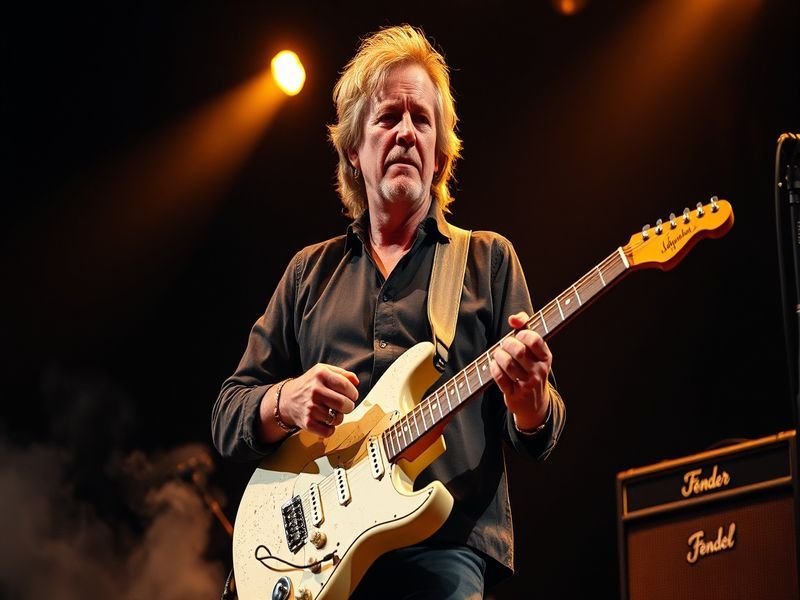
Even outside of music, Buckingham’s aesthetic—his layered clothing, his long hair, and his unassuming yet commanding stage presence—became iconic. He embodied the rock star archetype without succumbing to its excesses, a rare balance that endeared him to fans across the globe.
A Career Defined by Reinvention
One of the most remarkable aspects of Buckingham’s career is his ability to reinvent himself without losing his core identity. While many artists struggle to adapt to changing musical landscapes, Buckingham thrived. His 2018 departure from Fleetwood Mac and subsequent solo work demonstrated his commitment to artistic integrity, even when it meant leaving behind the band that made him a legend.
His live performances, too, were a masterclass in reinvention. Whether performing solo with just his guitar and a loop pedal or fronting a full band, Buckingham’s shows were a testament to his versatility. His 2019 solo tour, An Evening with Lindsey Buckingham, showcased not only his classic hits but also deep cuts and covers, proving that his musical curiosity was as boundless as his talent.
The Man Behind the Guitar
Beyond his music, Lindsey Buckingham is known for his reserved yet charismatic personality. Unlike the flamboyant frontmen of his era, Buckingham let his guitar do the talking. His interviews were marked by thoughtful reflections on his craft, his collaborations, and the ever-changing music industry.
Buckingham’s personal life has also had its share of challenges. His relationship with Stevie Nicks, though complicated, fueled some of Fleetwood Mac’s most enduring music. Later, his marriage to Kristen Messner and their three children provided a grounding force in his life. Despite the pressures of fame, Buckingham remained dedicated to his family and his art, a balance that speaks to his character.
Legacy and Influence
As Lindsey Buckingham continues to tour and record, his legacy grows ever stronger. In 2018, he was inducted into the Rock & Roll Hall of Fame as a member of Fleetwood Mac, a fitting tribute to a career that has spanned over five decades. Yet, his influence extends far beyond awards and accolades. It lives in the music of those he inspired, in the albums he produced, and in the countless fans who discovered rock music through his guitar.
Buckingham’s story is one of perseverance, innovation, and unwavering passion. It’s a reminder that true artistry isn’t just about skill—it’s about the ability to connect, to evolve, and to leave an indelible mark on the world. As rock music continues to evolve, Lindsey Buckingham’s guitar will remain a guiding light, a testament to the power of melody and the enduring spirit of rock ‘n’ roll.
What’s Next for Lindsey Buckingham?
With a career that has already spanned more than 50 years, the question of what’s next for Lindsey Buckingham is one that fans around the world are eager to answer. While he has stepped back from the rigors of touring with Fleetwood Mac, Buckingham shows no signs of slowing down. His recent work, including collaborations with artists like Christine McVie and his ongoing solo projects, suggests that he is far from done.
In interviews, Buckingham has hinted at new music in the works, as well as a continued focus on live performances. His 2023 tour, which included stops in North America and Europe, proved that his appeal remains as strong as ever. For a guitarist who has already achieved legendary status, Buckingham’s next chapter may well be his most surprising yet.
Whatever comes next, one thing is certain: Lindsey Buckingham’s guitar will continue to echo through the halls of rock history, inspiring future generations of musicians and fans alike.