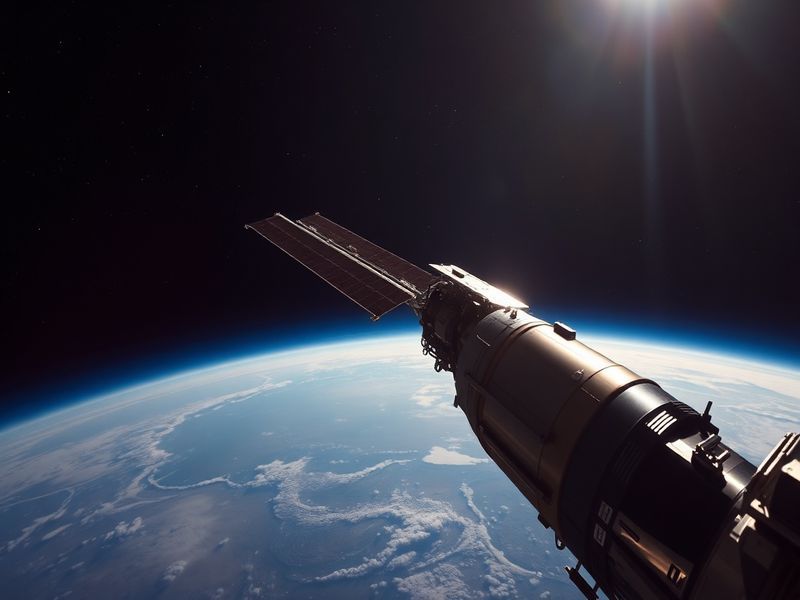
The International Space Station (ISS) has become a symbol of global cooperation and scientific progress since its first module launched in 1998. This habitable artificial satellite orbits Earth at an altitude of approximately 400 kilometers, serving as a unique laboratory where microgravity research transforms our understanding of physics, biology, and materials science. More than just a scientific facility, the ISS represents what humanity can achieve when nations set aside differences to pursue common goals in space exploration.
The Evolution of Space Stations: From Concept to Reality
The idea of space stations dates back to the early 20th century, with visionaries like Hermann Oberth and Wernher von Braun imagining orbiting platforms for scientific research and military purposes. The first actual space station, Salyut 1, launched by the Soviet Union in 1971, demonstrated that humans could live and work in space for extended periods. This was followed by the American Skylab in 1973, which hosted three crews for a total of 171 days.
The modular approach began with Russia’s Mir station in 1986, which remained operational for 15 years and hosted international crews. The ISS program, initiated in 1993, combined American, Russian, European, Japanese, and Canadian efforts to create the most complex structure ever assembled in space. Today, the ISS stretches 109 meters end-to-end—about the size of a football field—and weighs 420,000 kilograms.
Key Milestones in Space Station Development
- 1971: First space station (Salyut 1) launches, though the crew dies during re-entry
- 1973: Skylab becomes America’s first space station with three successful missions
- 1986: Mir station begins continuous human presence in space for 15 years
- 1998: First ISS module (Zarya) launches from Kazakhstan
- 2000: First permanent crew arrives at the ISS
- 2011: Space Shuttle program ends, leaving Russian Soyuz as the only human transport to ISS
The transition from single-launch stations to modular, expandable outposts marked a fundamental shift in how we approach long-term space habitation. This evolution continues with commercial stations like Axiom Space’s planned modules and China’s Tiangong station, which became operational in 2022.
Life on a Space Station: Daily Operations and Challenges
Astronauts on the ISS follow a carefully structured daily schedule that balances work, exercise, and rest. The station operates on Greenwich Mean Time to maintain a consistent schedule across international crews. Each crew member typically works 10-hour days, divided between maintenance, scientific experiments, and public outreach activities.
One of the most critical aspects of life in orbit is exercise. Without gravity, muscles atrophy and bones lose density at rates much faster than on Earth. Astronauts exercise for about two hours daily using specialized equipment including the Advanced Resistive Exercise Device (ARED) and the Treadmill with Vibration Isolation System (TVIS). Failure to maintain this regimen could result in severe health complications during and after missions.
The Psychological Aspect of Long-Duration Spaceflight
Living in confined spaces with the same small group of people for months requires careful psychological management. The ISS crew quarters are about the size of a phone booth, and privacy is minimal. NASA and international partners implement rigorous psychological screening and support systems to maintain crew mental health.
Communication delays also pose challenges. Messages to Earth take between 1.5 to 2 seconds each way, making real-time conversations impossible. Astronauts rely on recorded messages and periodic video conferences with family and mission control. The isolation is compounded by the constant hum of equipment and the absence of natural day-night cycles.
Scientific Research and Technological Innovation
The primary purpose of the ISS has always been scientific research that can only be conducted in microgravity. Over 3,000 experiments have been conducted on the station since 2000, spanning multiple disciplines. These experiments have led to breakthroughs in drug development, materials science, and fundamental physics.
One notable area of research involves protein crystal growth. In microgravity, proteins form larger, more perfect crystals than on Earth, allowing scientists to determine their structures more accurately. This has led to improved treatments for conditions like muscular dystrophy and cancer. Similarly, research on fluid dynamics in microgravity has improved our understanding of how fuels and other liquids behave in space.
Commercial and Industrial Applications
Beyond pure science, the ISS has become a platform for commercial research and development. Companies like SpaceX and Boeing have used the station to test new technologies that could reduce the cost of future space missions. The station has also hosted commercial facilities like the Space Tango lab, which provides biotechnology companies access to microgravity environments for drug development and tissue engineering.
NASA’s Commercial Orbital Transportation Services (COTS) program has encouraged private companies to develop cargo and crew transport capabilities. This has led to the successful deployment of SpaceX’s Dragon spacecraft and Orbital ATK’s Cygnus vehicle, both of which regularly resupply the ISS. These commercial partnerships have significantly reduced the cost of accessing low Earth orbit.
The Future of Space Stations: Beyond the ISS
While the ISS is currently scheduled to operate through 2030, its eventual retirement will mark the end of an era in international cooperation. However, the next generation of space stations promises to be even more ambitious. NASA’s Artemis program, which aims to return humans to the Moon, includes plans for the Gateway lunar outpost—a small station orbiting the Moon that will serve as a staging point for crewed missions to the lunar surface and eventually Mars.
China’s Tiangong station, with its three-module configuration, represents another major development. Fully assembled in 2022, Tiangong is designed for long-duration stays and scientific research. Russia has also announced plans for its own station, ROSS, which would focus on Earth observation and research in higher orbital inclinations.
The Commercial Space Station Era
Perhaps the most exciting development is the emergence of commercial space stations. Companies like Axiom Space, Blue Origin, and Voyager Space are developing their own orbital platforms that will operate independently of government programs. Axiom Space plans to attach commercial modules to the ISS starting in 2026 before separating into a fully independent station.
These commercial stations will likely focus on manufacturing, research, and space tourism. The low Earth orbit economy is projected to grow significantly in the coming decades, with estimates suggesting it could be worth $1 trillion or more by 2040. This new era will democratize access to space, allowing more countries and companies to participate in space-based activities.
The evolution of space stations reflects humanity’s growing ambition to become a multi-planetary species. From the early days of Salyut and Skylab to the modular marvel of the ISS and the commercial outposts of tomorrow, these orbital platforms have transformed from Cold War symbols to collaborative laboratories that benefit all of humanity. As we look toward the Moon, Mars, and beyond, space stations will remain our first footholds in the final frontier.